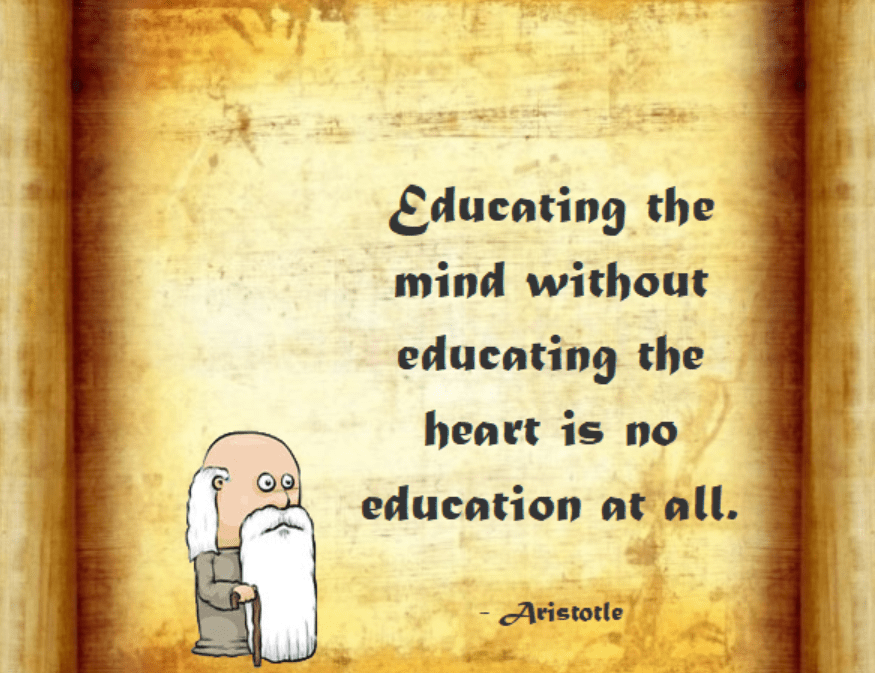
“Educating the mind without educating the heart is no education at all.”
Aristotle
Aristotle (384-322 BCE) was a renowned ancient Greek philosopher, scientist, and polymath. He was born in Stagira, Greece, and became a student of Plato at the Academy in Athens. Aristotle’s contributions spanned numerous fields, including philosophy, logic, biology, physics, ethics, politics, and more. He is considered one of the most influential thinkers in Western philosophy and has had a lasting impact on fields such as science, ethics, and metaphysics.
Aristotle’s works cover a wide range of topics and are extensive in scope. Some of his notable works include “Nicomachean Ethics,” in which he explores the nature of human virtue and moral character, and “Politics,” where he examines various forms of government and their principles.
Aristotle’s approach to knowledge and understanding relied heavily on observation, categorization, and logical reasoning. His system of logic, known as Aristotelian logic or syllogistic reasoning, had a significant influence on Western philosophy and scientific inquiry for centuries.
Overall, Aristotle’s contributions have had a profound impact on philosophy, science, and many other areas of human thought, making him one of the most important figures in the history of Western intellectual tradition.
The quote, “Educating the mind without educating the heart is no education at all,” highlights the importance of developing both intellectual and emotional aspects of an individual through education. It suggests that a truly comprehensive education should not only focus on academic knowledge and intellectual growth but also on nurturing the emotions, values, and character of an individual.
Here’s a breakdown of the meaning:
- “Educating the mind”: This refers to the traditional understanding of education, which emphasizes intellectual development, critical thinking, acquiring knowledge, and honing cognitive skills.
- “Without educating the heart”: This implies that a complete education should go beyond intellectual pursuits and should involve the cultivation of one’s emotions, empathy, compassion, and moral values. It emphasizes the significance of emotional intelligence and ethical development.
- “Is no education at all”: This phrase indicates that an education solely focused on intellectual aspects, neglecting the emotional and ethical dimensions, is incomplete and inadequate. It suggests that true education encompasses the holistic development of an individual’s intellectual, emotional, and moral faculties.
In essence, the quote highlights the need for a balanced and well-rounded education that not only nurtures the intellect but also fosters qualities such as empathy, kindness, and ethical reasoning. It suggests that an education that neglects the heart, the emotional and ethical aspects, falls short of providing a truly meaningful and comprehensive learning experience.
Thank you for reading my writings. If you’d like to, you can buy me a coffee for just £1 and I will think of you while writing my next post! Just hit the link below…. (thanks in advance)

 The Sage Page