Quote of the Day: Practice

“The first time you try anything worthwhile, you will feel like rubbish — but even riding a bike was once just practice in falling.”
— The Sage


There is a quiet discouragement that often arrives at the beginning of any new pursuit. Whether it is a skill, a habit, or a long-held ambition, the early attempts rarely match the picture we had in mind. The Sage reminds us that this feeling is not failure — it is simply the natural starting point.

We tend to forget how many things we now do effortlessly once felt impossible. Riding a bike, for example, is not something anyone begins by mastering. It is learned through imbalance, misjudgment, and the occasional fall. What looks smooth in hindsight was once awkward, uncertain, and full of small mistakes.

Progress is built on repetition, not perfection. Feeling like rubbish at the start is not a sign to stop, but a sign that you have begun. With patience and practice, what once felt impossible becomes familiar — and eventually, even effortless.

— The Sage


Thank you for reading my writings. If you’d like to, you can buy me a coffee for just £1 and I will think of you while writing my next post! Just hit the link below…. (thanks in advance)


Quote of the Day: The Good Guide

“A good guide does not carry you when your hands are full, but shows you how to travel lightly — for even a feather feels heavy when you refuse to let go.”
— The Sage


We often look to others for guidance when life feels heavy. We want solutions, direction, and sometimes even rescue — someone to take the weight from our hands and lead us forward. But The Sage reminds us that true guidance rarely works that way.

A good guide does not remove our burdens for us. Instead, they help us understand what we are carrying — and whether we need to carry it at all. Much of what weighs us down is not necessity, but habit: old worries, expectations, or attachments that we have never thought to question.

When our hands are full, even the smallest thing can feel like too much. A feather becomes a burden. But when we learn to let go, to travel more lightly, the path itself becomes easier. The role of a guide is not to carry us, but to show us that we were never meant to carry so much in the first place.

— The Sage


Thank you for reading my writings. If you’d like to, you can buy me a coffee for just £1 and I will think of you while writing my next post! Just hit the link below…. (thanks in advance)
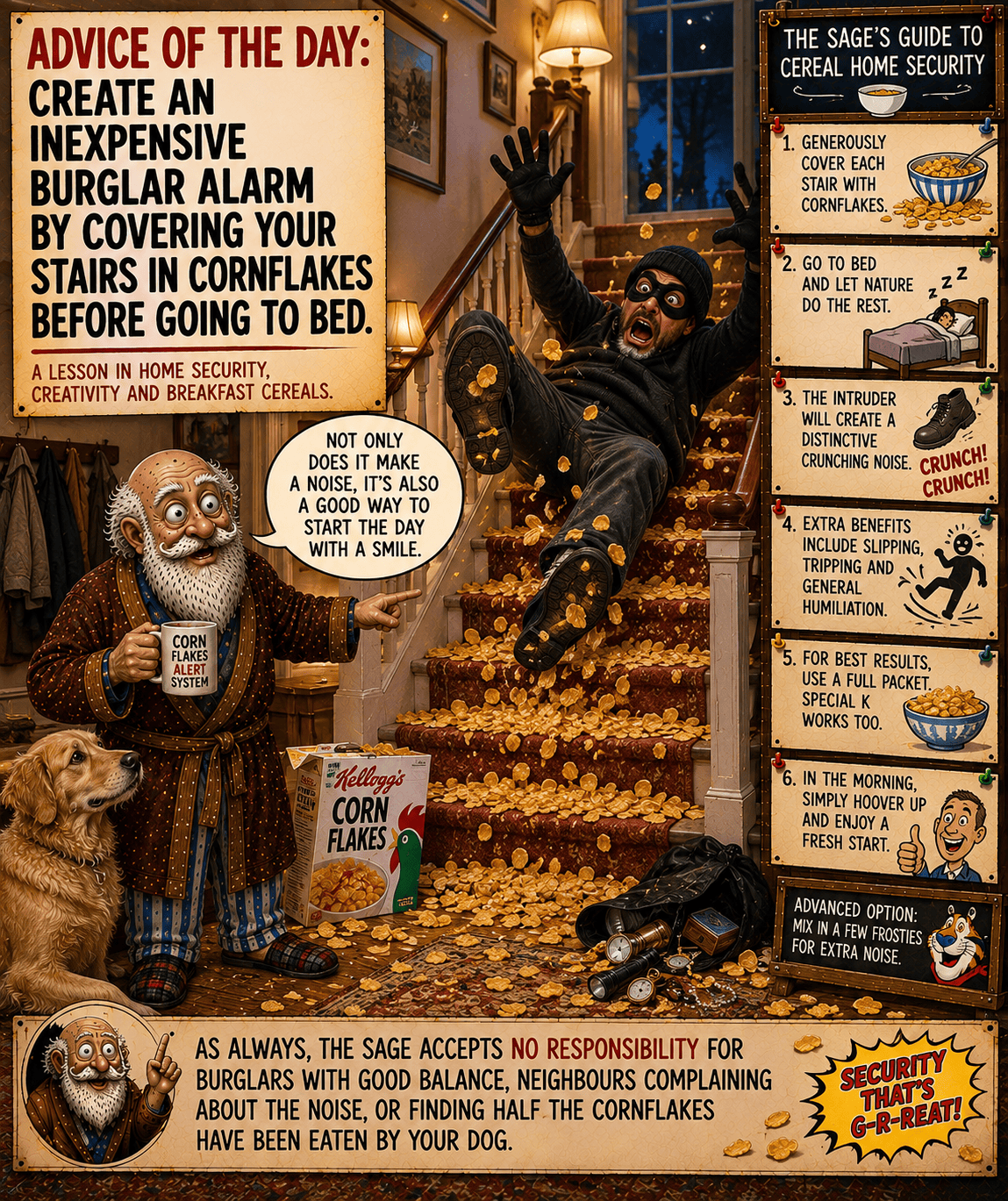
Advice of the Day: Disposing of Used Tissues

Avoid unsightly waste by throwing used tissues upwards and letting gravity decide where they belong.

the sage

Used tissues present a surprisingly persistent problem. Bins fill up, pockets become questionable, and surfaces begin to develop a troubling history. The Wise Sage recommends outsourcing the entire decision to physics.

Simply toss each used tissue confidently into the air and carry on with your day. Gravity, ever reliable, will ensure that the tissue eventually comes to rest somewhere. Over time, a natural distribution system will emerge, creating what experts might describe as “organic placement.”

For best results, vary your throwing technique. A gentle lob will encourage close-range placement, while a more ambitious launch can introduce tissues to entirely new areas of the home. This keeps the environment dynamic and prevents any one location from becoming overwhelmed.

If guests appear concerned, simply explain that you are experimenting with “decentralised waste management.” This suggests innovation and will discourage further questions.

As always, The Sage accepts no responsibility for where anything lands, what anything touches, or discovering one several days later in a place you absolutely did not expect.


Thank you for reading my writings. If you’d like to, you can buy me a coffee for just £1 and I will think of you while writing my next post! Just hit the link below…. (thanks in advance)
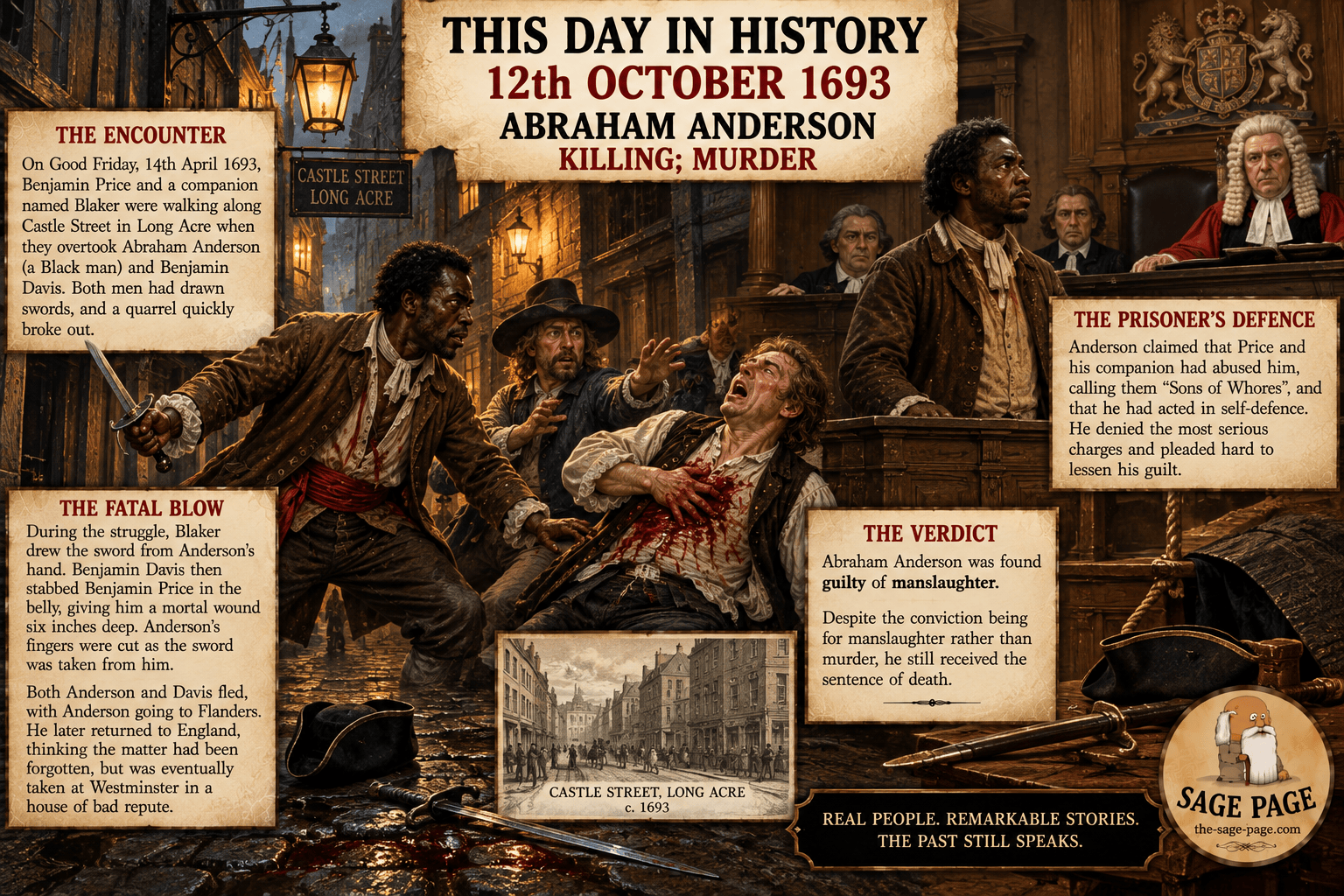
This Day in History: April 16th, 1729

“A Walk in the Park… for Profit”

On a spring evening in 1729, a quiet walk through St James’s Park became the setting for a calculated scheme of intimidation—one that relied not on violence, but on fear, reputation, and the threat of scandal.

At its centre was a man named John Mitchel, whose chosen method of making money was as simple as it was effective:

Accuse… and be paid to stay silent.


An Encounter at Night

On the evening of March 29th, at around nine o’clock, William Cornish was sitting on a bench in St James’s Park when Mitchel approached him.

At first, the conversation appeared ordinary enough.

Mitchel asked whether Cornish was a servant, and began speaking casually about himself. But the exchange quickly took an uncomfortable turn, becoming suggestive and intrusive.

Sensing something was amiss, Cornish got up to leave.


The Threat

He did not get far.

Mitchel seized him and delivered a chilling ultimatum:

Pay—or face ruin.

He told Cornish that unless he handed over money, he would swear an accusation of sodomy against him—a charge which, in 18th-century England, carried not only social destruction but the very real possibility of death.

This was not an idle threat.

Mitchel made it clear that this was his trade.


A Criminal Business Model

According to Cornish’s testimony, Mitchel openly boasted of his method:

  • He walked the park at night
  • Selected his targets carefully
  • And extracted money through fear of exposure

He claimed he could make four or five guineas in a single evening, relying on the fact that his victims would rather pay than risk public accusation.

It was extortion built on silence.


🔎 Trial Echo

“William Cornish depos’d, That being in St. Jame’s Park on the 29th of March , near 9 a-Clock at Night, he sat down on a Bench by him, and ask’d him, if he was a Gentleman’s Servant? telling him, that he liv’d with his Father, an Upholster in Gerard-Street, and that he, the Prisoner could show 9 Inches; asking the Prosecutor if he could? Upon this, he, the Prosecutor, went away; but he collar’d him, and told him, If he did not give him a Guinea, he would swear Sodomy to him; telling him, he had got so much Money of such a One, and so much of such a One, on the same Account; and that when he wanted Money, he took a Walk in the Park, and got 4 or 5 Guineas a-Night of Gentlemen, because they would not be expos’d”


The Payment

Under pressure, Cornish eventually gave in.

He paid half a guinea (10s 6d)—money he had to borrow from a friend—simply to make the threat go away.

But Mitchel did not stop there.

Days later, he returned—this time attempting to extract even more, asking for three additional guineas, brazenly offering a note as if this were a legitimate transaction.


Turning the Tables

This second approach proved his undoing.

Rather than comply again, Cornish used the opportunity to have Mitchel apprehended.

What had been a private act of intimidation was now dragged into the public arena—exactly the situation Mitchel had relied on his victims to avoid.


The Verdict

At trial, the facts were clear and straightforward.

The jury found Mitchel:

Guilty.

His punishment reflected the nature of the crime—not violent, but deeply disruptive to public order and trust.


Sentence

The court ordered:

  • Three months’ imprisonment
  • A fine of £10
  • And most visibly—
  • The pillory at Charing Cross

Justice in Public

The pillory was not merely a punishment—it was a spectacle.

Placed in a public thoroughfare, the offender was exposed to the crowd, often subjected to ridicule, abuse, and worse.

For a man whose crimes depended on secrecy and intimidation, this was a fitting reversal.

Mitchel, who had relied on silence, was now made into a public example.


Why This Case Matters

This case offers a fascinating glimpse into:

  • The power of reputation in 18th-century society
  • The dangers of false accusation
  • And the ways in which crime adapted to social fears

Mitchel’s scheme worked because the accusation he threatened was so serious—and so shameful—that many would pay to avoid it ever being spoken aloud.

It is a reminder that not all crime relies on force.

Sometimes, fear is enough.


Thank you for reading my writings. If you’d like to, you can buy me a coffee for just £1 and I will think of you while writing my next post! Just hit the link below…. (thanks in advance)

Advice of the Day: Treating a Cold

Stop your nose running by inserting a slug up each nostril.

the sage

A runny nose is one of the most persistent and irritating symptoms of a cold. Tissues offer only temporary relief, and dignity is quickly abandoned. The Wise Sage proposes a more… organic solution.

Slugs, being naturally slow-moving and moisture-loving, are ideally suited to the task of regulating nasal flow. By carefully placing one slug in each nostril, you create a living barrier that both blocks and manages unwanted movement. It’s nature solving a problem it never intended to solve.

For best results, select slugs of equal size to ensure balance and symmetry. The Sage recommends a calm approach during insertion, as sudden movements may encourage independent decision-making on the part of the slugs.

If questioned, simply explain that you are “trying something holistic.” This will prevent most follow-up enquiries.

As always, The Sage accepts no responsibility for horrified reactions, unexpected sensations, or needing to explain yourself to a medical professional.


Thank you for reading my writings. If you’d like to, you can buy me a coffee for just £1 and I will think of you while writing my next post! Just hit the link below…. (thanks in advance)

Quote of the Day: Deception

“Fraud often hides behind a heavy curtain, but the performance is usually betrayed by how cheaply it is staged.”
— The Sage


Deception rarely presents itself as obvious. It prefers atmosphere — a sense of importance, complexity, or authority that discourages closer inspection. Like a stage production, it draws the eye to the curtain, the lighting, the suggestion that something substantial lies behind it.

But The Sage reminds us that appearances can only carry an illusion so far. Sooner or later, the details begin to show. The stitching looks rushed, the props feel insubstantial, and the story begins to strain under its own weight. What seemed impressive at a distance often reveals itself as cheaply constructed upon closer view.

There is a quiet skill in learning to look past the curtain. To notice not just what is presented, but how it is held together. In doing so, we become less susceptible to illusion — and more attuned to what is genuine, which rarely needs such elaborate disguise.

— The Sage


Thank you for reading my writings. If you’d like to, you can buy me a coffee for just £1 and I will think of you while writing my next post! Just hit the link below…. (thanks in advance)
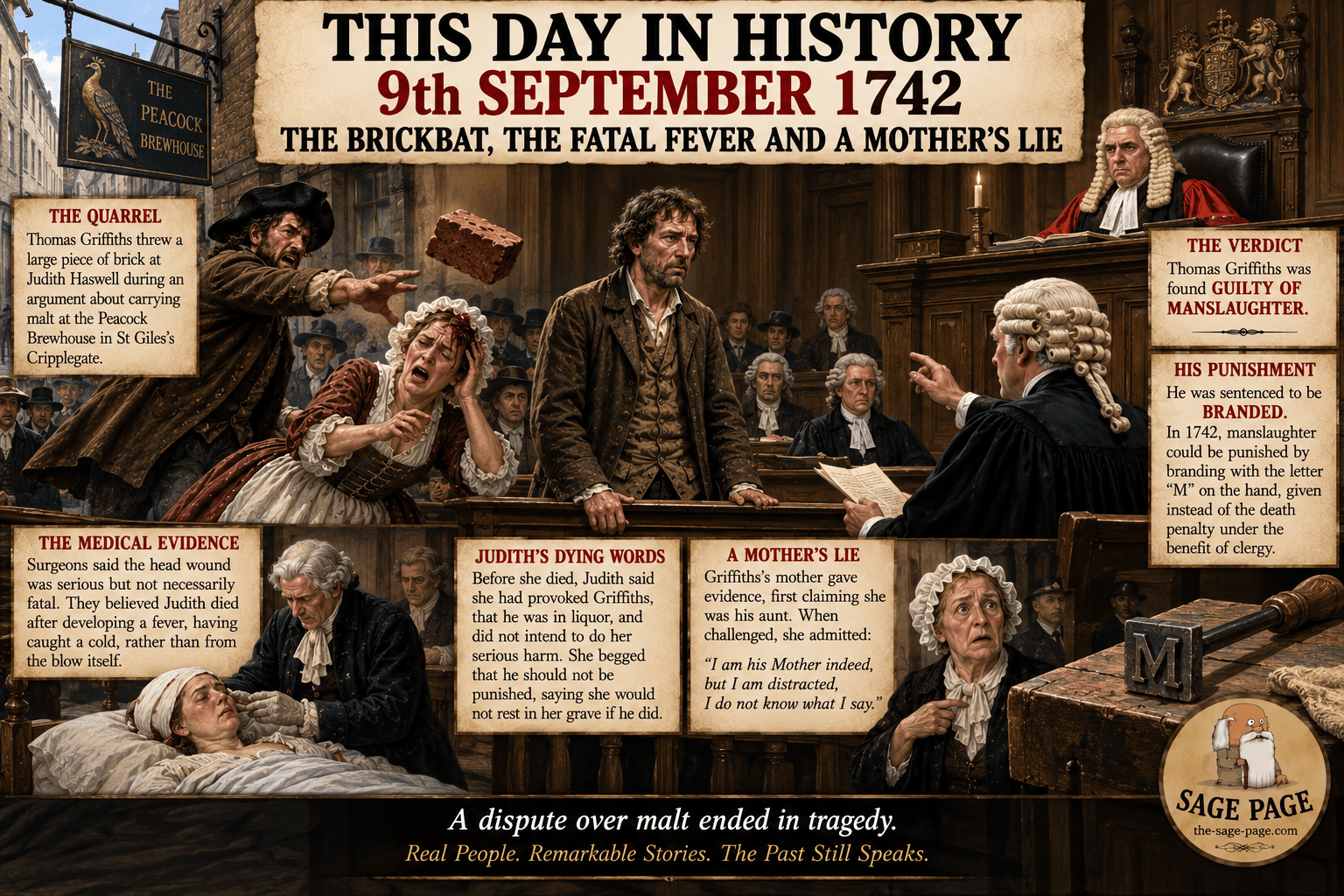
This Day in History: April 15th, 1692

“The Execution of Henry Harrison”

On a cold April morning in 1692, Henry Harrison was led from Newgate to the gallows—his fate sealed by a case that combined murder, deception, and a motive rooted in money.

At the centre of it all was a respected physician:

Dr. Nicholas Clench.


The Murder of Dr Clench

Dr Clench was a well-known London physician—a man of standing, wealth, and reputation.

His death was sudden.

His body was discovered under deeply suspicious circumstances, and almost immediately, attention turned toward Harrison.

Why?

Because Harrison had been in direct contact with him shortly before his death.


The Motive: Money and Trust

The case quickly revealed a powerful motive.

Harrison was believed to have gained access to Dr Clench under false pretences, luring him into a situation where he could be robbed.

This was no random act.

It appeared planned.

Dr Clench, a man of means, had been targeted—and after his death, suspicion fell heavily on Harrison as someone who had both opportunity and intent.


The Evidence Against Him

At the Old Bailey trial on 6th April 1692, the prosecution laid out a case built on:

  • Harrison’s association with Dr Clench
  • His presence at crucial moments
  • And most damaging of all—his inconsistent explanations

Witnesses came forward to contradict him.

His story shifted.

Details changed.

And with each contradiction, the jury’s confidence in him weakened.


A Case of Credibility

In one of the most telling aspects of the trial, Harrison’s own words worked against him.

What he claimed at one moment, he appeared to abandon the next.

In a courtroom without forensic science, this was devastating.

The case became less about proving exactly how Dr Clench died…

…and more about whether Harrison could be believed at all.


🔎 Trial Echo

“He was seen in company with the Doctor, and being questioned thereof, gave such differing Accounts, as rendered him suspected by all that heard him.”


The Verdict

The jury did not hesitate.

Harrison was found:

Guilty.

In the justice system of the time, where reputation and consistency carried enormous weight, his failure to present a coherent defence proved fatal.


Newgate and the Final Days

Awaiting execution in Newgate Prison, Harrison came under the care of the Ordinary of Newgate.

He attended prayers.

He listened to instruction.

He appeared, outwardly, to prepare for death.

But crucially—he never delivered a clear, unequivocal confession.


🔎 The Ordinary’s Reflection

“He applied himself to Devotion, yet was not so free in his Confession as might be expected of one under such Circumstances.”


The Execution

On April 15th, 1692, Harrison was taken to the place of execution.

As was customary, he addressed the crowd—but his words did not resolve the lingering uncertainty.

No clear admission.

No final clarity.

Only the end.


A Case That Lingers

The death of Dr Clench was avenged in the eyes of the law.

But the case leaves behind a troubling question:

Was Harrison unquestionably guilty?

Or was he condemned, in part, because he failed to convince?

In an age before modern evidence, the line between the two was dangerously thin.


Why This Case Matters

This case is a powerful example of how justice once operated:

  • Motive mattered
  • Testimony ruled
  • Consistency could decide life or death

Henry Harrison’s fate reminds us that in early modern England, a man could hang not only for what he had done…

…but for how poorly he explained himself.


Thank you for reading my writings. If you’d like to, you can buy me a coffee for just £1 and I will think of you while writing my next post! Just hit the link below…. (thanks in advance)

This Day in History: April 14th, 1860

“You Are Striking the Wrong One”

On a lamplit street in Marylebone in the spring of 1860, a routine police enquiry turned into a sudden and brutal assault—one that left a constable bleeding in the road and his attackers fleeing into the night.

It is a case that captures the unpredictable danger of Victorian street policing, where a moment’s misunderstanding could end in violence.


A Suspicious House

At around a quarter past eight on the evening of 14th April 1860, Police Constable Thomas Bell was on duty in Cumberland Street, Bryanston Square.

Noticing something amiss at No. 43 — an open dining-room window — he did what any diligent officer would do: he knocked at the door.

A woman answered.

But before the exchange could go far, a man emerged from inside the house, claiming he had business there. Bell was unconvinced.

As the constable moved to detain him, the man bolted.


The Struggle in the Street

Bell gave chase and caught hold of the man in the road. The two struggled for control, grappling on the pavement under the glow of a nearby gas lamp.

Then, without warning, two more men appeared.

They were William Thomas and Alexander Green.

From their coat sleeves, they produced life-preservers — short, weighted bludgeons designed for striking.

What followed was swift and savage.


“You Are Striking the Wrong One”

As Bell wrestled with the suspect on the ground, the two men struck him.

First to the back.

Then to the head.

Bell, believing for a moment that they had come to assist him, turned and shouted:

“You are striking the wrong one!”

But the blows continued.

His head was split open. Blood poured onto the pavement. The attackers, along with the original suspect, fled into the night.


Witnesses in the Lamplight

Several witnesses saw the attack unfold in those brief, chaotic moments.

A groom named Charles Frith observed two men loitering before the struggle began. He saw one of them strike the constable and later identified Thomas as he stumbled past, losing his hat.

Another witness, Edward Wilson, was even closer. He saw both attackers draw their weapons and strike Bell, identifying Thomas clearly and describing his distinctive Inverness cape.

Inside the house, Louisa Blythe confirmed that the man Bell attempted to detain had no legitimate business there.

The scene, though lasting no more than a couple of minutes, was witnessed from multiple angles — all pointing to the same violent conclusion.


A Policeman Left for Dead

When help reached Bell, he was lying in the road, his head “streaming with blood.”

He suffered multiple wounds consistent with blows from a life-preserver and was unable to return to duty for nearly two weeks.

In an era before modern protective equipment, such injuries could easily have proved fatal.


Arrest and Further Violence

Three days later, on 17th April, the two men were located in Nightingale Street, casually playing cards.

When officers attempted to arrest them, the situation escalated once again.

Thomas resisted violently, kicking and striking an officer.

Green seized a poker and attacked the constables, while Thomas threatened to take their lives if they attempted to restrain him.

It was only with effort that the officers subdued and removed them.


Trial and Conviction

At trial, the evidence was clear and consistent:

  • The constable’s testimony
  • Multiple eyewitness accounts
  • Medical evidence confirming the nature of the injuries

Both men were found Guilty of feloniously wounding with intent to cause grievous bodily harm.

Their sentence:

Eight years’ penal servitude.


Why This Case Matters

This case is a vivid reminder of the dangers faced by Victorian policemen — often working alone, in poor lighting, and without the protections modern officers take for granted.

It also highlights a striking irony:

Constable Bell’s instinctive trust — his assumption that the approaching men were there to help — was precisely what made the attack so devastating.

In a matter of seconds, assistance became assault.

And a routine knock at a door became a near-fatal encounter.


Thank you for reading my writings. If you’d like to, you can buy me a coffee for just £1 and I will think of you while writing my next post! Just hit the link below…. (thanks in advance)

Quote of the Day: Anger

“Anger often arrives as a killer at the throat, but wisdom learns to step back and see only its outline before it strikes.”
— The Sage


Some emotions do not arrive gently. They come quickly, sharply, and with force — tightening the throat, narrowing the mind, and demanding immediate expression. The Sage recognises this moment well: the instant where reaction feels not only justified, but inevitable.

Yet there is a small, crucial space before action. A moment, often brief, in which we can choose to observe rather than respond. To see anger not as a command, but as a shape — an outline forming, rather than a force that must be obeyed. In that space, control becomes possible.

Wisdom does not deny emotion, nor does it pretend calmness is always easy. But it does suggest that even the strongest impulses can be softened by awareness. To recognise the outline of anger is to loosen its grip — and in doing so, to prevent it from becoming something far more destructive.

— The Sage


Thank you for reading my writings. If you’d like to, you can buy me a coffee for just £1 and I will think of you while writing my next post! Just hit the link below…. (thanks in advance)

Advice of the Day: Cleaning the Bathroom

Save time cleaning your bathroom by setting off a small, controlled explosion and starting again.

the sage

Bathroom cleaning can involve scrubbing, chemicals, and an uncomfortable awareness of what you’re actually dealing with. The Wise Sage believes this is an inefficient use of both time and dignity.

Instead, take a more decisive approach. By removing the bathroom entirely, you eliminate not only the dirt, but the very concept of cleaning. A carefully judged detonation (or, failing that, aggressive demolition with a hammer while muttering “that’ll do it”) allows you to return the room to a blank canvas — or at least a vaguely alarming hole.

For those seeking a less dramatic method, the Sage recommends turning on all taps, blocking the drains, and allowing nature to conduct a full-scale “rinse cycle” of the entire room. Over time, either the bathroom will be clean, or it will no longer be recognisably a bathroom — both acceptable outcomes.

If questioned, simply say you are “renovating.” This is a remarkably versatile explanation and will prevent most follow-up enquiries.

As always, The Sage accepts no responsibility for structural damage, confused neighbours, or explaining to an insurance company why your sink is now in the garden.


Google-Friendly Excerpt (50–60 words)

Advice of the Day: Cleaning the Bathroom

Today’s Viz Top Tip:
Save time cleaning your bathroom by setting off a small, controlled explosion and starting again.

Bathroom cleaning can involve scrubbing, chemicals, and an uncomfortable awareness of what you’re actually dealing with. The Wise Sage believes this is an inefficient use of both time and dignity.

Instead, take a more decisive approach. By removing the bathroom entirely, you eliminate not only the dirt, but the very concept of cleaning. A carefully judged detonation (or, failing that, aggressive demolition with a hammer while muttering “that’ll do it”) allows you to return the room to a blank canvas — or at least a vaguely alarming hole.

For those seeking a less dramatic method, the Sage recommends turning on all taps, blocking the drains, and allowing nature to conduct a full-scale “rinse cycle” of the entire room. Over time, either the bathroom will be clean, or it will no longer be recognisably a bathroom — both acceptable outcomes.

If questioned, simply say you are “renovating.” This is a remarkably versatile explanation and will prevent most follow-up enquiries.

As always, The Sage accepts no responsibility for structural damage, confused neighbours, or explaining to an insurance company why your sink is now in the garden.


Google-Friendly Excerpt (50–60 words)

The Wise Sage returns with another hilariously reckless “Advice of the Day.” This time he tackles cleaning the bathroom with a completely unusable, nuclear-level solution involving demolition and total reset. In true Viz Top Tips style, this guide is absurd, chaotic, and guaranteed to avoid actual cleaning altogether.


Thank you for reading my writings. If you’d like to, you can buy me a coffee for just £1 and I will think of you while writing my next post! Just hit the link below…. (thanks in advance)