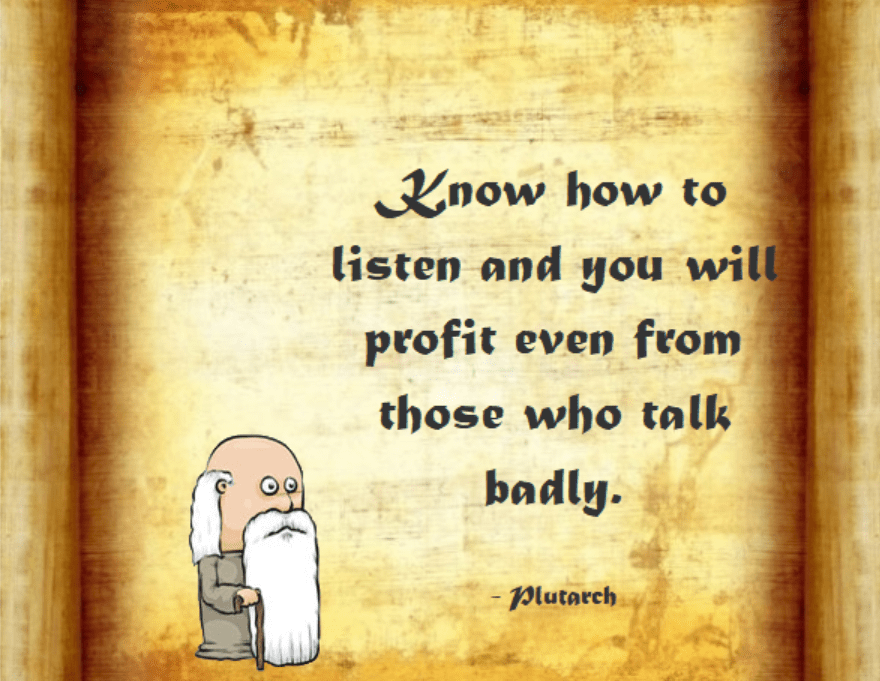
“Know how to listen, and you will profit even from those who talk badly.“
Plutarch
Plutarch was a Greek historian, biographer, and essayist who lived during the 1st and 2nd centuries AD. He was born around 46 or 50 AD in the Greek town of Chaeronea, which is located in what is now modern-day Greece. Plutarch’s works have had a significant impact on the study of history and biography.
He received a good education in philosophy and rhetoric and later traveled extensively throughout the Roman Empire, visiting places like Egypt and Rome. Plutarch held several important positions in his hometown, including serving as a priest of Apollo.
Plutarch’s most famous works are his “Parallel Lives” (also known as “Lives of the Noble Greeks and Romans”), a series of biographies comparing the lives of notable Greeks and Romans. He wrote these biographies to highlight the similarities and differences between influential figures of the two civilizations. Some of the famous figures he compared were Alexander the Great and Julius Caesar, Demosthenes and Cicero, and many others.
In addition to his biographical works, Plutarch also wrote essays on various topics, covering philosophy, ethics, and politics. His writings are characterized by a moral and ethical focus, seeking to draw lessons from history and the lives of great men to inspire virtuous behavior and personal improvement.
Plutarch’s works have been highly regarded throughout history for their insights into the lives of historical figures and the values of classical antiquity. They have been influential in shaping the understanding of ancient history and continue to be studied and respected by scholars and readers worldwide.
The quote “Know how to listen, and you will profit even from those who talk badly” suggests that there is value in being a good listener and that even from negative or poorly expressed conversations, one can still gain something beneficial.
At its core, the quote emphasizes the importance of active and attentive listening. When you truly listen to what others are saying, even if their communication skills are not the best or if their message seems negative, you can find opportunities to learn and gain insights.
Here are a few interpretations of the quote:
- Extracting valuable information: Even when someone is not skilled at expressing themselves or is being negative, there might be nuggets of wisdom or useful information hidden within their words. By paying attention and understanding the core message, you can still gain something valuable.
- Developing empathy: Listening attentively to others, especially those who are struggling to communicate effectively or who may be expressing their frustrations, can help you develop empathy and understanding. You may gain insights into their perspective and feelings, enabling you to connect with them on a deeper level.
- Learning from mistakes: Sometimes, people who talk badly or negatively may unintentionally provide examples of what not to do or how not to communicate. By observing these patterns, you can learn from their mistakes and avoid similar pitfalls in your own communication.
- Strengthening patience and tolerance: Actively listening to those with challenging communication styles can test your patience and tolerance. Embracing this challenge and striving to remain attentive can help you build patience and a more open mindset.
In essence, the quote encourages us not to dismiss or ignore others simply because they may not communicate well or appear negative. By mastering the art of listening, we can extract value from various conversations and interactions, even those that may initially seem unproductive or difficult. It’s a reminder that learning and growth can be found in unexpected places if we remain open and attentive to others.
Thank you for reading my writings. If you’d like to, you can buy me a coffee for just £1 and I will think of you while writing my next post! Just hit the link below…. (thanks in advance)

 The Sage Page