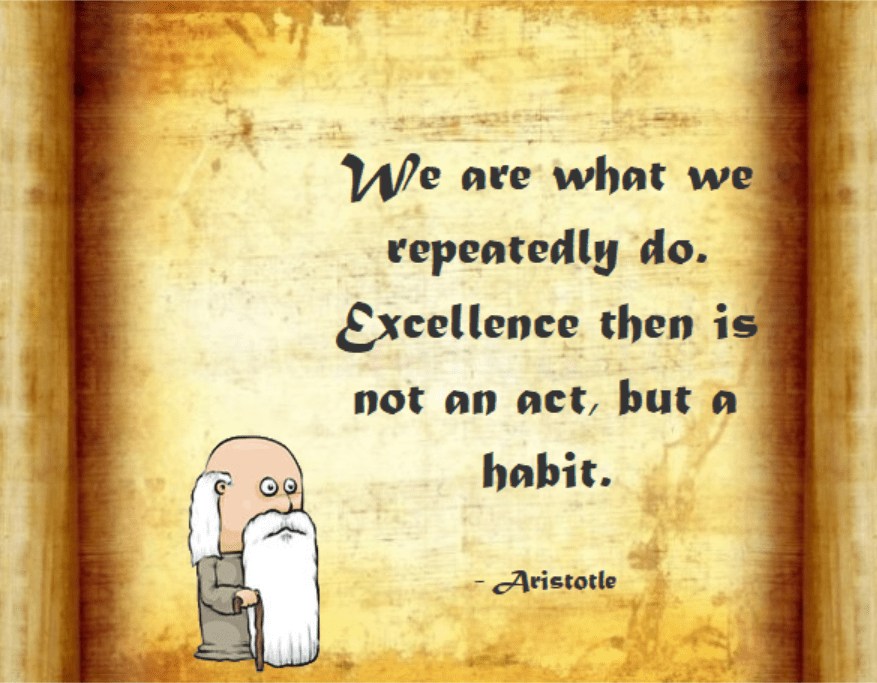
“We are what we repeatedly do. Excellence, then, is not an act, but a habit.”
Aristotle
Aristotle (384–322 BC) was a Greek philosopher, scientist, and polymath who made significant contributions to various fields of knowledge, including philosophy, natural science, ethics, politics, and more. He was a student of Plato and later became the tutor to Alexander the Great. Aristotle’s ideas and writings have had a profound and lasting influence on Western thought and continue to be studied and debated to this day.
Some of Aristotle’s notable contributions include:
- Logic and Philosophy: Aristotle’s work in logic laid the groundwork for formal reasoning. He developed a system of categorizing and analyzing different types of arguments, known as syllogisms, which have been central to the study of logic and reasoning.
- Metaphysics: Aristotle explored questions about the nature of reality, existence, and the principles that underlie the universe. His work on metaphysics delved into concepts such as causation, substance, potentiality, and actuality.
- Natural Science: Aristotle made significant contributions to the fields of biology, zoology, and natural philosophy. His observations and classifications of animals, plants, and natural phenomena formed the basis for early scientific understanding in these areas.
- Ethics and Virtue: Aristotle’s ethical philosophy focused on the concept of eudaimonia, often translated as “happiness” or “flourishing.” He believed that the key to a good life was the cultivation of virtues and the pursuit of moral excellence.
- Politics: Aristotle’s political philosophy examined the best ways to structure societies and governments. He discussed various forms of government, including monarchy, aristocracy, and democracy, and offered insights into how these systems could be balanced for the well-being of the state and its citizens.
- Poetics: In his work “Poetics,” Aristotle analyzed the nature of tragedy and drama. He discussed the components of a well-constructed play and the role of emotions in art.
Aristotle’s ideas have had a lasting impact on Western philosophy and science, shaping the development of Western thought for centuries. His works were preserved and studied by scholars throughout history, and his influence can be seen in fields ranging from philosophy to biology to politics.
The quote “We are what we repeatedly do. Excellence, then, is not an act, but a habit” is often attributed to the ancient Greek philosopher Aristotle. This quote reflects Aristotle’s philosophy on the nature of excellence and virtuous living.
At its core, the quote suggests that our actions and behaviors define who we are as individuals. It emphasizes that our character and qualities are not determined by isolated actions or occasional acts of excellence, but rather by the consistent patterns of behavior that we engage in over time.
Aristotle believed that excellence, or what he referred to as virtue, is not simply an occasional act or a single achievement. Instead, it is a result of cultivating certain habits and consistently practicing virtues in our daily lives. Virtues are positive traits or qualities, such as courage, honesty, kindness, and wisdom. According to Aristotle, excellence is attained when these virtues become an inherent part of our character through continuous practice and repetition.
In other words, the quote underscores the idea that excellence is not the result of one exceptional moment or action, but rather the outcome of a lifestyle characterized by virtuous behavior. If we consistently engage in virtuous actions and strive for excellence in our everyday choices, these actions become habitual and shape our identity and character.
This concept can be applied to various aspects of life, whether it’s personal development, professional growth, or the pursuit of ethical behavior. By cultivating positive habits and consistently embodying virtues, we can strive for a higher level of excellence that becomes an integral part of who we are.
Thank you for reading my writings. If you’d like to, you can buy me a coffee for just £1 and I will think of you while writing my next post! Just hit the link below…. (thanks in advance)

 The Sage Page