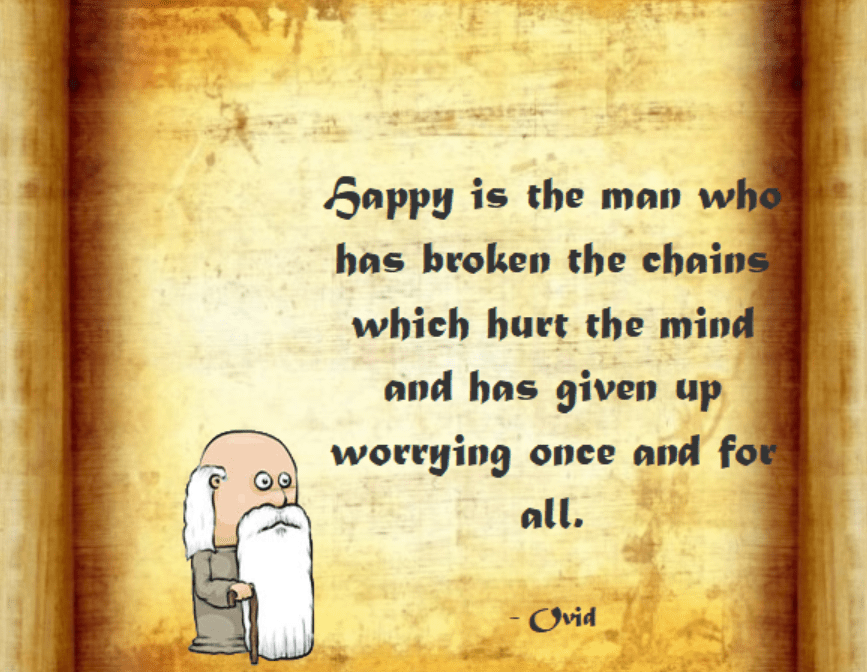
“Happy is the man who has broken the chains which hurt the mind, and has given up worrying once and for all.”
Ovid
Ovid, also known as Publius Ovidius Naso, was a Roman poet who lived from the first century BCE to the first century CE. He was born on March 20, 43 BCE, in Sulmo, a town in central Italy. Ovid is considered one of the most important figures in Roman literature and is best known for his narrative poem, “Metamorphoses.”
Ovid’s early works included love elegies, such as his collection called “Amores,” which explored themes of love, romance, and mythology. His poetry was characterised by its wit, charm, and lyrical style. Ovid’s most famous work, “Metamorphoses,” is an epic poem comprising fifteen books that retell various myths and legends from Greek and Roman mythology, focusing on the theme of transformation.
However, Ovid’s literary career took a dramatic turn when he was exiled by the Roman Emperor Augustus in 8 CE. The exact reasons for his exile remain uncertain, but it is believed to be connected to his involvement in some form of scandal or political intrigue. Ovid was banished to Tomis (modern-day Constanța, Romania) on the Black Sea coast, where he spent the rest of his life in exile. During this time, he wrote his Tristia (“Sorrows”) and Epistulae ex Ponto (“Letters from the Black Sea”), expressing his sadness and longing for Rome.
Ovid’s works, both before and after his exile, had a significant influence on later Roman and European literature. His poetry explored themes of love, mythology, and transformation, and his unique style and storytelling techniques continue to captivate readers today. Ovid’s impact on Western literature and art has been profound, with his works inspiring countless adaptations, translations, and interpretations throughout history.
The quote “Happy is the man who has broken the chains which hurt the mind, and has given up worrying once and for all” expresses the idea that true happiness can be found by freeing oneself from mental burdens and worries.
In this context, “the chains which hurt the mind” refers to negative thoughts, anxieties, and concerns that can weigh a person down and cause mental distress. These chains metaphorically bind and restrict one’s mental well-being and overall happiness.
The quote suggests that breaking these chains and letting go of worrying can lead to a state of contentment and happiness. By releasing oneself from the grip of persistent worries and anxieties, one can experience a sense of freedom and peace of mind. It implies that happiness can be attained by consciously choosing not to be consumed by unnecessary concerns and focusing on positive aspects of life instead.
The quote encourages individuals to cultivate a mindset that is free from unnecessary mental burdens and worries, emphasising the importance of finding inner peace and tranquility as a path to true happiness.
Thank you for reading my writings. If you’d like to, you can buy me a coffee for just £1 and I will think of you while writing my next post! Just hit the link below…. (thanks in advance)

 The Sage Page
Once upon a time, I knew someone who was studying Ovid. Outdoors though, t’was the season and it was allowed so I went possum hunting. She waited a long time for me to come home, and she worried. I brought it home and cooked it. It tastes like pork and is made with sweet potatoes. She’d been learning Latin and studying Ovid. So she said:
“Sic ego nec sine te nec tecum vivere possum* — Ovid.”
I said, “Does that mean that you like possums who can’t spell because I’ve seen that when you quote someone verbatim and they’ve made a spelling mistake that you put [sic] indicating that it’s an exact copy including the mistake. I know what “ego” is but the rest seems like a mistake. Does this Ovid guy know English?”
“Ugh, no. ‘vivere possum’ means ‘I can live.’ ”
“Well, he can’t live if we eat him…”
*So I can’t live either without you or with you. — Ovid.
She explained that Publius Ovidius Naso would say, if he knew me, that I should go into exile and be happy without her.
LikeLiked by 1 person
Brilliant Doug, just Brilliant!
LikeLiked by 1 person
Thanks very much. I appreciate the feedback. I never really know if something I write works until I hear a comment.
LikeLiked by 1 person