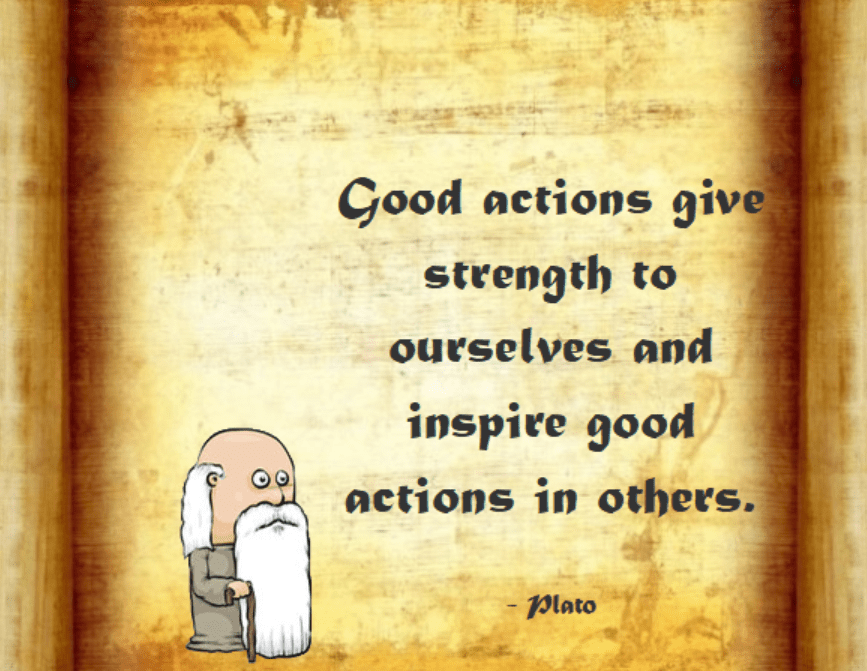
“Good actions give strength to ourselves and inspire good actions in others.”
Plato
Plato was an ancient Greek philosopher and mathematician who lived from approximately 428/427 BCE to 348/347 BCE. He was a student of another renowned philosopher, Socrates, and went on to become the teacher of Aristotle, who in turn became the tutor of Alexander the Great.
Plato is widely regarded as one of the most influential figures in the development of Western philosophy. His philosophical ideas and writings explored a broad range of topics, including metaphysics, ethics, politics, epistemology, and the nature of reality. He founded the Academy in Athens, which was one of the earliest known organized institutions of higher education in the Western world.
Plato’s philosophy often involved the use of dialogues or conversations to convey his ideas. His most famous work is “The Republic,” a comprehensive exploration of justice, the ideal state, and the nature of the philosopher-king. In this work, he introduced the famous allegory of the cave, which explores the concept of knowledge and the distinction between appearance and reality.
Plato’s philosophical ideas had a lasting impact on subsequent generations and continue to be studied and debated today. Some of his key concepts include the theory of Forms or Ideas, the immortality of the soul, and the pursuit of knowledge as a path to virtue and wisdom.
Plato’s contributions to philosophy, mathematics, and political theory have earned him a prominent place in intellectual history, making him one of the most influential thinkers of all time.
The quote “Good actions give strength to ourselves and inspire good actions in others” suggests that engaging in virtuous and positive behaviors not only benefits the individual but also has a ripple effect, influencing and motivating others to do the same.
At its core, the quote highlights the interconnectedness of human actions and the potential for goodness to spread. When individuals engage in acts of kindness, generosity, compassion, or any other positive action, it not only enhances their own character and well-being but also serves as an inspiration to those around them.
By setting an example through good actions, individuals can inspire others to follow suit and create a chain reaction of positive change. This can create a supportive and uplifting environment that fosters personal growth, collective well-being, and a sense of community.
Furthermore, the quote implies that engaging in good actions builds inner strength and character. When individuals consistently choose to do what is right, they cultivate a sense of integrity, resilience, and moral fortitude. This inner strength enables them to navigate life’s challenges with grace and inspires others to do the same.
In summary, the quote emphasizes the transformative power of good actions. Not only do such actions positively impact the individual undertaking them, but they also have the potential to inspire and uplift others, fostering a cycle of virtuous behavior and creating a better world.
Thank you for reading my writings. If you’d like to, you can buy me a coffee for just £1 and I will think of you while writing my next post! Just hit the link below…. (thanks in advance)

 The Sage Page