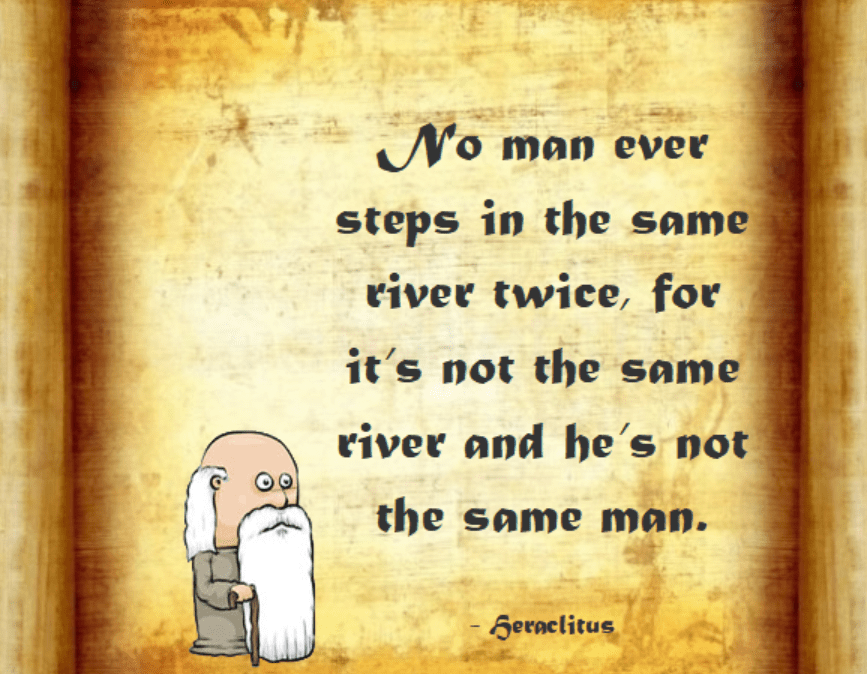
“No man ever steps in the same river twice, for it’s not the same river and he’s not the same man.“
Heraclitus
Heraclitus was an ancient Greek philosopher who lived around the 6th and 5th centuries BCE in the city of Ephesus, which is now part of present-day Turkey. He is known for his profound ideas about the nature of reality, change, and the interconnectedness of the universe.
Heraclitus is often referred to as “Heraclitus of Ephesus” to distinguish him from other philosophers with similar names. Unfortunately, only fragments of his writings have survived, and much of his work is known through quotations and references made by later philosophers and historians.
One of Heraclitus’ central beliefs was that change is fundamental to the universe. He famously stated, “No man ever steps in the same river twice, for it’s not the same river and he’s not the same man.” This quote illustrates his idea that everything is constantly in a state of flux and that permanence is an illusion.
Heraclitus also emphasized the concept of “logos,” which can be understood as the underlying principle or order that governs the universe. He saw the world as a dynamic interplay of opposites, such as day and night, hot and cold, and harmony and discord, all held together by the logos.
His philosophical ideas were often expressed through enigmatic and poetic language, earning him the nickname “the Obscure.” Heraclitus’s work influenced many philosophers, including later Greek thinkers such as Plato and Aristotle, as well as philosophers throughout history. His emphasis on change and the interconnectedness of all things continues to resonate in various philosophical and scientific disciplines to this day.
The quote “No man ever steps in the same river twice, for it’s not the same river and he’s not the same man” is a famous statement attributed to the ancient Greek philosopher Heraclitus. This quote captures his philosophy of flux and constant change.
The quote suggests that both the river and the person stepping into it are in a constant state of transformation. The river is always in motion, with the water flowing and changing. It is never the same from one moment to the next. Likewise, the person stepping into the river is also changing. Time passes, experiences shape us, and we are not the same person we were in the previous moment.
This statement emphasizes the impermanence and dynamic nature of existence. It highlights the idea that the world is in a perpetual state of flux and that nothing remains static. It challenges the notion of stability and encourages us to recognize and embrace the constant change and transformation that is inherent in life.
Metaphorically, the quote invites us to reflect on the transitory nature of our experiences and the importance of embracing the present moment. It reminds us that life is a continuous journey, and each encounter with the world and ourselves is unique and ever-evolving.
In summary, the quote emphasizes the idea that change is a fundamental aspect of existence, both in the external world and within ourselves. It encourages us to embrace this constant flux and appreciate the beauty and richness found in the ever-changing nature of life.
Thank you for reading my writings. If you’d like to, you can buy me a coffee for just £1 and I will think of you while writing my next post! Just hit the link below…. (thanks in advance)

 The Sage Page
The river reference has Buddhist origins too – from around the same time.
LikeLiked by 1 person
I love this quote. Even as finish writing this I am not the same man. I love the transience by which we all exist.
LikeLike