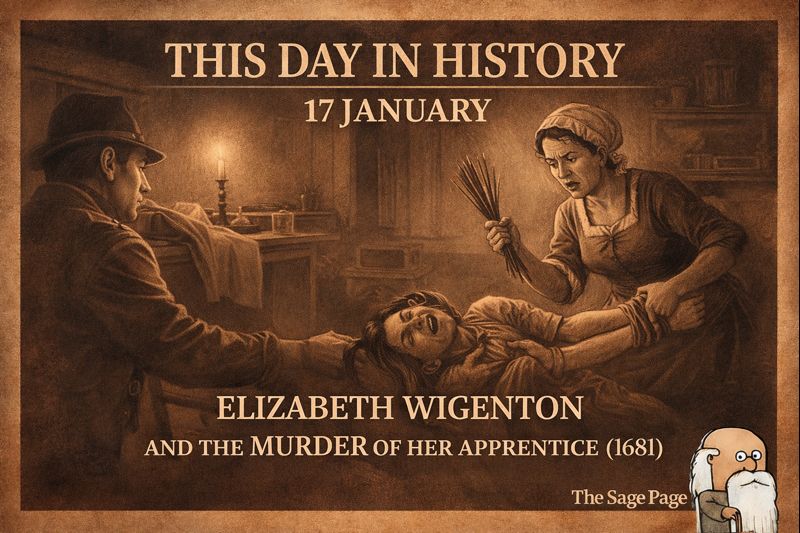
On Monday 17 January 1681, the Sessions of the Old Bailey were finally held, having been postponed the previous Wednesday due to sittings at Guildhall. Among the proceedings that day was a case of exceptional cruelty.
Elizabeth Wigenton, of Ratcliff Parish, was tried for the murder of a girl about thirteen years of age, who was bound to her as an apprentice.
The offence
Wigenton was a coat-maker by trade. She had set the young girl to work on a piece of sewing, but found the workmanship unsatisfactory. In response, she beat the child severely.
This, however, did not satisfy her anger.
Wigenton then escalated the punishment. She went and fetched a bundle of rods, and arranged for a man to hold the girl while she carried out further violence. The child was bound, helpless, and subjected to a prolonged whipping.
The original account records the severity in stark terms:
“She whiped her so unmercifully, that the blood ran down like rain.”
Even then, Wigenton would not stop. She could not be persuaded to desist until the girl, overcome by pain and distress, fainted away with crying. From the injuries inflicted upon her, the child died shortly afterwards.
The trial
When brought before the court, Wigenton offered little in her own defence. She did not deny the beating, nor dispute the facts as laid before the jury.
Her only statement was:
“That she did not think to kill her.”
Evidence was then given that Wigenton was widely known among her neighbours as a cruel woman, establishing that this act was not an isolated lapse, but part of a recognised pattern of behaviour.
Verdict
The jury reached a clear conclusion.
Elizabeth Wigenton was found guilty of wilful murder.
In the legal context of 1681, this verdict carried only one consequence. Although the sentence is not repeated in the extract, the punishment for wilful murder was death.
Why this case matters
This case exposes the dark underside of apprenticeship in early modern London. Apprentices lived within households, subject to the authority and temperament of their masters and mistresses, with little oversight. Abuse could remain hidden until it ended in tragedy.
It is also notable for involving:
- A female defendant in a murder case
- The killing of a child apprentice
- Sustained, deliberate cruelty rather than a single act of violence
For Elizabeth Wigenton, 17 January 1681 marked the moment when private brutality became public crime — and when the law intervened with its most severe judgment.
Source
- Elizabeth Wigenton, tried at the Old Bailey, 17 January 1681, for the wilful murder of her apprentice.
Original Proceedings text as supplied; case reference t16810117-1.
Thank you for reading my writings. If you’d like to, you can buy me a coffee for just £1 and I will think of you while writing my next post! Just hit the link below…. (thanks in advance)

 The Sage Page