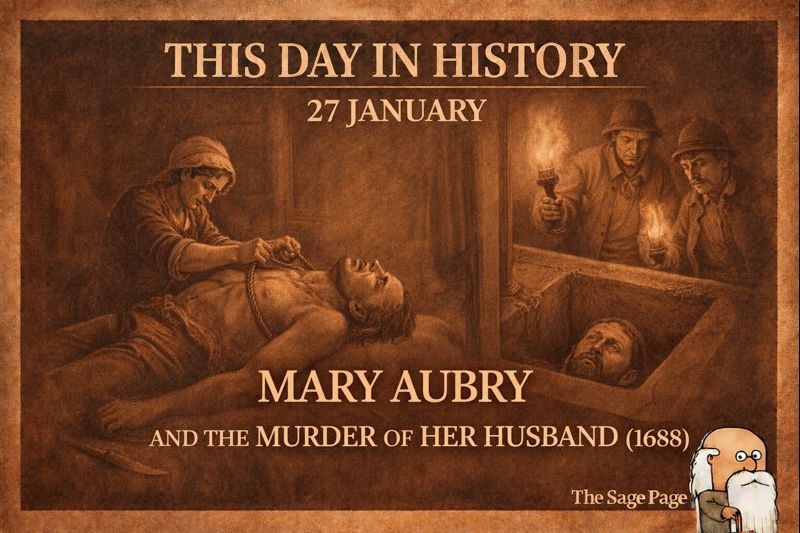
On 27 January 1688, in the parish of St Martin-in-the-Fields, London, a French midwife named Mary Aubry acted on a long-expressed threat and murdered her husband, Denis Hobry — a man known locally for his drunkenness and violence.
Mary and Denis had been married for four years. He squandered her earnings, frequently beat her, and subjected her to physical abuse. In her own testimony compiled in contemporary pamphlets, Mary admitted that if her husband did not change his behaviour, she had told him she would kill him.
The murder and the body parts
On the morning of 27 January, Denis returned home inebriated. After assaulting Mary again — beating her and trying to force himself on her — he fell asleep, leaving Mary with a choice between ongoing abuse and desperate action.
Mary strangled him with a garter. Still distraught and determined to hide what she had done, she dismembered his body over several days, disposing of the parts separately:
- The torso was left near a dunghill on Parker’s Lane.
- The head and limbs were hidden in privies at the Savoy Palace.
Once the body parts were discovered and reassembled, the identity of the victim became clear, and Mary was arrested.
Old Bailey trial — 22 February 1688
Mary appeared before the Old Bailey on 22 February 1688 on an indictment of murder, though under the early modern legal category of petty treason, since a wife killing her husband was considered an attack on social hierarchy — a “lesser” form of treason.
She pleaded guilty, and the next day received the death sentence:
that she should be drawn from Newgate to the place of execution, and there burnt with fire till she was dead.
This sentence reflected the 17th-century rule that petty treason — particularly the killing of a husband by a wife — warranted execution by burning at the stake.
Execution — 2 March 1688
On Friday, 2 March 1688, Mary Aubry was taken from Newgate Prison to Leicester Fields. Witnesses recorded that she appeared penitent, often lifting her hands and eyes heavenward and showing sincere sorrow for her crime and its consequences on her fate.
At around half past ten in the morning, a stake had been prepared. Mary was hanged slowly by a rope attached to the stake, strangling for some time before wood was piled around and burnt until her body was reduced to ashes.
Burning at the stake was the statutory punishment for petty treason in England at this time, intended to mark the perceived breach of social and sexual order represented by a wife killing her husband.
Why this case matters
The case of Mary Aubry resonated far beyond the Old Bailey:
- It was the subject of multiple pamphlets, ballads and prints shortly after the events.
- Contemporary observers used it to debate questions of gender, violence, language and domestic authority in urban London.
- The brutality of the murder and the sensational nature of the dismemberment etched her into both popular and legal memory.
For historians and legal scholars, the case reveals how early modern England’s legal categories like petty treason worked, and how public sentiment, print culture, and social bias (including anti-Catholic and anti-foreign feeling) could shape reactions long after the trial itself.
Thank you for reading my writings. If you’d like to, you can buy me a coffee for just £1 and I will think of you while writing my next post! Just hit the link below…. (thanks in advance)

 The Sage Page