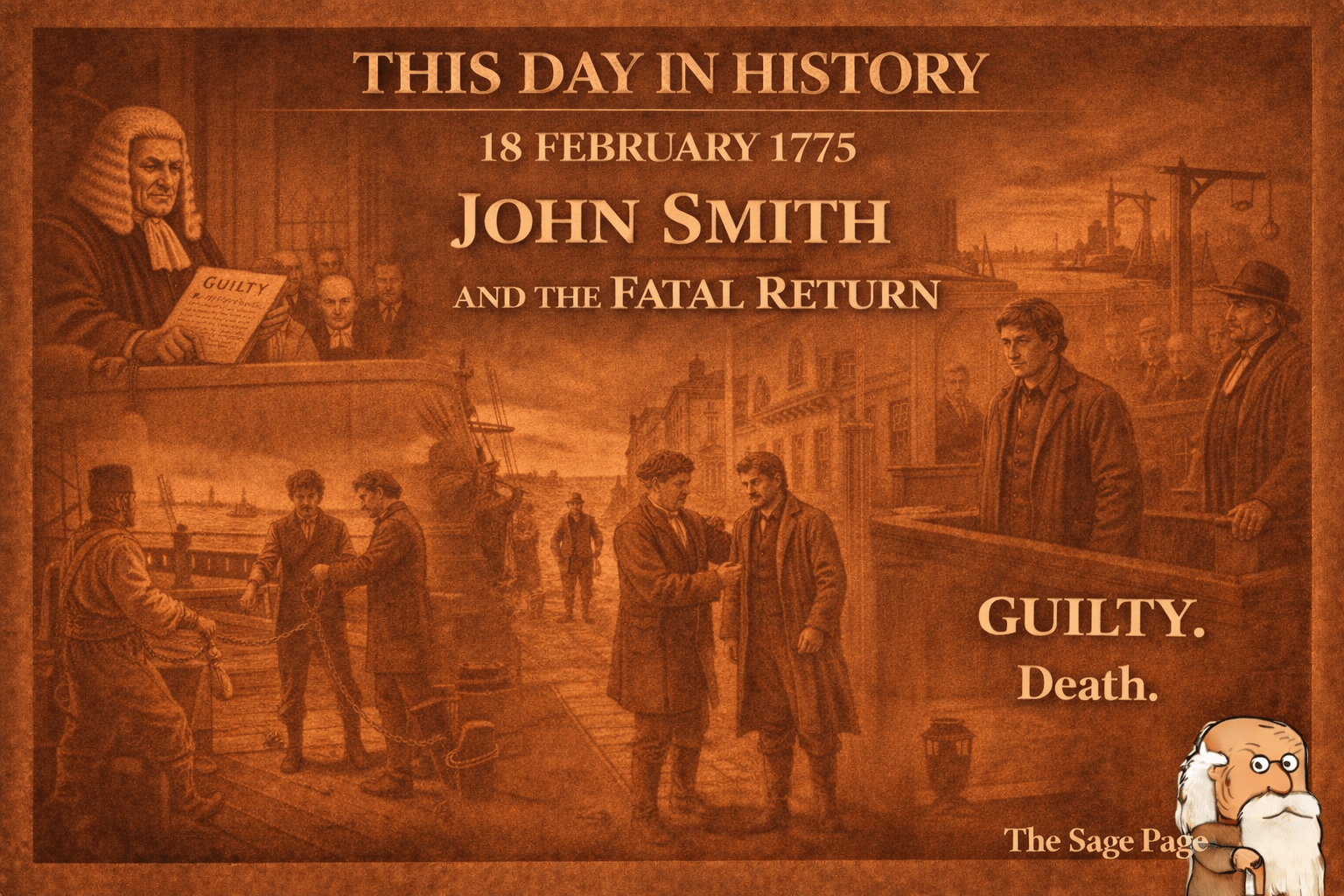
On 18 February 1775, John Smith stood once more before the Old Bailey.
He had already escaped the gallows once.
Now he was on trial for doing the one thing the law most feared:
Returning from transportation before the expiration of his term.
He was found guilty.
He was sentenced to death.
The First Crime: Highway Robbery
Smith’s troubles had begun at the Maidstone Summer Assizes, 1773, where he was tried for a highway robbery committed against William Love, described as an old Greenwich College man.
Robert Stephens, turnkey of Maidstone Gaol, testified:
“He was found guilty and received judgment of death.”
Smith was confined seven or eight months.
But like many capital convicts of the era, he received a conditional reprieve.
His sentence of death was commuted on condition that he be:
Transported for fourteen years.
Stephens recalled telling him plainly:
“Jack you go for fourteen years.”
Smith allegedly replied:
“America should not hold him fourteen years, nor two neither.”
It was a boast that would soon prove disastrous.
Transportation and Return
Smith was placed aboard ship. The captain gave receipt for his body.
At some point thereafter — the exact mechanism unknown — Smith returned to England.
Whether he escaped, bribed a crewman, or simply slipped back amid lax enforcement, the record does not say.
But on 12 January 1775, he was discovered in Aldersgate Street.
Richard Spratly, who had known him most of his life, arrested him.
The offence was simple:
He was back.
The Law on Returning from Transportation
Under eighteenth-century statute, returning from transportation before expiry of one’s term was itself a capital felony.
No new crime was required.
Presence alone was enough.
When Smith appeared at the Old Bailey in February 1775, the prosecution merely had to prove:
- His original conviction
- His sentence of transportation
- His identity
- His unlawful return
The copy of the original conviction was read in court.
The jury had little difficulty.
The Defence
Smith claimed:
“I was sent out of the land; I never received sentence of transportation. I did not know for what time.”
But the turnkey contradicted him.
“We inform them.”
The jury believed the officials.
Verdict and Sentence
The verdict:
Guilty.
The sentence:
Death.
For the second time in two years, John Smith stood condemned to hang.
However, further record shows his sentence outcome was again transportation, and on 14 July 1775 he was transported for a further fourteen years.
Twice spared. Twice exiled.
Returning from Transportation
In the eighteenth century, transportation was intended as removal and deterrence.
Convicts sentenced to seven or fourteen years were legally forbidden to return before expiration.
If they did:
- They could be indicted without evidence of any new offence
- Their previous conviction was read into the record
- The punishment was death
It was the law’s way of enforcing imperial exile.
Money Then & Now — Highway Robbery Context
Highway robbery was among the most feared crimes of the eighteenth century.
Victims were often:
- Travellers
- Merchants
- Pensioners like William Love
Robbery of even modest sums could result in a death sentence.
Public fear of armed robbery meant courts treated offenders severely — especially repeat offenders.
Smith’s original reprieve was mercy. His return was seen as defiance.
The American War Complication
Smith was transported again in July 1775.
That timing is extraordinary.
The American Revolutionary War had begun in April 1775. Within months, transportation to the American colonies became politically and logistically chaotic.
Convict ships were disrupted. Contracts faltered. Prison hulks began to fill in England.
It is entirely possible that Smith’s second transportation:
- Was delayed
- Was redirected
- Or placed him amid the collapsing system of Atlantic penal exile
If so, he became not merely a criminal — but a casualty of imperial upheaval.
Why This Case Matters
John Smith’s story reveals:
- The brutality of eighteenth-century penal law
- The fragility of conditional mercy
- The importance of transportation in Britain’s criminal system
- The global dimension of punishment
- The instability of empire on the eve of revolution
From Maidstone to America — and back to the dock at the Old Bailey — Smith’s life traces the harsh geography of eighteenth-century justice.
Sources
- Old Bailey Proceedings, 18 February 1775, trial of John Smith
- Kent Maidstone Assizes reference (1773 highway robbery conviction)
- Old Bailey Online punishment records
Thank you for reading my writings. If you’d like to, you can buy me a coffee for just £1 and I will think of you while writing my next post! Just hit the link below…. (thanks in advance)

 The Sage Page