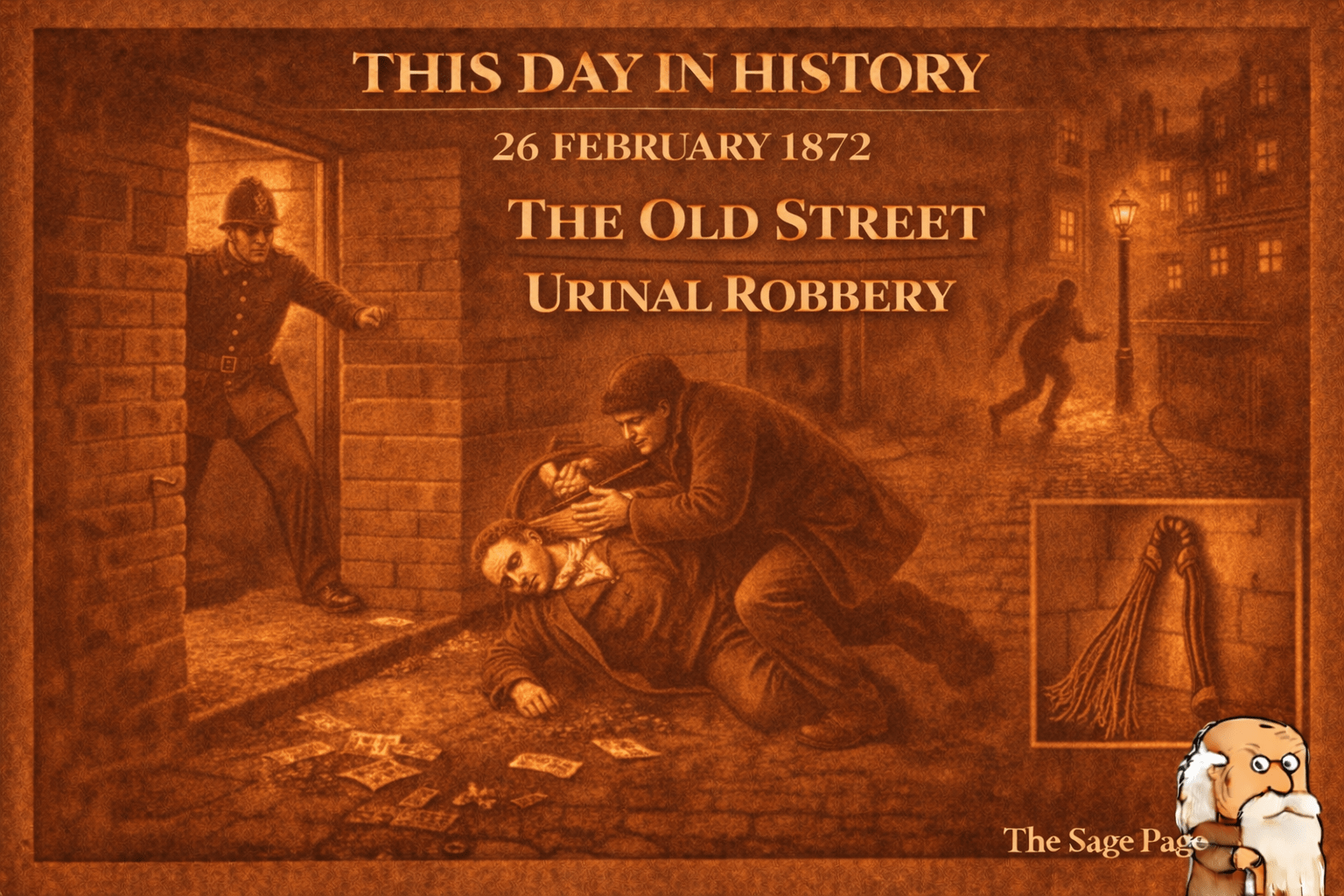
On 26 February 1872, Horace Crosby and George Dowling, both aged eighteen, stood before the Central Criminal Court, charged with robbery with violence.
The stolen goods?
Three postcards.
A handful of papers.
The violence, however, was real.
They were sentenced to eighteen months’ imprisonment and twenty lashes with the cat.
Old Street, 1:30 in the Morning
Edward Charles Carpenter, a wicker-worker of Addison Square, admitted he had been “tipsy.”
At around half past one in the morning on 17 February, he entered a public urinal off Old Street.
The two prisoners followed him in.
Inside one of the compartments:
- Dowling seized him.
- Threw him backwards.
- Knelt across his chest.
- Clamped a hand over his mouth.
Meanwhile, Crosby rifled his pockets.
Carpenter later recalled hearing:
“He ain’t got nothing.”
Followed by:
“Are you sure he ain’t got nothing?”
He had money — but hidden in his boot.
His pockets yielded only:
- Papers
- Bills
- Three postcards
Here is Edward Carpenter’s Testimony:
EDWARD CHARLES CARPENTER . I live at 10, Addison Square, and am a wicker-worker—on the morning of 17th February I remember going into a urinal—I was tipsy—the two prisoners followed me in—Crosby looked me very hard in the face, and Dowling was behind me, and all in a moment he put his arms round my head and against my breast, and the other hand he put on my fob, and forced me back on the ground—while I was on the ground he kept his hand over my mouth, and knelt across my chest—Crosby rifled all my pockets—I had nothing in them but papers and bills, and two or three post-cards—I heard Crosby say “He aint got nothing”—Dowling said “Are you sure he aint got nothing?”—Crosby said “Yes, nothing at all”—I don’t remember crying out at all—I did not see a policeman come into the urinal—I lost my senses—I was very much hurt across my chest—I thought I was dying—these (produced) are the papers and post-cards I had in my pocket.
Cross-examined by MR. WILLIAMS. I had some money about me, but it was in my boot—there were three or four compartments in the place, with an entrance on each side—I was in one of the compartments.
The Policemen Arrive
Police Constable Arthur Stevens heard cries of “Police!”
He entered from one side of the urinal.
He saw:
- Dowling kneeling on the victim’s chest
- Crosby with his hand inside the victim’s trousers pocket
The two attempted to flee.
They ran straight into the arms of another officer at the opposite entrance.
The prosecutor lay on his back, bleeding slightly from the mouth. His pockets were turned inside out.
The Defence
Dowling offered an imaginative explanation before the magistrate:
He claimed he had entered the urinal and seen another man fleeing, pursued by a policeman — and had himself been mistakenly seized.
The jury was unmoved.
Verdict and Sentence
Guilty.
Sentence:
- Eighteen months’ imprisonment
- Twenty lashes with the cat
The Cat in 1872
By 1872, the death penalty for robbery without murder had long been abolished.
But corporal punishment remained.
The “cat” — short for cat-o’-nine-tails — was a whip of multiple knotted cords.
Flogging in prison was:
- Painful
- Public within the prison
- Intended as deterrent
Twenty lashes was no light punishment.
It was inflicted on the bare back.
Why This Case Is So Striking
Compared with our previous February cases:
- 1771: Death by hanging for shooting.
- 1784: Death sentence (commuted) for pistol robbery.
- 1790: Death for burglary.
- 1872: Eighteen months and flogging — for violent theft of postcards.
The legal world had changed.
Violence still mattered.
But the Bloody Code was gone.
The state now punished with imprisonment and corporal discipline rather than the gallows.
Why It Matters
This case reveals:
- The everyday vulnerability of Victorian urban life
- The persistence of violent street crime
- The transformation of English punishment
- The strange triviality of stolen goods compared to the brutality used
Three postcards.
Twenty lashes.
Justice, by 1872, had shifted from execution to correction — but it was not gentle.
Sources
- Central Criminal Court Sessions Paper, 26 February 1872
- Trial of Horace Crosby and George Dowling
Thank you for reading my writings. If you’d like to, you can buy me a coffee for just £1 and I will think of you while writing my next post! Just hit the link below…. (thanks in advance)

 The Sage Page