The Islington Shoe Shop Theft
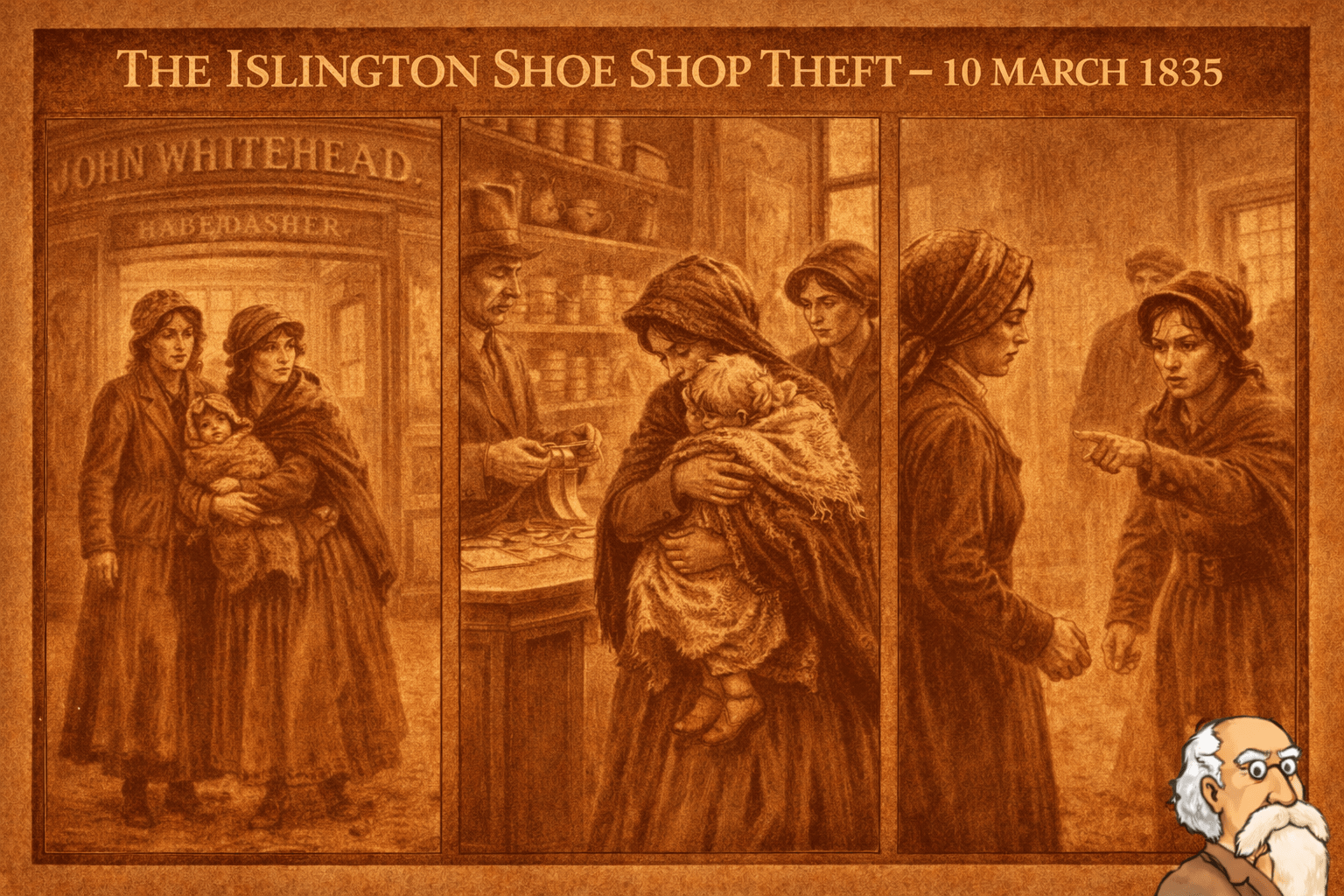
On 10 March 1835, two women walked into a small haberdasher’s shop in Islington and attempted a simple but carefully timed theft.
Their target?
A modest pair of shoes worth two shillings.
But a suspicious shopkeeper and an observant eye quickly turned the attempt into a criminal prosecution at the Old Bailey.
The Customers Who Were “Not in a Hurry”
The shop belonged to John Whitehead, a haberdasher.
On that evening, his wife Elizabeth Whitehead was serving in the shop when two women entered together:
- Mary Thorpe, aged 34
- Bridget Wheeler, aged 32
One of them was carrying a child.
They asked for a pair of shoes priced at half a crown.
Mrs Whitehead unlocked the guard protecting the goods and began preparing to serve them.
At that very moment, a stranger entered the shop asking for one pennyworth of tape.
One of the women quickly reassured her:
“You may serve this gentleman, we are not in a hurry.”
It sounded polite.
But it was the signal for the theft.
The Distraction
As Mrs Whitehead crossed the shop to deal with the tape customer, she noticed something suspicious.
While her back was turned, Bridget Wheeler lifted a pair of shoes and hid them beneath her shawl.
The man with the tape continued to delay matters by hesitating over the width he wanted.
It was a classic distraction technique often used by shoplifters of the period.
But Mrs Whitehead had already seen enough.
The Child as a Hiding Place
When the tape customer finally left, Mrs Whitehead immediately confronted Wheeler.
She demanded payment for the shoes.
Wheeler denied having them.
Then, in a moment of improvisation, she seized the child from Thorpe’s arms, hid the shoes beneath the child’s clothing, and hurried out of the shop.
She soon returned with the child—but without the shoes.
By then the alarm had been raised.
The Arrest
John Whitehead quickly joined his wife in the shop.
Seeing the empty space where the shoes had been, he threatened to call the police.
Both women insisted they were innocent and even offered to be searched.
But Wheeler soon changed tactics, suggesting:
If he went to Bagnigge Wells Road, her husband would pay for the shoes.
The explanation convinced no one.
The pair were taken to the police station.
The Trial
At the Old Bailey, the prosecution relied primarily on the testimony of Elizabeth Whitehead, who had seen the shoes taken.
Although character witnesses spoke on Wheeler’s behalf—including a shoemaker who vouched for her reputation—the evidence was clear.
Both women were found guilty of simple larceny.
Their punishment was comparatively mild.
Three months’ confinement.
A Familiar London Trick
The case illustrates a common shoplifting strategy of the early nineteenth century:
- Two or more accomplices enter a shop.
- One distracts the shopkeeper with a complicated purchase.
- Another steals goods while the shopkeeper’s attention is diverted.
In this case, the plan might even have involved the mysterious “tape customer”, whose hesitation conveniently occupied Mrs Whitehead just long enough for the theft.
Whether he was part of the scheme or simply an unlucky coincidence remains unknown.
Epilogue
The stolen item was hardly valuable—just a pair of shoes worth two shillings.
Yet small thefts like this filled the daily business of the Old Bailey.
For London shopkeepers, the lesson was simple:
politeness from customers was not always what it seemed.
Sometimes the most dangerous words in a shop were:
“Take your time—we’re not in a hurry.”
Sources
- Old Bailey Proceedings, 6 April 1835, trial of Mary Thorpe and Bridget Wheeler.
- Testimony of Elizabeth Whitehead and John Whitehead.
- Central Criminal Court Sessions Papers.
Thank you for reading my writings. If you’d like to, you can buy me a coffee for just £1 and I will think of you while writing my next post! Just hit the link below…. (thanks in advance)

 The Sage Page