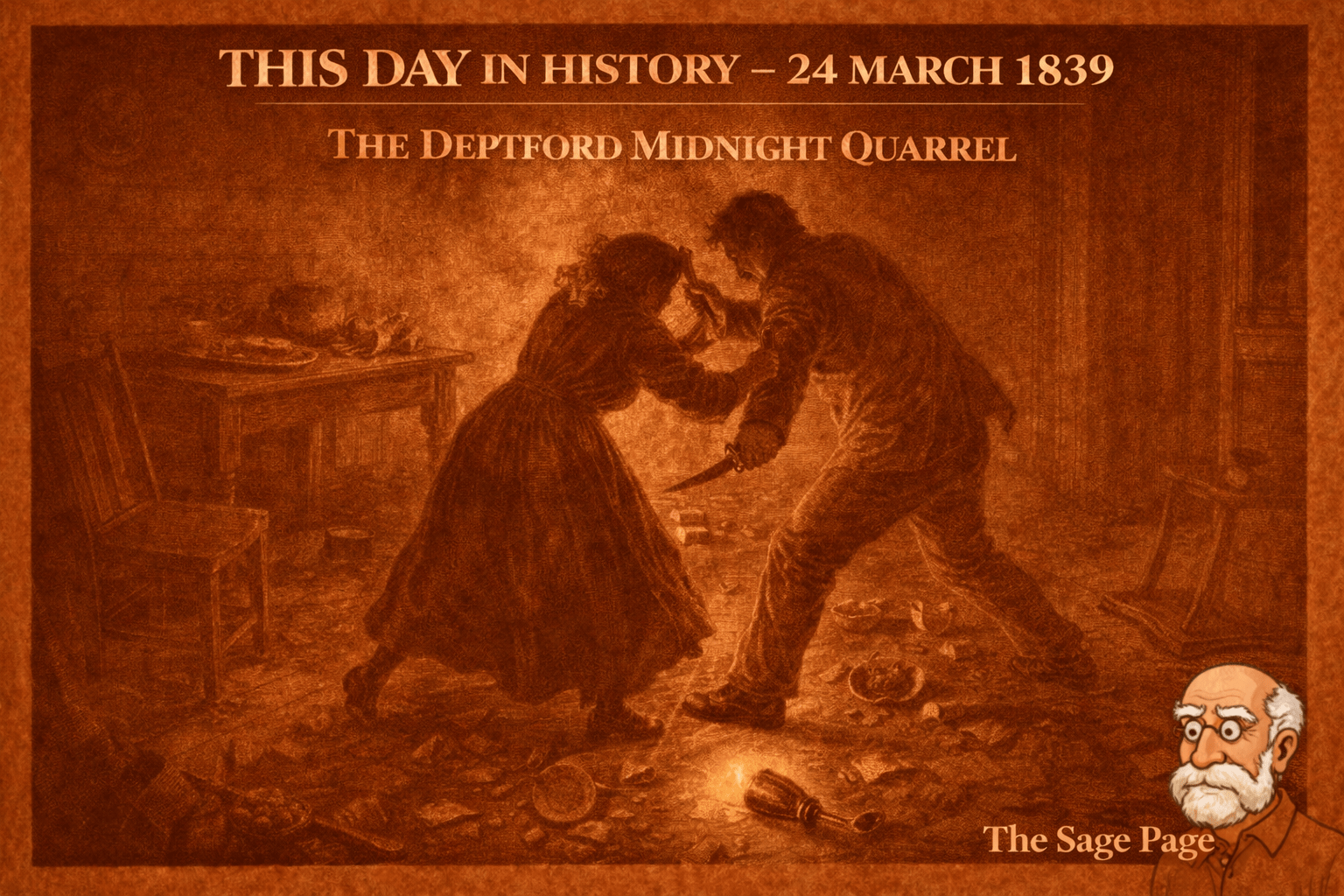
The Deptford Midnight Quarrel
On a dark and disorderly Sunday night in Deptford, a drunken quarrel between husband and wife spiralled into violence, leaving one man horribly wounded and a marriage laid bare before the courts of London.
At around midnight on 24 March 1839, Thomas Hearn, a labourer of Mill Lane, returned home “very much intoxicated” after an evening spent drinking in the Broadway. His wife, Ann Hearn, was not yet home. When she did arrive, what followed was not reconciliation—but accusation.
Thomas, fuelled by drink and jealousy, accused his wife of consorting with another man. By his own admission, he “called her bad names” and struck her first. What began as a domestic quarrel quickly descended into a full physical struggle.
A Room in Darkness
The scene inside the couple’s lodging was one of chaos.
In the course of the fight, a candle—the only source of light—was knocked to the floor and extinguished. The room fell into near-total darkness. Crockery shattered underfoot. Furniture was overturned. Husband and wife grappled blindly in the gloom.
Thomas later described the moment with striking honesty:
“I must have struck her first, for I am very bad when I am in liquor.”
Ann, meanwhile, had been using a knife moments earlier to cut wood for the fire. As the struggle intensified, and with Thomas allegedly grabbing her by the hair and throwing her onto the bed, she lashed out.
In the darkness, the blade found its mark.
A Terrible Wound
Thomas staggered from the room and sought help. When light was finally brought to the scene, the extent of his injuries became clear.
Surgeon Edward Downing later described the damage in stark terms:
- A wound five and a half inches long
- Curving across the left cheek, from ear to mouth
- In places cut to the bone
- Bleeding “very profusely”
It was, he said, a dangerous wound, and had it been slightly lower, it might have proved fatal.
Despite this, Thomas—remarkably—returned to work within two days.
The Wife in Hiding
Police, alerted by cries in the street, soon arrived. Ann Hearn was not immediately found.
Instead, she had fled the house and concealed herself nearby—hidden among timber, bricks, and a cart in a neighbouring yard. It was a telling detail: not the act of a calculating criminal, but of someone caught in panic after a violent domestic struggle.
When discovered, she reportedly admitted the act and expressed a grim fatalism about her fate.
Back in the house, officers recovered the knife, hidden on a cupboard shelf. Upon seeing it, Ann confirmed it was the weapon used.
A Marriage on Trial
At trial, the case unfolded less as a tale of cold-blooded violence and more as a tragic portrait of a volatile relationship.
Thomas himself did not present as a wronged innocent. On the contrary, his testimony was filled with admissions:
- He had been heavily drunk
- He had initiated the violence
- He had wrongly accused his wife
- He was “wicked enough” to have done what she described
Ann’s defence rested on fear and self-preservation. She claimed:
- He seized her by the hair
- Forced her onto the bed
- Attempted to choke her
- That she struck out with the knife in the struggle, without intent to cause serious harm
It was, in essence, a case of mutual violence, illuminated only briefly by candlelight before descending into darkness—both literal and moral.
Verdict and Sentence
Despite the complexities, the jury returned a verdict of Guilty.
Ann Hearn, aged 27, was sentenced to:
Two Years’ Imprisonment
A relatively moderate sentence, reflecting perhaps:
- The husband’s admitted aggression
- The chaotic circumstances
- The absence of clear intent to kill
Aftermath and Reflection
This case offers a stark window into the realities of working-class domestic life in early Victorian London—where alcohol, poverty, and close quarters could turn suspicion into violence with frightening speed.
There is no clear villain here.
Instead, we are left with:
- A husband who struck first and remembered little
- A wife who fought back in fear
- A moment of darkness in which a life-altering injury was inflicted
And, perhaps most strikingly, a justice system willing—if only slightly—to recognise the difference between intent and desperation.
Sources
- Old Bailey Proceedings, 8 April 1839, trial of Ann Hearn (t18390408-541)
- Testimony of Thomas Hearn, Edward Downing (surgeon), and attending officers
- Contemporary records of Metropolitan Police procedure in Deptford
Life in Deptford, 1839 — Drink, Density, and Domestic Strain
Deptford in the 1830s was a place where life pressed in from all sides.
Once a thriving naval hub, the area had become a patchwork of cheap lodgings, dockside labour, and overcrowded housing. Families often lived in single rooms, sharing walls—and sometimes floors—with neighbours who could hear every argument, every crash, every cry for help.
Privacy, in any meaningful sense, barely existed.
Work was irregular. Men like Thomas Hearn, a smith, relied on physically demanding labour that could disappear without warning. Wages fluctuated. Tempers, unsurprisingly, did the same.
And then there was drink.
Public houses were not simply places of leisure—they were social centres, places of warmth, escape, and, frequently, excess. Alcohol played a quiet but persistent role in many Old Bailey cases of the period, lowering inhibitions and sharpening grievances that might otherwise have cooled.
Domestic disputes were rarely private matters. As in this case, neighbours and passers-by often became witnesses, drawn by noise, violence, or the simple fact that walls were thin and lives were lived loudly.
What unfolded in Mill Lane that night was not unusual.
What was unusual was that it ended up in court—and recorded for history.
Epilogue: Two Years Behind Walls
Ann Hearn’s sentence—two years’ imprisonment—would have taken her into a penal system in transition.
By the late 1830s, prisons such as Millbank and Coldbath Fields were increasingly governed by ideas of discipline, reform, and isolation. Gone were the older, chaotic gaols where prisoners mixed freely. In their place came regimes built on silence, routine, and control.
A typical day might include:
- Long hours of menial labour (picking oakum, sewing, or washing)
- Strict enforcement of silence
- Limited contact with other prisoners
- Basic, often harsh, living conditions
For women, imprisonment carried an additional burden: social stigma.
Unlike her husband—who returned to work within days—Ann would emerge not simply as someone who had served a sentence, but as a woman marked by it. Employment prospects, already limited, would narrow further. Reputation, once damaged, was rarely repaired.
And yet, the sentence itself tells a story.
She was not transported.
She was not condemned to death.
The court, perhaps reluctantly, recognised what modern readers see more clearly: that this was not a calculated act of violence, but a moment born of fear, chaos, and provocation.
When Ann Hearn walked free again, two years later, she would have stepped back into the same world—but not, one suspects, into the same life.
Thank you for reading my writings. If you’d like to, you can buy me a coffee for just £1 and I will think of you while writing my next post! Just hit the link below…. (thanks in advance).

 The Sage Page