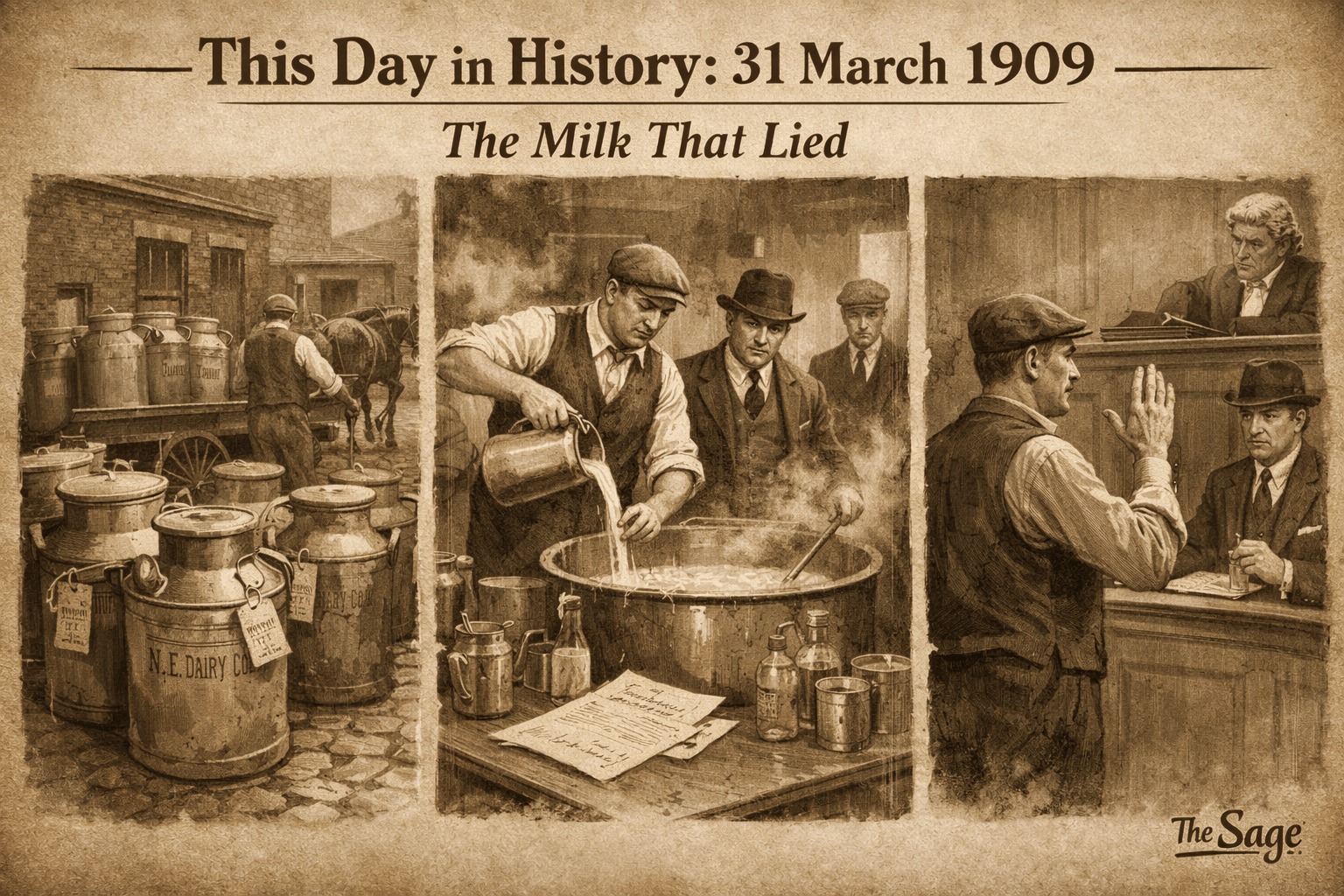
The Milk That Lied – The North-Eastern Dairy Conspiracy
A Business Built on Trust
In early 1909, customers of the North-Eastern Dairy Company, in Islington, believed they were buying something simple:
Fresh milk.
Delivered daily.
Measured honestly.
Consumed without question.
But behind the scenes, something was very different.
The First Consignment
The story begins around 31 March, when the first consignments of milk arrived from suppliers—including deliveries of separated (skimmed) milk.
By early April, the system was in motion.
According to later testimony, this milk was not sold as it arrived.
It was mixed.
The Mixing Room
Inside the dairy, under the direction of manager William Palmer, milk was blended in varying proportions.
Albert Cobb, a senior milkman, explained:
- Separated milk was regularly mixed with fresh milk
- Instructions were given in writing each morning
- The process was carried out openly, in front of the carriers
“The mixing was done in the dairy… the carriers could see everything that was done.”
This was not a one-off.
It had been happening for months.
The Sampling
On 2 April, milk carrier John Alfred Webster was stopped on his round and a sample of his milk was taken for analysis.
This was routine enforcement.
But the results were not.
The milk was found to be:
- Deficient in fat
- Adulterated
A prosecution followed.
The Defence – A Convenient Story
At the North London Police Court, the company relied on a familiar legal defence:
“Warranty.”
They claimed:
- The milk had been sold exactly as it was received
- Any defect lay with the supplier—not the dairy
To support this, Webster gave evidence.
But his testimony was not true.
“It Was a Lie”
At trial, Webster admitted it openly.
He had been told what to say.
“Palmer told me what I was to say… I was not to mention Cobb’s name at all.”
Why?
Because Cobb had previous convictions.
Webster had originally testified that:
- Palmer received the milk
- Palmer handled its distribution
But in reality:
- Cobb had received it
- Cobb had overseen the mixing
Under pressure, Webster confessed:
“It was not a true story; it was a lie.”
A Wider Conspiracy
The deception went further.
Evidence showed:
- Milk was deliberately mixed with separated milk
- Instructions were issued to control the proportions
- Staff were coached to present a false version of events
Even after the first hearing, Webster was urged to maintain the falsehood:
“You ought to have stuck to the lie… we should have been all right then.”
The case was no longer about milk.
It was about perverting justice itself.
The Science of the Fraud
An expert analyst revealed something even more telling.
The sample did not merely show reduced quality—it showed added water.
- Fat content: too low
- Solids: too low
- Water: too high
This was not accidental.
It was manipulation.
The Verdict
The court made its position clear.
This was not a case about poor milk.
It was a case about lying under oath.
Webster was found:
GUILTY.
With a strong recommendation to mercy.
Palmer, tried separately, was also found:
GUILTY.
Sentencing was postponed—but the damage was done.
Why This Case Matters
This case marks a shift in criminal history:
From violent crime…
to systematic commercial deception.
No pistols.
No midnight break-ins.
Instead:
- False accounts
- Manipulated evidence
- And a quiet betrayal of public trust
It also reminds us that:
The most dangerous lies are often the ordinary ones.
A bottle of milk.
A daily routine.
A trusted supplier.
All quietly corrupted.
Footnote: The Deadly Business of Milk Adulteration
While the offences in the North-Eastern Dairy case may appear, at first glance, to belong to the realm of petty commercial dishonesty—watered milk, skimmed profits, and a few lies told under oath—the broader history of milk adulteration reveals something far more troubling.
In mid-19th century New York, a scandal erupted that would become known as the Swill Milk Scandal. Dairies attached to distilleries fed cows on the hot, fermenting waste from alcohol production—known as “swill.” The animals, often diseased and kept in appalling conditions, produced a thin, bluish milk scarcely fit for consumption.
Rather than discard it, producers improved its appearance through ingenuity of the most dangerous kind. The milk was thickened with flour or starch, whitened with plaster of Paris, and sometimes coloured with additives to give the illusion of richness. What emerged looked, to the unsuspecting eye, like wholesome milk.
It was anything but.
Consumed widely by the urban poor—particularly infants—the contaminated milk was linked to widespread illness and death. Contemporary estimates suggested that thousands of children died as a result of this practice before public outrage forced reform.
By comparison, the actions of Webster, Palmer, and Jarvis may seem almost modest: the dilution of milk, the concealment of its true composition, and the orchestration of false testimony. Yet the principle is the same. Whether by water, by skimming, or by more sinister means, the adulteration of food represents a betrayal of trust—one that, in its most extreme forms, has proven deadly.
In this light, the quiet deceit uncovered in a North London dairy yard belongs to a much larger and darker story: one in which profit is drawn, quite literally, from the thinning of the public’s daily bread—and milk.
Thank you for reading my writings. If you’d like to, you can buy me a coffee for just £1 and I will think of you while writing my next post! Just hit the link below…. (thanks in advance)

 The Sage Page