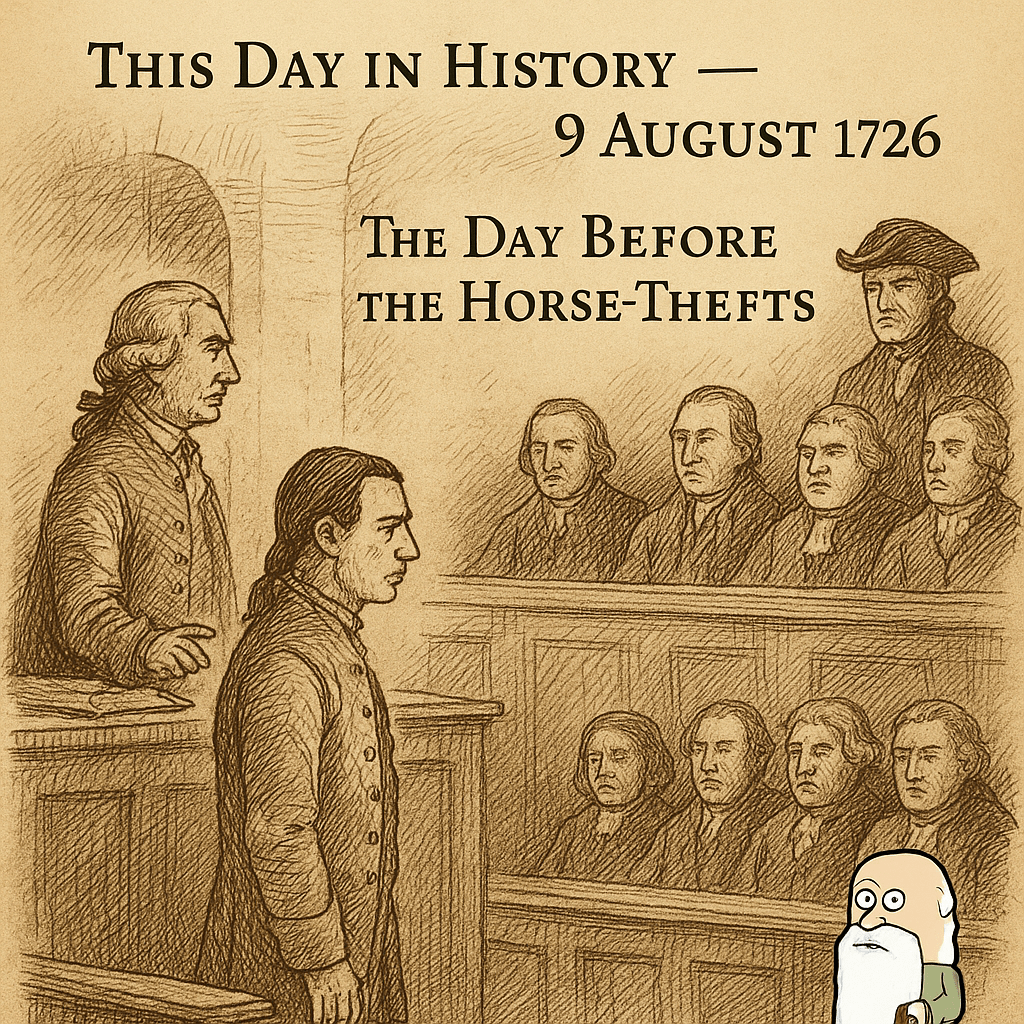
The Day Before the Horse-Thefts
An alias in the alehouse. A bay gelding in his eye. Tomorrow, trouble.
London, 9 August 1726.
In a smoky alehouse off Smithfield, a man who calls himself George Prentice — or Johnson, depending who asks — studies the comings and goings of horse-dealers and hostlers. He drinks little, listens much. Tomorrow will be market day of a different sort.
On 10 August, according to the later indictment, a bay gelding belonging to John Street will be taken; and in a second count, a grey gelding belonging to Robert Hanson will change hands for a hasty £15. Those are the facts the Old Bailey will print at month’s end; tonight is the quiet before the paper trail begins.
When the court eventually sits, the clerk will read:
“George Prentice, alias Johnson, indicted for stealing a bay gelding, value 10 l., the goods of John Street… and again indicted for a grey gelding, value 10 l., the goods of Robert Hanson; 10th of August.”
Witnesses swear to ownership and to dealings “on the 10th of August… the price was £15”; the alias is noted; the pattern is clear.
⚖️ The Trial at the Old Bailey
Date: Late August 1726
Location: Court of the Old Bailey, London
The prosecution’s case is straightforward.
- John Street testifies that his bay gelding was secure until the night of the 9th–10th. By dawn, the horse and Prentice were both gone.
- Robert Hanson recounts how, on the 10th, Prentice approached him with the grey gelding, pressing for a quick sale. The price — £15 — was tempting, but the circumstances were odd.
- Both men identify Prentice in court, and their certainty is unshaken.
Prentice’s defence is weak: he claims confusion over ownership, offering no receipts or credible witnesses to support his story. The jury is unimpressed.
The foreman’s verdict comes quickly:
Guilty on both counts.
⛓️ The Sentence
Horse theft in 1726 is a capital offence — the gallows at Tyburn are the usual end for such convictions. The court sentences George Prentice, alias Johnson, to death by hanging.
Whether he was eventually executed or had his sentence commuted is not recorded in the surviving proceedings, but the public nature of such cases meant his conviction would have been widely known — a warning to other would-be horse thieves.

📜 Why It Matters
Public Example: Such trials were printed in the Old Bailey Proceedings and read aloud in alehouses, ensuring the lesson spread far beyond the dock.
Harsh Deterrents: The Prentice case shows the severity of Georgian justice — horses were vital for transport, farming, and trade, so their theft was treated on par with murder in some instances.
Market Vulnerabilities: Smithfield and other horse markets were bustling, poorly policed spaces, ideal for sharp operators.
Alias Culture: The use of “alias” in indictments reflects how criminals often adopted multiple identities to confuse victims and authorities.
Thank you for reading my writings. If you’d like to, you can buy me a coffee for just £1 and I will think of you while writing my next post! Just hit the link below…. (thanks in advance)

 The Sage Page