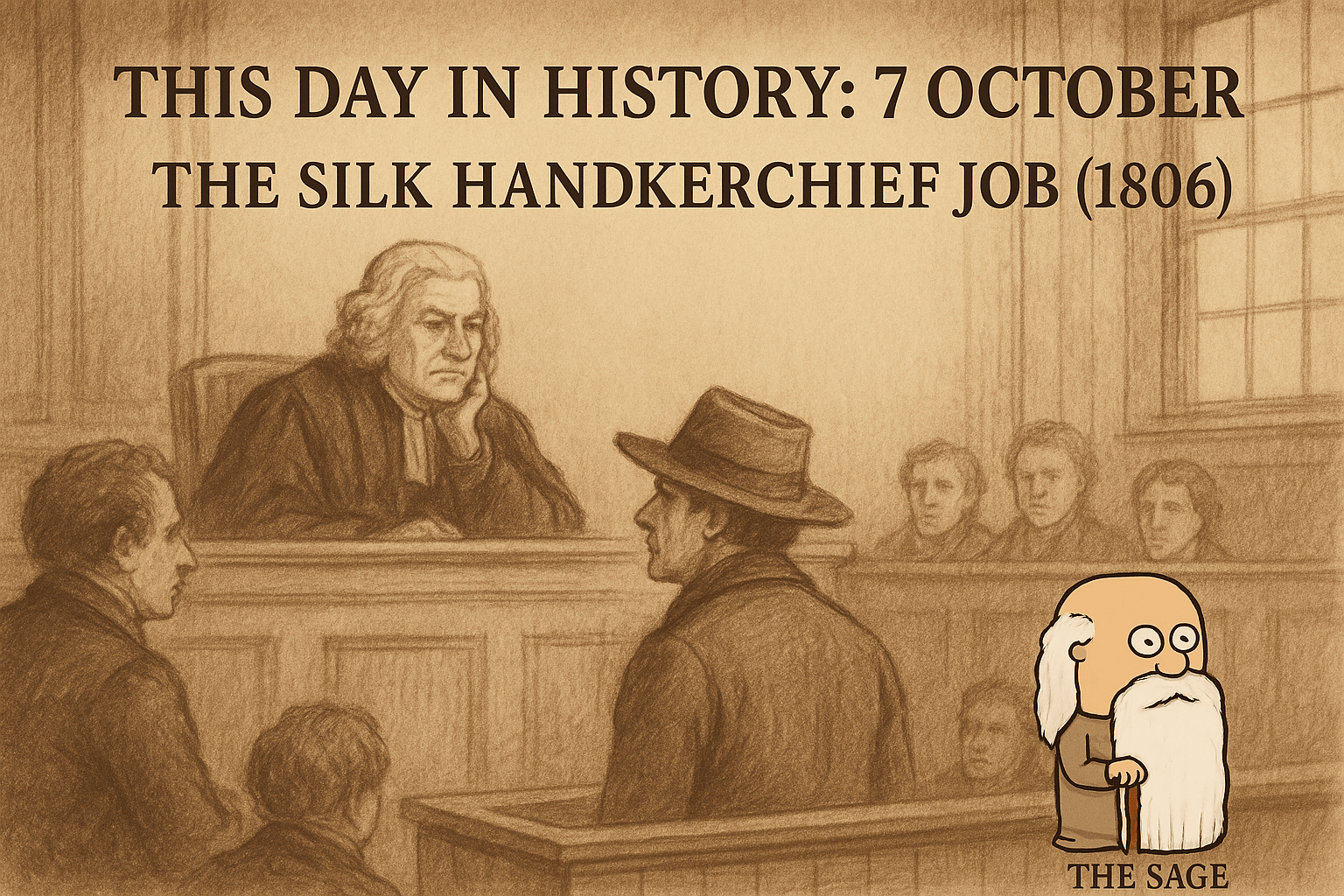
On the bustling streets of London on 7 October 1806, pockets were a battleground. Among the carriages, chatter, and hawkers’ cries, William King reached deftly into the coat of George Pritchard, drawing out a silk handkerchief valued at a shilling. A minor fortune to some, and proof of guilt to others.
The theft was swift, the handkerchief soft, and the law merciless.
King was caught not long after, his pockets searched by a sharp-eyed constable who found the silk still folded and faintly scented. When the case came before the Old Bailey later that month, the courtroom filled with the usual cast of London’s minor tragedies — the victim, the constable, the thief, and a public hungry for justice.
The Trial at the Old Bailey
The indictment read with its customary precision:
“William King was indicted for privately stealing, on the 7th of October, from the person of George Pritchard, one silk handkerchief, value one shilling.”
Pritchard described how he’d been walking through the City when he felt the faintest tug at his pocket. Turning, he saw King’s hand withdraw — and the flash of silk vanishing into the thief’s coat.
Pritchard: “I seized him directly, crying out ‘Stop thief!’”
Constable: “I came up and searched him — found the article upon him, and he could give no account of its ownership.”
King offered little in defence beyond the weary protest of his kind:
King: “I picked it up off the ground, sir.”
The jury, unmoved, returned a verdict of Guilty, and the judge delivered the sentence with ritual brevity:
“To be transported for seven years.”
That phrase — seven years — carried its own weight in the courtroom air. It meant exile, not death; a living punishment sent across oceans to New South Wales.
Why it Mattered
In the early 1800s, London’s pocket-picking epidemic was one of the most common offences at the Old Bailey. Handkerchiefs, watches, and purses were the currency of survival for the city’s poorest.
A silk handkerchief was both fashion and fortune — proof of gentility and a day’s wage for those desperate enough to steal one.
William King’s conviction tells a larger story about Georgian London: a society where petty theft could send a man halfway round the world, where small crimes filled great ships, and where transportation became Britain’s unlikely solution to overcrowded prisons.
The fate of King himself is lost to time — but the handkerchief, the shout of “Stop thief!”, and the sentence of seven years live on in the fading ink of the Old Bailey’s record.
Source
R v. William King (t18061029-47), tried at the Old Bailey on 29 October 1806, for privately stealing a silk handkerchief from George Pritchard on 7 October 1806. Verdict: Guilty. Sentence: Transportation for seven years.
Old Bailey Proceedings Online
Thank you for reading my writings. If you’d like to, you can buy me a coffee for just £1 and I will think of you while writing my next post! Just hit the link below…. (thanks in advance)

 The Sage Page
King became something of a celebrity
LikeLiked by 1 person
Hi Mike, did he drink at the Pig’s Arms? Hope all is great in your world!
LikeLike