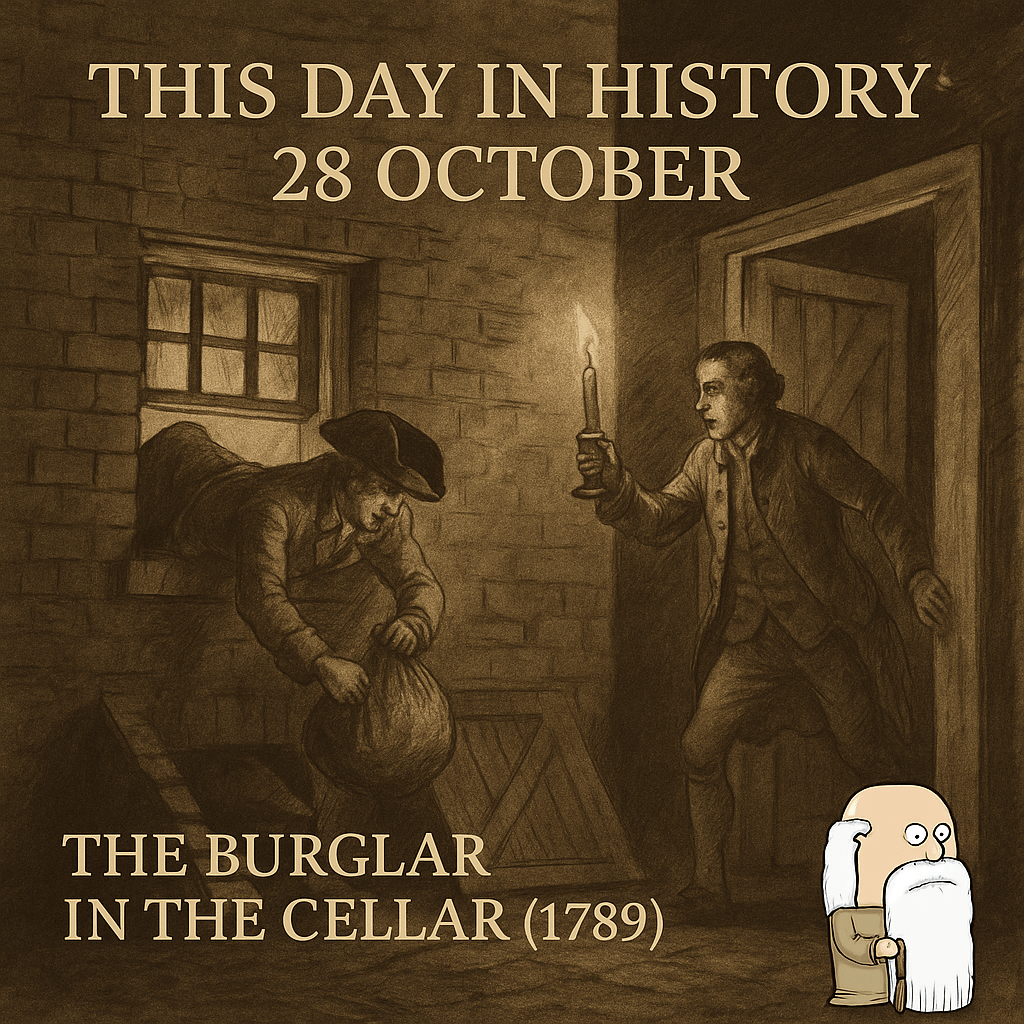
It was the dead of night on one October evening when David Braithwaite made his ill-fated entrance into London history. His plan was simple: slip through a cellar window, steal what he could, and be gone before dawn. What he hadn’t counted on was a watchful servant — and a trapdoor that creaked like guilt itself.
The break-in
Braithwaite chose the house of William Webb, a respectable tradesman living in the City. Around midnight, neighbours heard the scratch of a file and the dull thud of footsteps below street level.
Servant (witness): “I was roused from my bed by the sound of a latch lifting in the kitchen. I took a candle and went down softly. There I saw him, sir — a man stooping by the cellar door with a bundle in his hand.”
The startled servant called out, and Braithwaite bolted for the window. Unfortunately, he’d forgotten the small matter of his exit route. He wedged himself halfway through the narrow frame, and when the constable arrived moments later, he was still stuck — legs kicking, curses echoing.
The trial at the Old Bailey
The trial opened on 28 October 1789 with Braithwaite charged for breaking and entering the dwelling-house of William Webb and stealing goods to the value of forty shillings.
Clerk of Arraigns: “David Braithwaite, you stand indicted for burglary in the dwelling-house of William Webb. How say you — guilty or not guilty?”
Braithwaite: “Not guilty, sir. I never meant to steal aught — only to find my way out again.”
The court laughed. The judge did not.
Evidence was straightforward: the broken latch, the missing goods (found in his bundle), and the servant’s testimony.
Judge: “You found your way in, Mr Braithwaite — I fancy the jury will help you find your way out.”
It took the jury little time to reach a verdict. Guilty.
Sentence and aftermath
Burglary in the 1780s carried the death penalty, but judges often tempered justice with pragmatism. Braithwaite’s record and circumstances persuaded the court to recommend mercy. His sentence was transportation for seven years, likely to Botany Bay.
Judge: “Let this serve as instruction that every man’s home is his castle, even its cellar.”
Why this mattered
David Braithwaite’s case shows how the Georgian justice system balanced terror with leniency. Burglary was classed among capital offences, yet the courts were already shifting away from the gallows toward transportation and reform. His story — absurd and almost comic in its ending — is one of countless that turned domestic panic into colonial exile.
Source
R v. David Braithwaite (t17891028-11), tried at the Old Bailey on 28 October 1789 for burglary. Verdict: Guilty. Sentence: Transportation for seven years.
Old Bailey Proceedings Online
Thank you for reading my writings. If you’d like to, you can buy me a coffee for just £1 and I will think of you while writing my next post! Just hit the link below…. (thanks in advance)

 The Sage Page