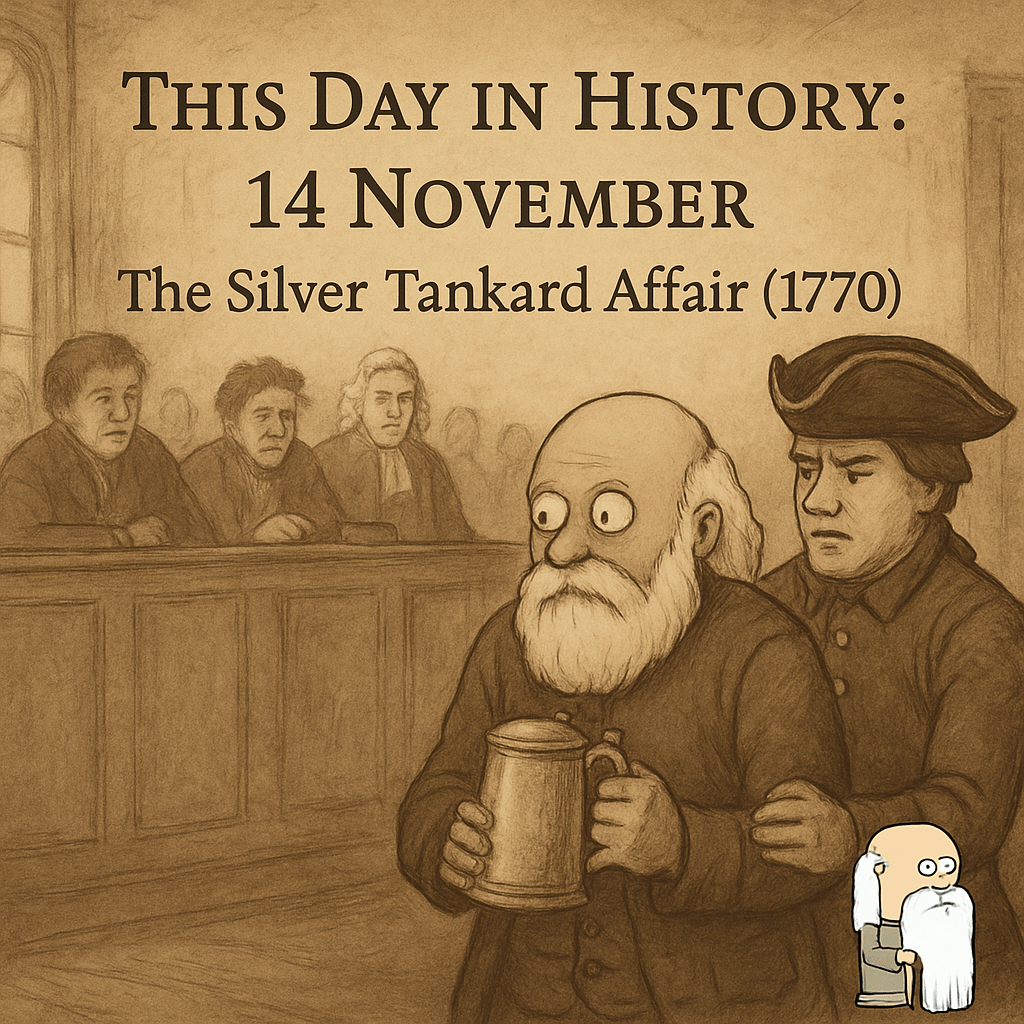
London, 14 November 1770 — a day cold enough for breath to fog the air, and warm enough inside the taverns for tempers and ale to flow freely.
In one such public house, a man named John Buckley made a choice that would carry him across the world.
The offence was simple, and simply foolish:
He stole a silver tankard — the pride of many a Georgian drinking house and the economic backbone of its trade. What began as a quiet evening’s drink would become a courtroom drama, and ultimately, a sentence of transportation for seven years.
The theft
The victim, a publican named John Gardner, kept his silver tankard behind the bar where customers might admire it — a gleaming symbol of prosperity and trustworthiness.
That trust was ill-placed.
Gardner: “The prisoner was drinking in my house. We had no quarrel nor words, but soon after he went away, I missed the tankard.”
Searching the street, Gardner spotted Buckley a short distance away, hurrying with something hidden under his coat.
Gardner: “I overtook him and told him he had my tankard. He said he had not, but I found it under his coat.”
The tankard was unmistakable — engraved, heavy, and still warm from the landlord’s hand.
Buckley insisted he was innocent. His explanation? He had found the tankard “lying on the ground” outside the tavern, and had meant to return it.
Even the court laughed.
The trial at the Old Bailey
That morning, 14 November 1770, Buckley stood at the Old Bailey bar, the silver tankard placed plainly on the evidence table.
Clerk: “John Buckley, you stand indicted for feloniously stealing one silver tankard, value seven pounds, the property of John Gardner. How say you — guilty or not guilty?”
Buckley: “Not guilty.”
But the evidence was overwhelming:
- The landlord’s pursuit
- The discovery of the tankard concealed under Buckley’s coat
- The absence of any plausible explanation
The jury retired only briefly.
Foreman: “Guilty.”
Sentence and aftermath
Stealing a silver tankard was no small matter. Silver was wealth, and taverns were hubs of economic and social life. The judge delivered the sentence with practiced solemnity:
Judge: “You shall be transported for the term of seven years.”
Buckley was sent first to the hulks, the floating prison ships moored on the Thames. From there, he would join the many who would cross the seas to the penal colonies — his fate sealed by one moment of ale-fuelled temptation.
Why this mattered
Buckley’s case reveals the harsh practicality of Georgian justice:
- Taverns were essential public spaces; crimes against them were crimes against community stability.
- Silverware theft was a serious economic blow, not a trivial incident.
- Transportation served as the empire’s answer to overcrowded prisons and small but persistent crime.
In short: one man’s poor decision in a warm tavern led to seven years under a foreign sun.
Source
R v. John Buckley, tried 14 November 1770 at the Old Bailey for stealing a silver tankard.
Case reference: t17701114-9
Verdict: Guilty
Sentence: Transportation for seven years
Thank you for reading my writings. If you’d like to, you can buy me a coffee for just £1 and I will think of you while writing my next post! Just hit the link below…. (thanks in advance)

 The Sage Page