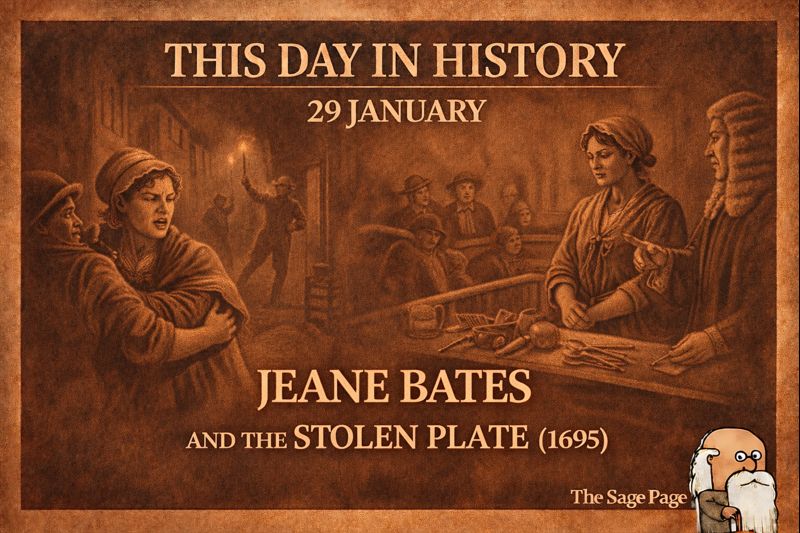
On 29 January 1695, Jeane Bates, also known as Jeane Bates alias Clark, committed a theft that would soon bring her before the Old Bailey — and ultimately to the gallows.
Her crime was not violent robbery, but domestic theft, carried out under a false name while employed as a servant.
The theft
The prosecution stated that Jeane Bates stole from Peter Courtney, Gentleman, a substantial quantity of household goods, including:
- six silver spoons
- forks, salts, and porringers
- a pepper box, mustard pot, and sugar box
- three yards of velvet
- a scarf, and other items
The total value ran into several pounds, a serious sum in the 1690s.
How it was discovered
Mrs Courtney swore that she had hired the prisoner on 26 January, under the name Betty Lambert. Bates remained in service for about four days.
During that time, the closet where the plate was kept was broken open, and the plate was stolen. At the same moment, Bates absented herself from service and disappeared.
The trial
At trial, Bates denied that she had ever been hired by Mrs Courtney. She offered no other defence.
Her denial did not stand.
- Mr Courtney’s clerk swore that Bates had indeed been hired as a servant.
- Another gentlewoman appeared in court, declaring that Bates had previously robbed her while in her service.
- When Bates’ hand was searched, it was found to be branded, marking her as a convicted offender.
The court noted that although she was still a young woman, she was “an old offender.”
The jury returned their verdict:
Guilty of the felony.
Sentence and imprisonment
Jeane Bates was sentenced to death, the standard punishment for felony theft of this value by a repeat offender.
She was committed to Newgate Prison, where she came under the care of the Ordinary of Newgate, whose published account repeats the facts of her crime and conviction almost word for word.
The plea of pregnancy
After sentence, Bates pleaded that she was with child, a claim that, if true, would have delayed execution.
A formal examination was ordered.
The claim was found to be false.
Execution
With no reprieve granted, Jeane Bates was taken to Tyburn and executed by hanging.
The Ordinary’s account records no dramatic final confession, only the grim certainty of punishment carried out after repeated offending and deception.
Why this case matters
The case of Jeane Bates shows how domestic service could provide opportunity for theft — and how quickly trust could turn into condemnation.
It also illustrates:
- the importance of branding in identifying repeat offenders
- how false names were used to gain employment
- the legal limits of pleading pregnancy
- the severity of punishment for property crime in late seventeenth-century England
For Jeane Bates, 29 January 1695 marked the offence that sealed her fate.
Sources
- Old Bailey Proceedings, Jeane Bates alias Clark, offence dated 29 January 1695
Ref: t16950403-14 - Old Bailey Sessions summary: s16950403-1
- Ordinary of Newgate’s Account: OA16950417
Thank you for reading my writings. If you’d like to, you can buy me a coffee for just £1 and I will think of you while writing my next post! Just hit the link below…. (thanks in advance)

 The Sage Page