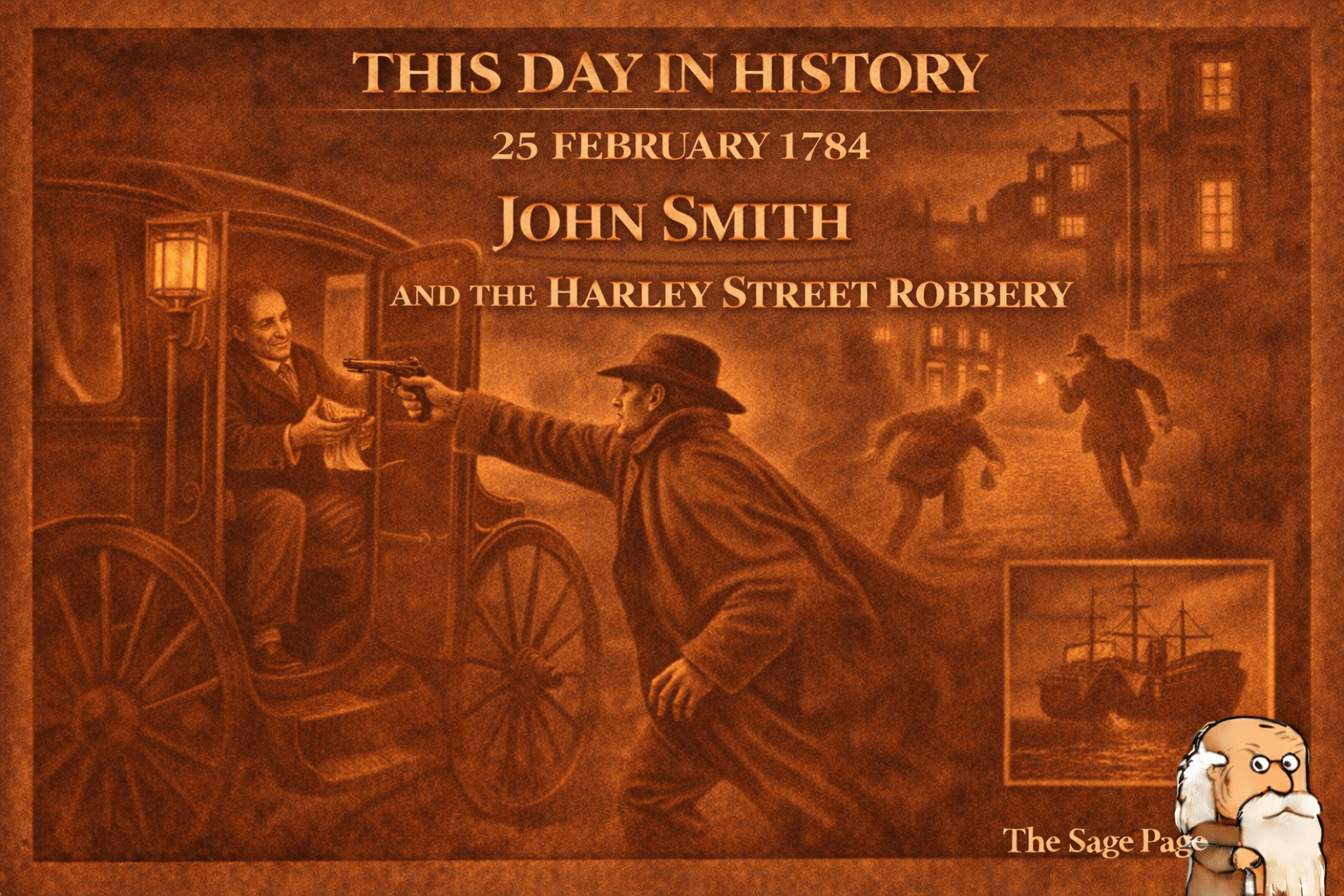
On 25 February 1784, John Smith stood before the Old Bailey, charged with violently robbing Francis Franco, Esq., on the King’s highway.
He was found guilty.
He was sentenced to death.
But he did not hang.
The Robbery in Harley Street
At two in the morning on 12 February, Francis Franco was travelling alone in a hackney coach through Harley Street.
The coach stopped.
The door was opened.
A pistol was presented.
The command was simple:
“Deliver.”
Franco hesitated.
The robber swore he would shoot if he were not quick.
Franco handed over:
- A silk purse containing forty-one guineas and two half-guineas
- A gold watch worth £20
- Two cornelian seals set in gold
The total value exceeded £60 — an enormous sum in 1784.
The Watchman’s Rattle
Just as the watch was delivered, Franco saw a watchman turning the corner and heard the rattle.
The robber fled.
Franco leapt from the coach.
The coachman and watchman pursued.
Within minutes, another watchman seized the suspect.
A pistol was found near where he had fallen during his flight.
The stolen watch was discovered in his coat pocket.
On being confronted, the prisoner said:
“As you have got your watch you may as well have your purse.”
He returned it himself.
The Confession
In court, John Smith did not deny the crime.
“I am guilty of the robbery; great distress and necessity forced me to do it; I leave myself to the mercy of the Court and the prosecutor.”
The jury convicted him.
Sentence: Death.
Mercy and Commutation
Remarkably, both prosecutor and jury recommended Smith to mercy.
The judge’s note recorded:
“Street robbery committed with a pistol and accompanied with threats.”
Officially, no mercy was granted.
Yet the death sentence was later commuted to seven years’ transportation to America.
On 31 July 1784, Smith was transported.
Money Then & Now
Forty-one guineas equalled over £43, plus the watch valued at £20.
Total loss: more than £60.
In 1784, £60 represented:
- Several years’ wages for a labourer
- Or the equivalent of many thousands of pounds today
Highway robbery of this magnitude was treated as a grave threat to public security.
Highway Robbery in Georgian London
Robbery “on the King’s highway” carried capital punishment.
The use of a firearm — especially accompanied by threat to shoot — made conviction almost certain.
Yet by the 1780s, juries increasingly recommended mercy in cases where:
- No injury occurred
- Property was recovered
- The offender confessed
The Bloody Code remained severe, but its application was beginning to soften.
Transportation to America — 1784
Smith’s sentence is particularly interesting.
In 1784, Britain was in a transitional moment.
The American War of Independence had ended in 1783.
Transportation to America was technically disrupted — yet convicts were still, in some cases, sent under altered arrangements before the Australian system was established in 1788.
His case sits at the cusp of imperial penal transition.
Within four years, transportation would shift decisively to New South Wales.
Smith narrowly missed becoming one of its first inhabitants.
Why This Case Matters
John Smith’s story reveals:
- The swiftness of eighteenth-century street justice
- The power of watchmen in London’s night policing
- The importance of confession in capital trials
- The growing tension between law and mercy
From pistol to pardon, the entire arc — crime, capture, conviction, commutation — unfolded within months.
In Georgian London, fortune turned quickly.
Sources
- Old Bailey Proceedings, 25 February 1784, trial of John Smith
- Transportation record, 31 July 1784
Thank you for reading my writings. If you’d like to, you can buy me a coffee for just £1 and I will think of you while writing my next post! Just hit the link below…. (thanks in advance)

 The Sage Page