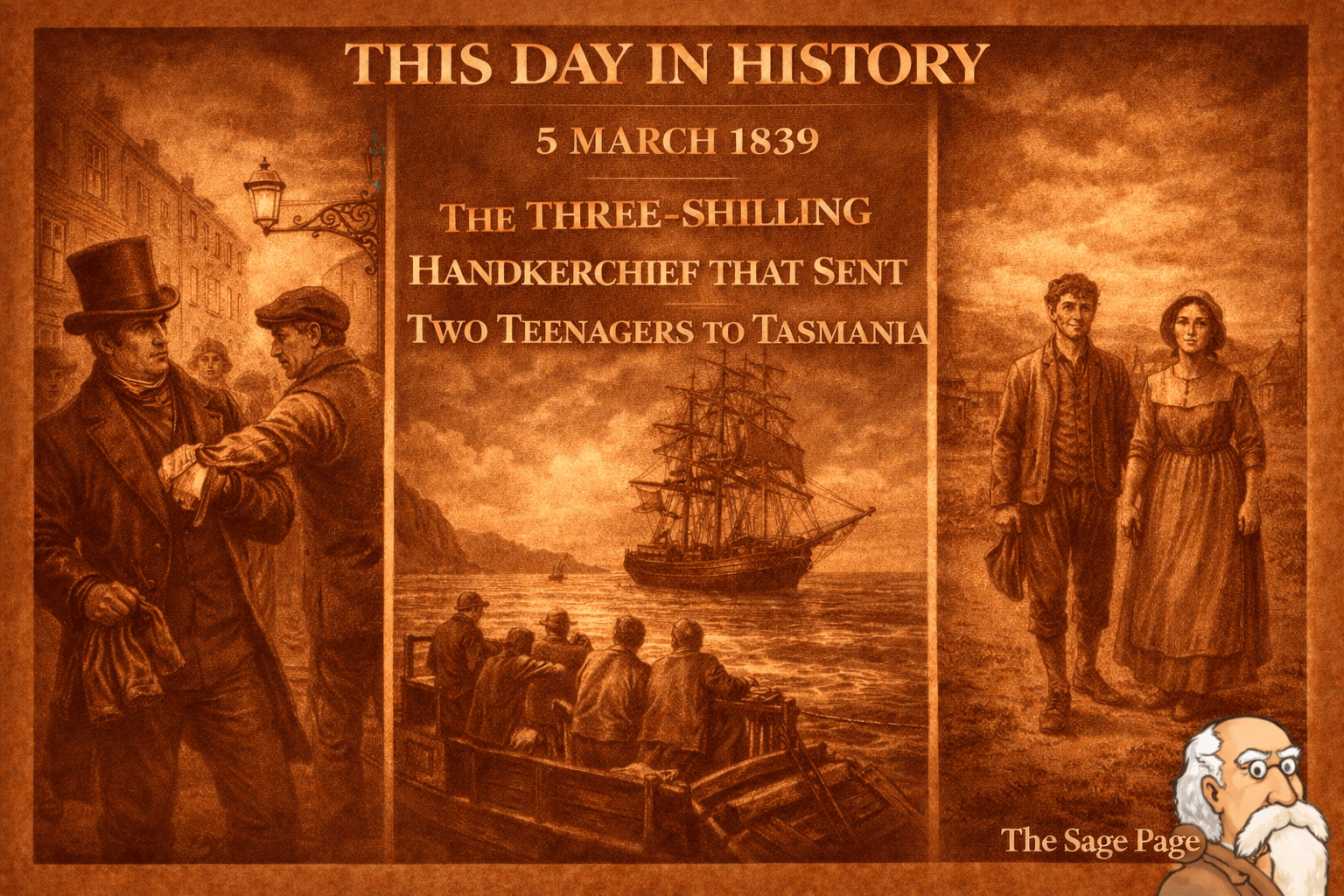
The Three-Shilling Handkerchief That Sent Two Teenagers to Tasmania
On 5 March 1839, two young Londoners stood in the dock at the Old Bailey.
Their crime was hardly grand.
They had stolen a handkerchief worth three shillings from the pocket of an unknown gentleman in Fenchurch Street.
Yet the punishment would send them to the other side of the world.
Their names were Charles Chapman, aged fifteen, and Eliza Clements, aged nineteen.
A Theft in Fenchurch Street
The incident occurred on 27 February 1839.
James Sulman, a shop assistant at 168 Fenchurch Street, was cleaning his master’s shop when he noticed a young boy behaving suspiciously in the street.
Sulman watched as the boy reached into a gentleman’s pocket and removed a handkerchief.
The thief then turned into Lime Street.
Sulman ran out and alerted Henry Isaacs, who quickly gave instructions for a policeman to stop the boy.
The arrest happened moments later.
When seized, the boy attempted to pass the stolen handkerchief to a young woman walking beside him.
The witnesses were clear about what they had seen.
Chapman denied being with any woman.
But Isaacs was certain:
“They were walking arm in arm up Lime Street.”
Eliza Clements was not arrested immediately.
She was taken two days later near the Mansion House, after Isaacs recognised her again in the street.
The Trial
At the Old Bailey the pair offered simple explanations.
Chapman claimed that two women had tried to show him a handkerchief.
Clements insisted she had merely been walking past when she was seized.
Neither defence convinced the court.
The jury delivered its verdict:
Guilty.
The sentence was severe.
Both were ordered to be transported for ten years.
For a boy of fifteen and a girl of nineteen, the punishment effectively meant exile.
From London to Van Diemen’s Land
Later that year both convicts were placed aboard the transport ship Woodbridge.
The ship sailed in 1839 carrying prisoners to Van Diemen’s Land, the penal colony now known as Tasmania.
For Chapman and Clements, the journey meant:
- months at sea
- permanent separation from London
- years of compulsory labour under colonial authority
Transportation was the British Empire’s answer to overcrowded prisons and rising crime.
Even minor theft could become a one-way voyage across the globe.
Life in the Colony
Once in Van Diemen’s Land, both convicts entered the colony’s strict labour system.
Convicts were assigned to employers, where they worked under supervision.
But the records show that adjustment was not easy.
Charles Chapman
Chapman’s conduct record reveals repeated trouble with the authorities.
As a young convict he absconded from service several times, attempting to escape his assigned employment.
Each time he was captured and punished before being returned to government control.
Absconding was common among young convicts struggling with the harsh discipline of colonial life.
Despite these setbacks, Chapman eventually progressed through the system and gained greater freedoms.
Eliza Clements
Eliza Clements followed a slightly different path.
Female convicts were usually first held in the colony’s Female Factory system before being assigned to work as domestic servants.
Like many transported women, she experienced disciplinary issues and reassignment between masters.
Over time, however, her conduct improved.
Eventually she was granted permission to marry, a privilege that colonial authorities granted only when a convict’s behaviour was considered satisfactory.
Marriage was often a turning point in a convict’s life.
Freedom in Tasmania
Both Chapman and Clements eventually obtained the privileges that marked the end of their sentences.
First came the Ticket of Leave, allowing them to live and work with limited supervision.
Later they received Conditional Pardons, which meant they were legally free within the colony but could not return to Britain.
The system had achieved its purpose.
Two petty offenders from London had become residents of the empire’s farthest frontier.
Epilogue
The theft of a handkerchief in Fenchurch Street might have seemed trivial.
Yet in the age of transportation, such crimes could reshape entire lives.
Chapman and Clements began as teenagers drifting through the crowded streets of London.
Their punishment sent them halfway around the world.
There, in the convict colony of Van Diemen’s Land, their story continued—not as pickpockets, but as settlers in a new society built in part by transported criminals.
For thousands like them, the path from London’s streets ended not at the gallows…
…but on the far side of the globe.
Sources
- Old Bailey Proceedings, 4 March 1839, trial of Charles Chapman and Eliza Clements.
- Digital Panopticon life archive (convict transportation and colonial records).
- Tasmanian convict conduct and permission records.
Thank you for reading my writings. If you’d like to, you can buy me a coffee for just £1 and I will think of you while writing my next post! Just hit the link below…. (thanks in advance)

 The Sage Page
Later, the price of transportation to the colonies went up to ten quid. But being a criminal was optional. A small price to pay for making possible the great Aussie Bands AC/DC, Cold Chisel and The Easybeats. Not to mention the national treasures John Farnham and the late lovely Olivia Newton-John.to name just a few.
>
LikeLike
Thanks Mike! The British justice system may have transported a few pickpockets and smugglers, but Australia kindly returned the favour with AC/DC, The Easybeats, and John Farnham. In historical terms, that’s an excellent return on investment. As The Sage might observe: history has a curious way of turning punishment into culture—and occasionally into very good music.
Thank you so much for the coffees, it is very much appreciated!
LikeLike