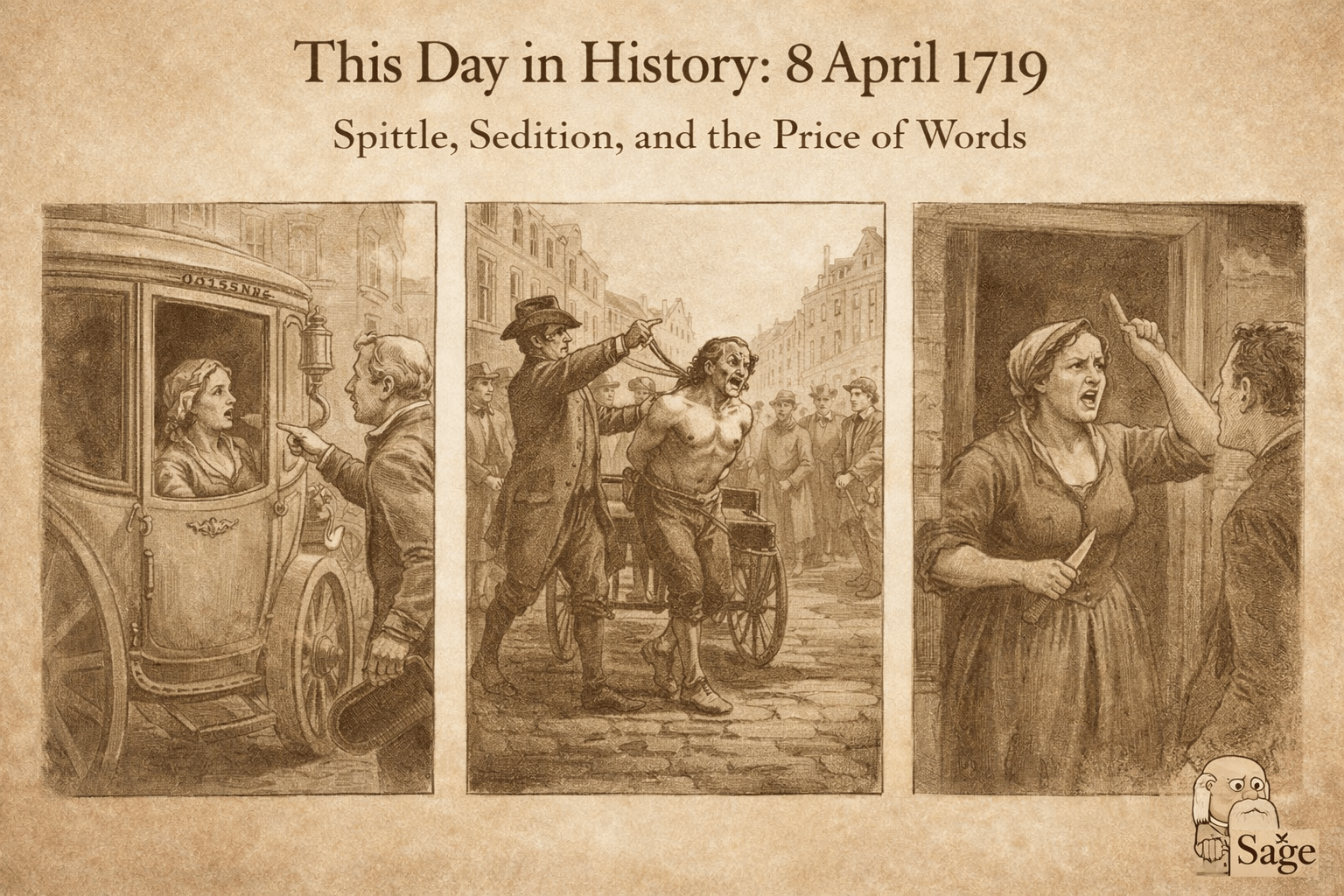
Spittle, Sedition, and the Price of Words
An Insult to a Princess
In April 1719, London witnessed not one, but two striking reminders of how seriously the Crown took both actions and words.
The first was brief, brazen, and unforgettable.
A man named Augustine Moore, a chairman by trade, encountered Her Royal Highness the Princess of Wales—and did something extraordinary.
He spat at her.
And as if that were not enough, he declared:
“She is no Princess… you may make as good a Princess of a cobbler’s wife.”
He went further still:
“King George is an usurper, and has no business here.”
There was no misunderstanding.
No retraction.
No defence.
A Swift and Public Justice
Moore did not contest the charge.
He pleaded:
👉 Guilty
The sentence reflected both the insult and its target:
- Public whipping from Somerset House to the Haymarket
- Three years imprisonment
This was not merely punishment—
It was spectacle.
A reminder that contempt for royalty would be answered not quietly, but visibly.
A Woman Who Would Not Recant
If Moore’s offence was sudden and shocking, Margaret Hicks offered something different:
👉 Persistence.
👉 Defiance.
👉 Repetition.
Witnesses testified that she openly declared:
“God curse King George.”
When challenged, she doubled down:
“G— d d— n King George, and you too.”
And when told she risked hanging?
Her reply was remarkable:
She “had rather be hang’d for that than anything else.”
The Morning After
Perhaps most damning of all—
She did not blame drink.
When confronted the next morning and asked if she remembered her words, she calmly repeated them.
This was no drunken slip.
It was conviction.
Or, at the very least—
Stubbornness elevated to principle.
Threat Turns to Treason
Hicks went further still.
Knife in hand, she declared:
If she had a man’s heart’s blood, she would “stick him.”
And chillingly:
“The first time King George came by the door she would stick him.”
At this point, words alone became something else.
👉 Threat
👉 Intent
👉 Sedition edged toward violence
The Verdict
Like Moore, Hicks had little defence beyond denial.
The evidence was clear.
The jury returned:
👉 GUILTY
Her sentence:
- 40 shillings fine
- Six months imprisonment
Less severe than Moore’s—
But still a clear warning.
Why This Case Matters
These two cases, heard on the same day, reveal something essential about early 18th-century justice:
👉 The Crown did not distinguish lightly between word and deed
- A spit could be treasonous
- A sentence spoken aloud could be criminal
- A threat could be treated as action
Yet there is also a contrast:
- Moore’s act was physical—and punished publicly
- Hicks’ offence was verbal—but persisted, repeated, and sharpened into danger
Together, they show a world in which loyalty was expected not only in action—
But in speech.
And where even the smallest defiance, once voiced aloud, might carry a very real cost.
Thank you for reading my writings. If you’d like to, you can buy me a coffee for just £1 and I will think of you while writing my next post! Just hit the link below…. (thanks in advance)

 The Sage Page