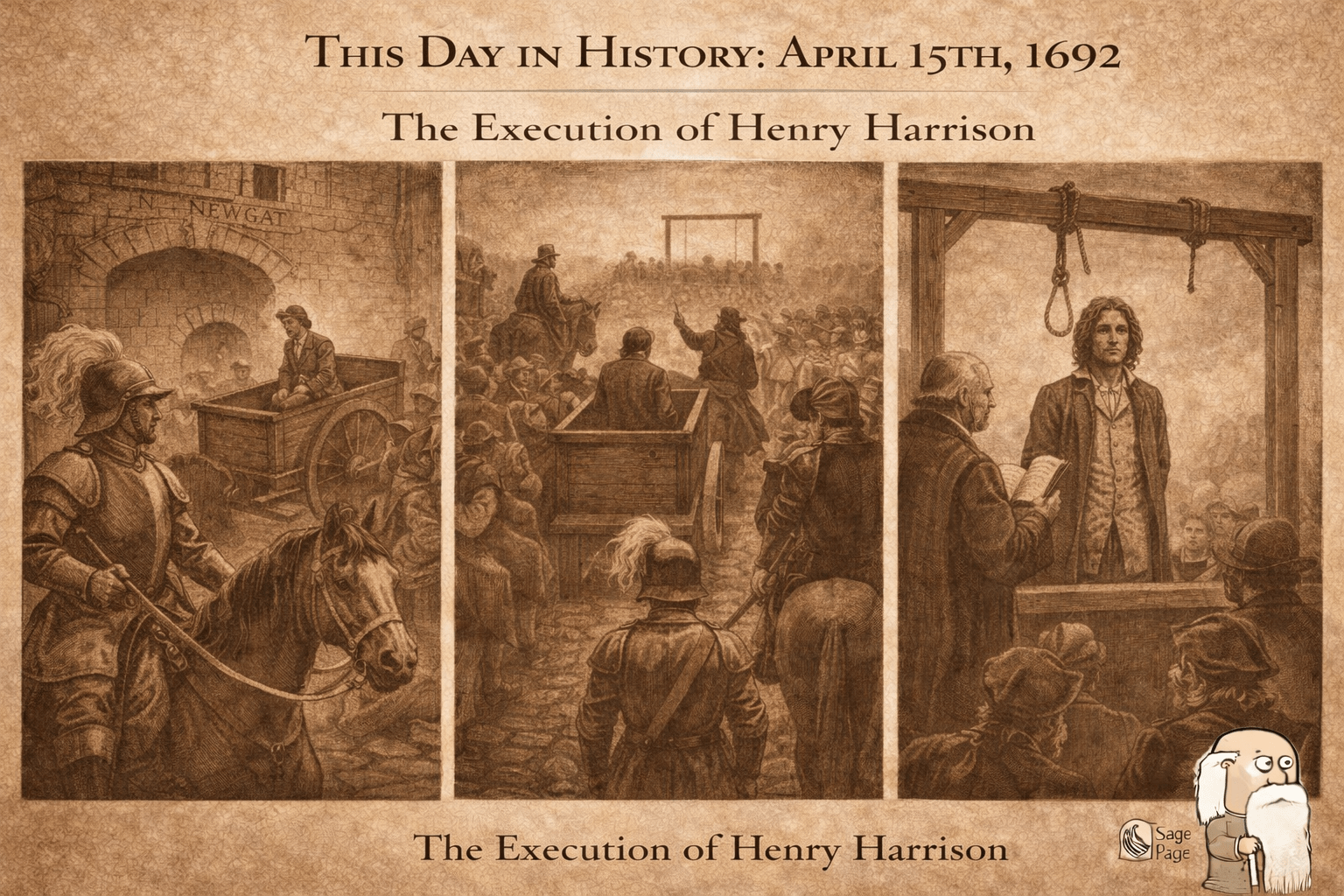
“The Execution of Henry Harrison”
On a cold April morning in 1692, Henry Harrison was led from Newgate to the gallows—his fate sealed by a case that combined murder, deception, and a motive rooted in money.
At the centre of it all was a respected physician:
Dr. Nicholas Clench.
The Murder of Dr Clench
Dr Clench was a well-known London physician—a man of standing, wealth, and reputation.
His death was sudden.
His body was discovered under deeply suspicious circumstances, and almost immediately, attention turned toward Harrison.
Why?
Because Harrison had been in direct contact with him shortly before his death.
The Motive: Money and Trust
The case quickly revealed a powerful motive.
Harrison was believed to have gained access to Dr Clench under false pretences, luring him into a situation where he could be robbed.
This was no random act.
It appeared planned.
Dr Clench, a man of means, had been targeted—and after his death, suspicion fell heavily on Harrison as someone who had both opportunity and intent.
The Evidence Against Him
At the Old Bailey trial on 6th April 1692, the prosecution laid out a case built on:
- Harrison’s association with Dr Clench
- His presence at crucial moments
- And most damaging of all—his inconsistent explanations
Witnesses came forward to contradict him.
His story shifted.
Details changed.
And with each contradiction, the jury’s confidence in him weakened.
A Case of Credibility
In one of the most telling aspects of the trial, Harrison’s own words worked against him.
What he claimed at one moment, he appeared to abandon the next.
In a courtroom without forensic science, this was devastating.
The case became less about proving exactly how Dr Clench died…
…and more about whether Harrison could be believed at all.
🔎 Trial Echo
“He was seen in company with the Doctor, and being questioned thereof, gave such differing Accounts, as rendered him suspected by all that heard him.”
The Verdict
The jury did not hesitate.
Harrison was found:
Guilty.
In the justice system of the time, where reputation and consistency carried enormous weight, his failure to present a coherent defence proved fatal.
Newgate and the Final Days
Awaiting execution in Newgate Prison, Harrison came under the care of the Ordinary of Newgate.
He attended prayers.
He listened to instruction.
He appeared, outwardly, to prepare for death.
But crucially—he never delivered a clear, unequivocal confession.
🔎 The Ordinary’s Reflection
“He applied himself to Devotion, yet was not so free in his Confession as might be expected of one under such Circumstances.”
The Execution
On April 15th, 1692, Harrison was taken to the place of execution.
As was customary, he addressed the crowd—but his words did not resolve the lingering uncertainty.
No clear admission.
No final clarity.
Only the end.
A Case That Lingers
The death of Dr Clench was avenged in the eyes of the law.
But the case leaves behind a troubling question:
Was Harrison unquestionably guilty?
Or was he condemned, in part, because he failed to convince?
In an age before modern evidence, the line between the two was dangerously thin.
Why This Case Matters
This case is a powerful example of how justice once operated:
- Motive mattered
- Testimony ruled
- Consistency could decide life or death
Henry Harrison’s fate reminds us that in early modern England, a man could hang not only for what he had done…
…but for how poorly he explained himself.
Thank you for reading my writings. If you’d like to, you can buy me a coffee for just £1 and I will think of you while writing my next post! Just hit the link below…. (thanks in advance)


