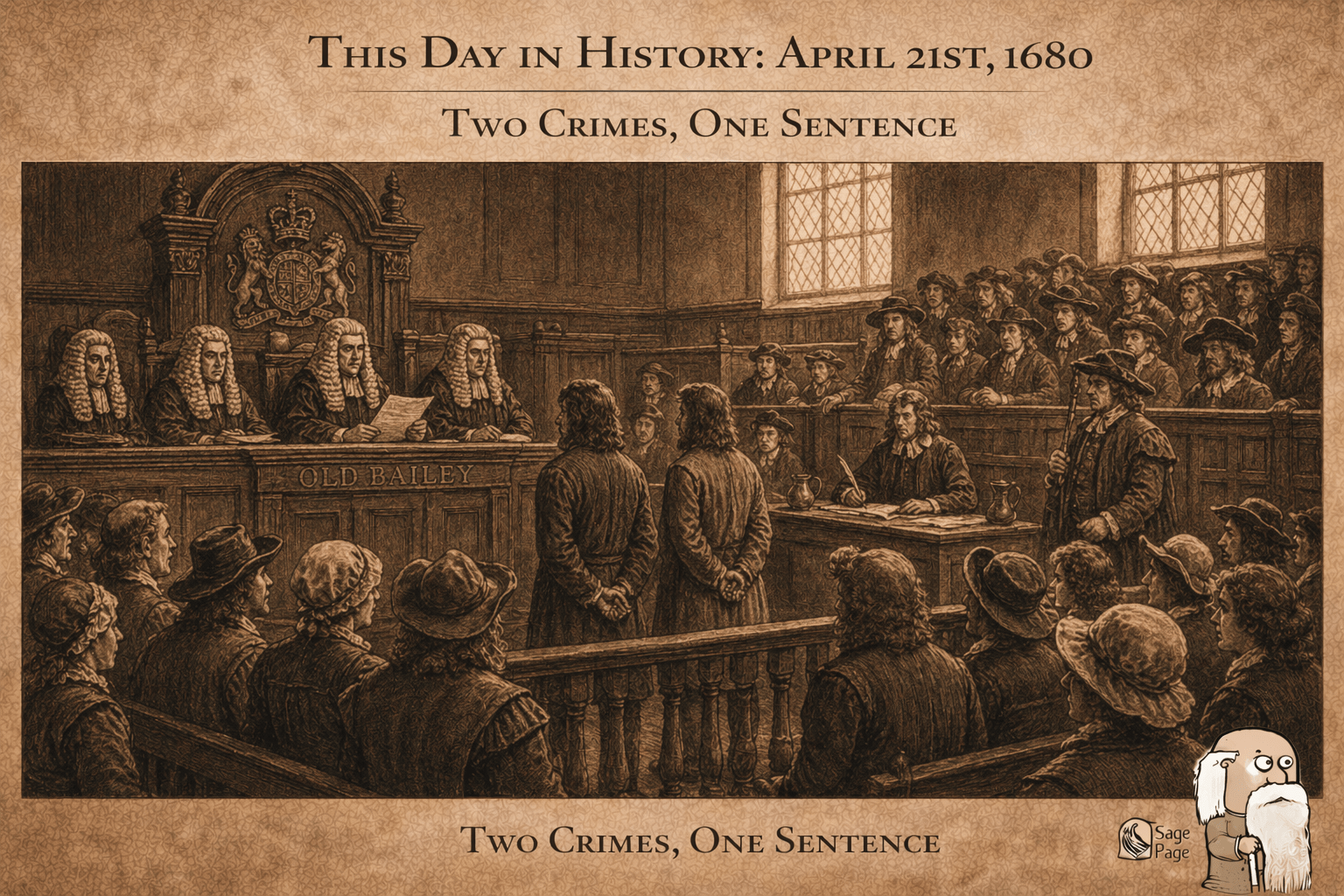
“Jealousy and Cruelty at the Old Bailey”
On this day in 1680, two very different crimes were heard at the Old Bailey—yet both ended in the same grim conclusion:
A sentence of death.
One case spoke of jealousy, rivalry, and fatal confrontation.
The other revealed a crime of shocking cruelty against a child.
Together, they offer a stark reminder of the breadth—and brutality—of early modern justice.
The Killing of John Jacob
The first case concerned Edward Harrison, accused of murdering John Jacob in King Street, Westminster.
What lay behind the violence was not random conflict, but something far more personal.
A Rivalry Turned Deadly
Evidence presented in court revealed a long-standing feud between the two men.
At the heart of it was Jacob’s belief that Harrison had been too familiar with his wife.
This suspicion led to repeated quarrels, threats, and escalating hostility.
According to witnesses:
- Harrison had previously lain in wait for Jacob
- He had attacked him on earlier occasions
- And had openly threatened to end his life—or lose his own
The situation had been building for some time.
The Final Encounter
On the night in question, tensions reached their breaking point.
After another incident involving Jacob’s wife—one that deeply angered him—Jacob reportedly vowed revenge.
Later that evening, at around ten o’clock, the two men met.
What followed was a violent confrontation.
A Fight to the Death
Harrison claimed that Jacob drew first, attacking him with his sword.
Forced to retreat into his own house, Harrison was pursued.
With no further room to escape, he drew his weapon and defended himself.
In the struggle that followed, Jacob received two deep wounds to the chest, each described as mortal, and fell dead at Harrison’s feet.
The Verdict
Despite the history of threats and the apparent aggression of the deceased, the jury reached a measured conclusion:
Guilty of manslaughter.
Even so, in the harsh legal climate of the time, this still carried the ultimate penalty.
🔎 Trial Echo
“Two mortal wounds on the breast… made him fall breathless at his feet.”
A Crime of Unspeakable Cruelty
The second case, tried at the same sitting, was of an entirely different—and far more disturbing—nature.
William Harding stood accused of the rape of a young girl, Sarah Southy, aged just seven or eight.
Lured and Attacked
Harding was said to have lured the child into a dark cellar with the promise of apples.
Once there, he committed what the court described as a “detestable villainy.”
The evidence revealed that the child had suffered severe harm.
For some time, she remained silent—fearful of punishment from her mother.
The Truth Revealed
Eventually, the extent of her suffering forced her to speak.
Her mother, upon learning what had happened, immediately sought medical assistance.
Surgeons examined the child and concluded that she had indeed been violently assaulted. She had also (tragically) contracted the venereal disease.
Her own account confirmed the attack.
A Pattern of Depravity
Further testimony painted a deeply troubling picture of Harding’s character.
Witnesses described him as:
- A habitual offender
- Engaged in acts of extreme moral corruption
- And suffering from a venereal disease, the symptoms of which were observed upon examination
The case left little room for doubt.
The Verdict
The jury found Harding:
Guilty of rape.
Like Harrison, he too was sentenced to death.
Justice in 1680
These two cases, heard side by side, reveal the stark realities of justice in the late 17th century:
- Violence born of jealousy
- Crimes of calculated cruelty
- And a legal system that dealt with both in the same final way
Though the circumstances differed greatly, both men stood before the same court…
and faced the same end.
Why This Day Matters
April 21st, 1680, serves as a sobering reflection on:
- The consequences of unchecked anger and suspicion
- The vulnerability of the young and powerless
- And the severity of early modern punishment
It is a day that shows both the human causes of crime…
and the unyielding nature of justice in the Old Bailey.
Thank you for reading my writings. If you’d like to, you can buy me a coffee for just £1 and I will think of you while writing my next post! Just hit the link below…. (thanks in advance)


