A Tavern Quarrel Turned Deadly
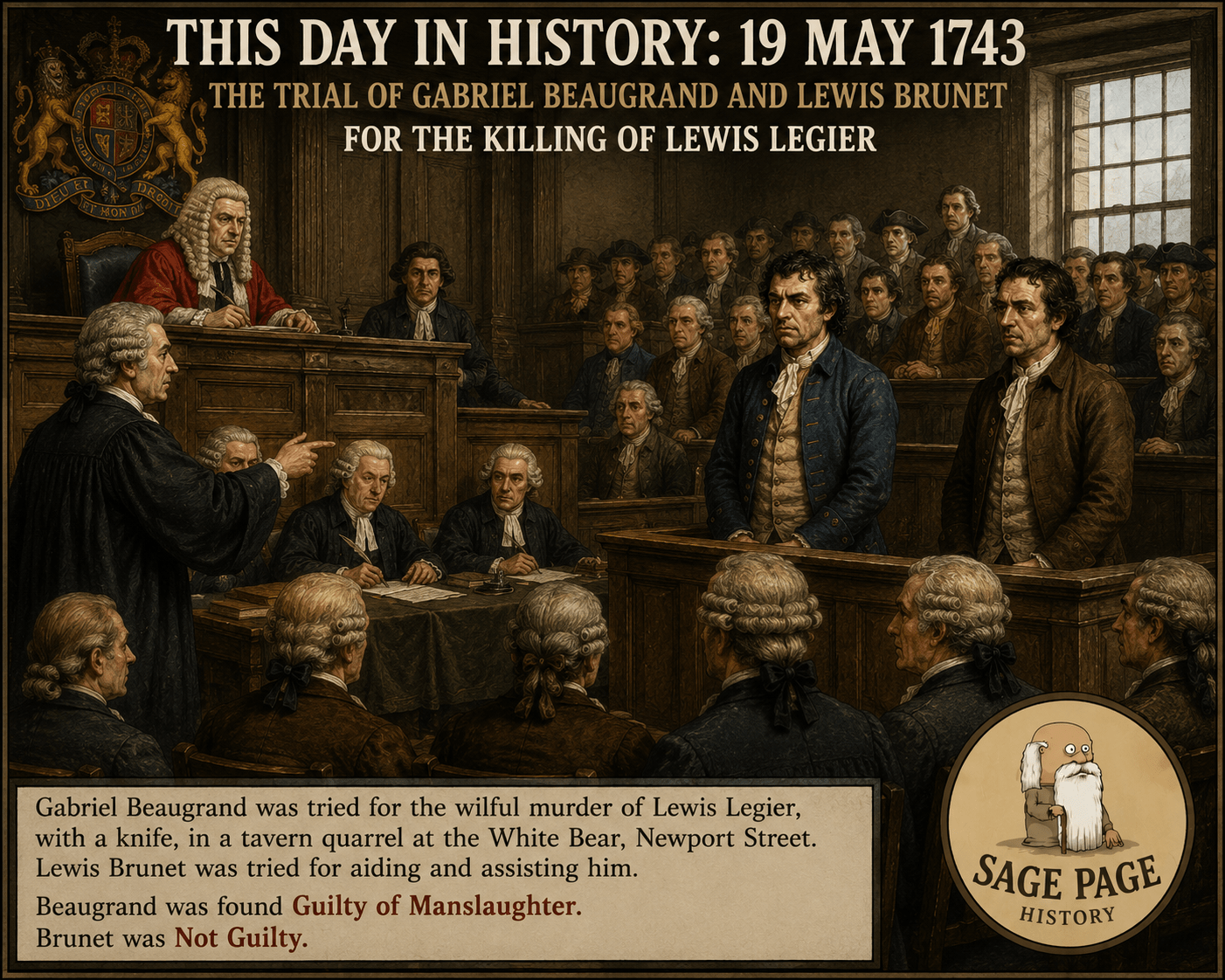
On 19 May 1743, Gabriel Beaugrand and Lewis Brunet stood trial at the Old Bailey for the killing of Lewis Legier, a cook who had, only hours before his death, been drinking and talking amicably in a London tavern.
What began as a trivial dispute over status at sea—sailor versus cook—ended in fatal violence.
“Brother Sailors”… Until They Weren’t
The encounter took place at the White Bear public house in Newport Street.
At first, the mood was friendly. Legier, who had served as a cook aboard a naval vessel, greeted Beaugrand warmly, calling him:
“Brother Sailor”
They spoke of ships, service, and life at sea. But the conversation turned competitive—then hostile.
The argument centred on a seemingly petty question:
- Who held greater status aboard ship: a sailor or a cook?
Beaugrand insisted that a sailor outranked a cook.
Legier, with some pride, disagreed.
From there, matters escalated quickly.
The First Blow
According to witnesses, Beaugrand:
- took up a pewter pot
- attempted to strike Legier
Legier responded immediately:
- pulling Beaugrand across the table
- striking him repeatedly with the same pot
By the time others intervened, Beaugrand’s head was badly wounded, bleeding heavily.
It might have ended there—a drunken brawl, nothing more.
But it did not.
The Fatal Moment
After the initial fight:
- tensions remained high
- Beaugrand withdrew briefly
- Brunet (his uncle) became involved in the dispute
Then, in a sudden and decisive moment, Beaugrand returned to Legier and struck him again—this time with a knife.
Witnesses did not clearly see the weapon, but the effect was immediate.
Legier cried out:
“I am dead”
He collapsed soon after.
The Surgeon’s Findings
The medical evidence confirmed the severity of the attack:
- three stab wounds
- one penetrating the liver and major blood vessels
- another reaching the lungs
The surgeon concluded that the wound to the liver caused instant death.
What had seemed, moments earlier, a tavern scuffle had become a killing.
Brunet’s Role
Lewis Brunet, Beaugrand’s uncle, was accused of:
- aiding
- encouraging
- continuing the fight
He had attempted to re-engage Legier during the altercation and was seen behaving aggressively even after the stabbing.
However, the court ultimately found insufficient evidence that he had participated in the fatal act itself.
Brunet was acquitted.
Verdict and Punishment
The jury reached a nuanced conclusion:
- Gabriel Beaugrand → Guilty of Manslaughter
- Lewis Brunet → Not Guilty
Rather than execution, Beaugrand received the traditional punishment:
Burnt in the Hand
This was a branding—literally marking him as a convicted felon, but sparing his life.
A Sudden Descent
This case stands as a classic example of how quickly violence could spiral in 18th-century London:
- a friendly meeting
- a petty dispute
- drink, pride, and insult
- then, in seconds, irreversible action
No long-standing feud.
No premeditated design.
Just a moment’s escalation—with fatal consequences.
Final Reflection
The law recognised the difference between murder and sudden passion.
Beaugrand was spared the gallows—but not punishment, nor the mark of his crime.
And for Lewis Legier, a man who entered the tavern as a “brother sailor,”
there was no second chance.
Thank you for reading my writings. If you’d like to, you can buy me a coffee for just £1 and I will think of you while writing my next post! Just hit the link below…. (thanks in advance)

 The Sage Page