
This Day in History: February 20th

Here are 10 historical events that took place on February 20th, listed in chronological order:

  1. 1792: The Postal Service Act, establishing the United States Post Office Department, was signed by President George Washington.
  2. 1831: The French Foreign Legion was established by King Louis Philippe to support his war in Algeria.
  3. 1872: The Metropolitan Museum of Art opened in New York City.
  4. 1933: The U.S. Congress passed the 20th Amendment to the Constitution, establishing the beginning and ending of the terms of the president and Congress.
  5. 1962: John Glenn became the first American to orbit the Earth as he flew aboard the Friendship 7 spacecraft during the Mercury-Atlas 6 mission.
  6. 1986: The Soviet Union launched the space station Mir into orbit.
  7. 2003: A fire broke out at The Station nightclub in Rhode Island during a performance by the band Great White, resulting in 100 deaths and over 200 injuries.
  8. 2014: The Ukrainian revolution culminated in the ousting of President Viktor Yanukovych.
  9. 2015: Leonard Nimoy, known for his role as Spock in Star Trek, passed away at the age of 83.
  10. 2020: The first death from COVID-19 in Italy occurred, marking a significant milestone in the global spread of the pandemic.

These events span various domains, including politics, arts, science, and tragic incidents, reflecting the diverse nature of historical occurrences on February 20th.

Thank you for reading my writings. If you’d like to, you can buy me a coffee for just £1 and I will think of you while writing my next post! Just hit the link below…. (thanks in advance)

Quote of the Day: Humility

“The greatest gift from you to me, is for you to teach me humility.”

Eric Shinn

Eric Shinn (Born September 12, 1975, in Charleston, West Virginia) is an American author, philosopher, and motivational speaker known for his contributions to the realms of self-help and personal development.

Early Life and Education

Eric Shinn was born to Margaret and Richard Shinn in Charleston, West Virginia. Raised in a modest household, he displayed an early interest in literature and philosophy. Shinn pursued his academic endeavors at Harvard University, where he earned a Bachelor of Arts in Philosophy. Following his undergraduate studies, he furthered his education at Stanford University, obtaining a Master’s degree in Positive Psychology.

Literary Career

Shinn embarked on his literary journey in the early 2000s, gaining recognition for his thought-provoking essays and motivational writings. His breakthrough came with the release of his debut book, “Journey to Humility,” published in 2005. The book explored Shinn’s personal experiences and philosophical insights, offering readers a guide to self-discovery and humility.

Philosophical Contributions

Eric Shinn’s work delves into the importance of humility as a transformative force in one’s life. He emphasizes the idea that embracing humility is not a sign of weakness but a powerful tool for personal growth and understanding. Shinn believes that true wisdom is found in acknowledging one’s limitations and learning from life’s challenges.

The Quote and Its Meaning

“The greatest gift from you to me is for you to teach me humility” encapsulates Shinn’s core philosophy. In positive terms, Shinn suggests that the act of teaching humility is a profound gift, fostering self-awareness and empathy. He encourages individuals to recognize the valuable lessons that humility imparts, creating a foundation for personal development and harmonious relationships.

Shinn’s writings and lectures have resonated with a wide audience seeking guidance in navigating the complexities of modern life. His unique blend of personal anecdotes, philosophical insights, and practical advice has earned him a dedicated following, and he continues to inspire others on their journeys toward self-discovery and humility.

Thank you for reading my writings. If you’d like to, you can buy me a coffee for just £1 and I will think of you while writing my next post! Just hit the link below…. (thanks in advance)

Thought of the Day: Poison

If poison expires, is it more poisonous, or no longer poisonous?

In general, the expiration date on a product, including poisonous substances, indicates the point beyond which the manufacturer cannot guarantee the product’s effectiveness, safety, or stability. It does not necessarily mean that the substance becomes more poisonous after the expiration date.

However, the stability of chemicals in a poisonous substance can change over time. For example, the potency or effectiveness of a poison might degrade, making it less potent than intended. Alternatively, some substances might break down into other compounds that could potentially be more harmful or less predictable.

Thank you for reading my writings. If you’d like to, you can buy me a coffee for just £1 and I will think of you while writing my next post! Just hit the link below…. (thanks in advance)

This Day in History: February 19th

Here is a list of 10 historical events that took place on February 19th, listed in chronological order:

  1. 1600: Philosopher Giordano Bruno is burned at the stake for heresy in Rome.
  2. 1807: Former U.S. Vice President Aaron Burr is arrested for treason in Wakefield, Alabama.
  3. 1846: The formal transfer of government between Texas and the United States takes place.
  4. 1878: Thomas Edison patents the phonograph.
  5. 1942: Japanese forces invade the island of Bali during World War II.
  6. 1945: U.S. Marines land on the island of Iwo Jima during World War II.
  7. 1986: The Soviet Union launches the space station Mir into orbit.
  8. 2002: NASA’s Mars Odyssey spacecraft begins mapping the surface of Mars.
  9. 2011: WikiLeaks founder Julian Assange is granted bail by the UK Supreme Court.
  10. 2018: A gunman opens fire at Marjory Stoneman Douglas High School in Parkland, Florida, resulting in 17 fatalities.

Thank you for reading my writings. If you’d like to, you can buy me a coffee for just £1 and I will think of you while writing my next post! Just hit the link below…. (thanks in advance)
Quote of the Day: Innocence

“Memorize the scent of innocence”

Hugh Morris


Hugh Morris (Hugh Anthony Morris; born November 8, 1960) is a British author and philosopher celebrated for his unique insights into the human experience. Born in the historic city of Bath, Somerset, Morris’s early life was marked by a deep connection with nature and an innate fascination with the sensory nuances of the world around him.

Educated at the University of Oxford, Morris delved into the study of philosophy, literature, and psychology, earning his degree in 1982. His academic pursuits were informed by a keen interest in exploring the intricacies of human perception and the profound impact of sensory experiences on memory and consciousness.

Morris’s early career was characterized by a diverse range of occupations, including stints as a nature guide, aromatherapist, and poetry workshop facilitator. These eclectic experiences provided him with a rich tapestry of sensory encounters, influencing his philosophical outlook and literary endeavors.

In 1990, Morris published his debut book, “Sensory Symphony,” a collection of essays and reflections that explored the interplay between human senses and memory. The work gained recognition for its poetic prose and Morris’s ability to articulate the profound impact of sensory experiences on one’s understanding of the world.

One of Hugh Morris’s most notable and often quoted passages is: “Memorize the scent of innocence.” This evocative statement reflects Morris’s belief in the power of sensory impressions to shape and preserve moments of purity and unspoiled beauty in one’s memory.

Morris’s subsequent literary works, including “Essence of Eternity” (1995) and “Scented Echoes” (2002), continued to delve into the theme of sensory perception and its influence on human consciousness. His writings garnered acclaim for their ability to transport readers into a realm where the senses played a central role in shaping the emotional and philosophical landscapes of his narratives.

Beyond his literary pursuits, Hugh Morris became a sought-after speaker on topics related to sensory perception, memory, and the philosophy of innocence. His lectures and workshops encouraged audiences to appreciate the richness of their sensory experiences and the profound impact these experiences can have on personal growth and understanding.

As of the latest available information, Hugh Morris remains an influential figure in the literary and philosophical realms, continuing to explore the profound connections between the senses, memory, and the essence of innocence in the human experience.

Thank you for reading my writings. If you’d like to, you can buy me a coffee for just £1 and I will think of you while writing my next post! Just hit the link below…. (thanks in advance)
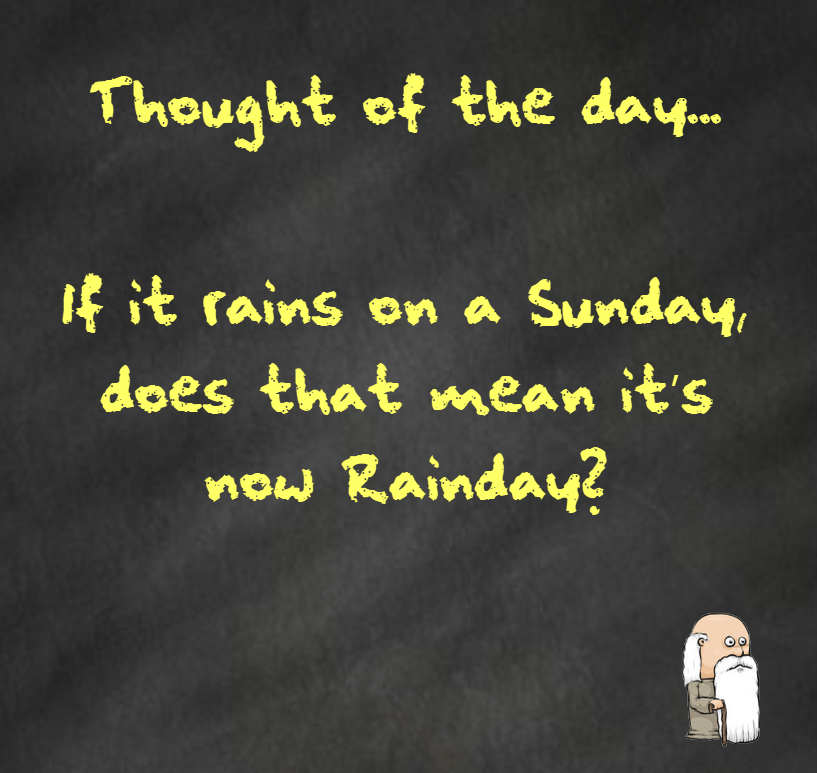
Thought of the Day: Sunday

If it rains on Sunday, does that mean it’s now Rainday?


The term “Rainday” is not a commonly recognized designation for a day on which it rains. In general, days of the week are not typically renamed based on specific weather conditions. However, some people may playfully use terms like “Rainy Sunday” to describe a day with precipitation. The traditional names of days of the week, such as Sunday, are not altered based on weather patterns.

The name “Sunday” has its origins in Old English and is derived from the word “Sun’s day.” In Old English, the day was known as “Sunnandæg,” which literally means “day of the sun.” This naming convention was influenced by Germanic and Norse mythology, where the sun was associated with the Norse sun goddess Sol.

The seven-day week, including Sunday, was widely adopted by various cultures and religions over time. In Roman tradition, Sunday was associated with the Sun god, Sol Invictus. As Christianity spread, Sunday took on additional significance as the day of rest and worship, in commemoration of the resurrection of Jesus Christ on the first day of the week. In many languages, the name for Sunday is derived from the Latin phrase “dies Solis,” meaning “day of the sun.”

Overall, the name Sunday reflects the historical and cultural connections between different civilizations, celestial bodies, and religious traditions.

Thank you for reading my writings. If you’d like to, you can buy me a coffee for just £1 and I will think of you while writing my next post! Just hit the link below…. (thanks in advance)

This Day in History: February 18th

Here is a list of 10 historical events that took place on February 18th, listed in chronological order:

  1. 3102 BCE: According to the Indian astronomical calculations, the Kali Yuga, or the age of darkness, is believed to have started on February 18, 3102 BCE, according to the Surya Siddhanta.
  2. 1564: Michelangelo Buonarroti, the Italian Renaissance sculptor, painter, and architect, passed away in Rome at the age of 88.
  3. 1685: Fort St. Louis in Texas is established by René-Robert Cavelier, Sieur de La Salle.
  4. 1745: The city of Surakarta, also known as Solo, in Java, Indonesia is founded.
  5. 1885: Mark Twain’s “Adventures of Huckleberry Finn” is published in the United States.
  6. 1930: Elm Farm Ollie becomes the first cow to fly in a fixed-wing aircraft and also the first cow to be milked in an airplane.
  7. 1970: The Chicago Seven defendants are found not guilty of conspiring to incite riots during the 1968 Democratic National Convention.
  8. 2001: FBI agent Robert Hanssen is arrested for spying for the Soviet Union. He would later plead guilty and be sentenced to life in prison.
  9. 2001: Dale Earnhardt, the legendary NASCAR driver, dies in a crash during the Daytona 500 in Florida.
  10. 2018: Nikolas Cruz opens fire at Marjory Stoneman Douglas High School in Parkland, Florida, killing 17 people and injuring numerous others in one of the deadliest school shootings in U.S. history.

Thank you for reading my writings. If you’d like to, you can buy me a coffee for just £1 and I will think of you while writing my next post! Just hit the link below…. (thanks in advance)

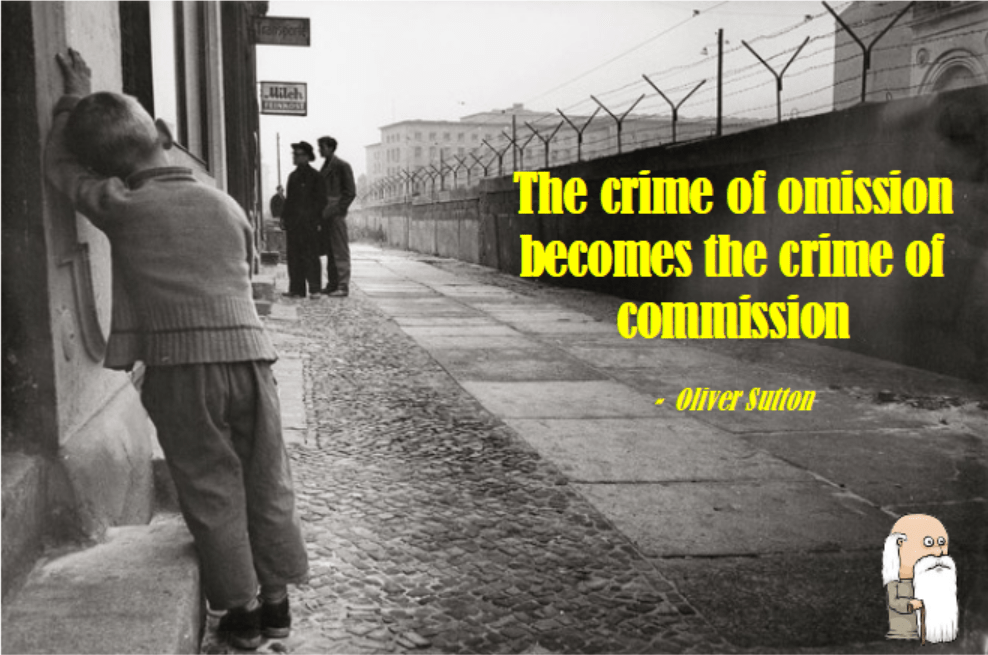
Quote of the Day: Crime

“The crime of omission becomes the crime of commission”

Oliver Sutton

Oliver Sutton (Oliver James Sutton; born September 5, 1955) is a British author and philosopher, renowned for his insightful contributions to literature and ethical discourse. Born in the picturesque town of Salisbury, Wiltshire, Sutton’s upbringing was marked by a combination of intellectual curiosity and a profound appreciation for the nuances of human morality.

Sutton’s educational journey led him to the University of Oxford, where he pursued a degree in Philosophy and Ethics, graduating in 1978. His academic pursuits laid the groundwork for his later exploration of ethical principles and their impact on human behavior.

After completing his education, Sutton delved into a career as a writer, drawing inspiration from classical philosophy and contemporary ethical dilemmas. His early works, including “Morality in the Modern Age” (1983) and “The Ethical Tapestry” (1987), established him as a thoughtful and contemplative voice in the realm of ethical philosophy.

One of Sutton’s notable quotes, which has become emblematic of his ethical philosophy, is: “The crime of omission becomes the crime of commission.” This thought-provoking statement encapsulates Sutton’s belief in the moral responsibility individuals bear for their actions, as well as the consequences of failing to act when morally obligated.

Throughout his career, Sutton has advocated for a nuanced understanding of morality, emphasizing the interconnectedness of actions and their ethical implications. His writings delve into the complexities of human decision-making and the ethical considerations that permeate various facets of life.

Sutton’s work is characterized by a commitment to fostering a more ethical and compassionate society. His philosophical explorations have resonated with a diverse audience, from academics to general readers seeking a deeper understanding of the moral fabric that shapes human interactions.

As a respected figure in the field of ethics, Sutton has also lectured at universities and participated in public discussions on ethical issues. His ability to bridge the gap between academic philosophy and accessible discourse has contributed to his influence in both scholarly and everyday spheres.

As of the latest information available, Oliver Sutton continues to engage with ethical philosophy, contributing to ongoing conversations about morality and ethical decision-making. His legacy remains firmly established in the literary and philosophical landscape, inspiring individuals to reflect on the ethical dimensions of their actions and the interconnectedness of moral responsibility.

Thank you for reading my writings. If you’d like to, you can buy me a coffee for just £1 and I will think of you while writing my next post! Just hit the link below…. (thanks in advance)

Thought of the Day: Deliveries

Why are deliveries on a ship called “cargo”, but in a car, it’s called a shipment?”

The terms “cargo” and “shipment” are both used to refer to goods or commodities being transported, but the choice of term often depends on the mode of transportation and historical conventions rather than a strict linguistic rule.

  1. Cargo on a Ship:
    • The term “cargo” is commonly associated with goods transported on a ship. Historically, the maritime industry has used the term “cargo” to describe the goods carried by a vessel. The usage of “cargo” in the context of shipping has deep historical roots and has become widely accepted in the maritime and logistics industries.
  2. Shipment in a Car:
    • When goods are transported in a car or any other land-based vehicle, the term “shipment” is often used. This terminology is more general and is commonly used across various modes of land transportation, including trucks and trains. The use of “shipment” in this context may be influenced by the broader nature of land transportation, which involves various modes and vehicles.

In essence, the choice between “cargo” and “shipment” is influenced by traditional usage within specific industries and modes of transportation. While the terms are often interchangeable in casual conversation, they have become associated with certain modes of transport based on historical conventions and industry practices.

Thank you for reading my writings. If you’d like to, you can buy me a coffee for just £1 and I will think of you while writing my next post! Just hit the link below…. (thanks in advance)

This Day in History: February 16th

Here is a list of 10 historical events that took place on February 16th, listed in chronological order:

  1. 600: Pope Gregory the Great decree on saying “God bless You” after a sneeze.
  2. 1741: Benjamin Franklin’s General Magazine (2nd US magazine) begins publishing.
  3. 1804: 1st self-propelled locomotive on rails demonstrated, in Wales.
  4. 1868: Benevolent and Protective Order of Elks forms (New York, NY).
  5. 1918: Lithuania proclaims its independence from Russia.
  6. 1923: Archaeologist Howard Carter unseals the burial chamber of Pharaoh Tutankhamun.
  7. 1959: Fidel Castro becomes Premier of Cuba after dictator Fulgencio Batista flees.
  8. 1968: In Haleyville, Alabama, the first 9-1-1 emergency telephone system goes into service.
  9. 1987: The trial of John Demjanjuk, accused of being a Nazi guard dubbed “Ivan the Terrible,” begins in Jerusalem.
  10. 2005: The Kyoto Protocol comes into force, regulating greenhouse gases for the first time.

Thank you for reading my writings. If you’d like to, you can buy me a coffee for just £1 and I will think of you while writing my next post! Just hit the link below…. (thanks in advance)