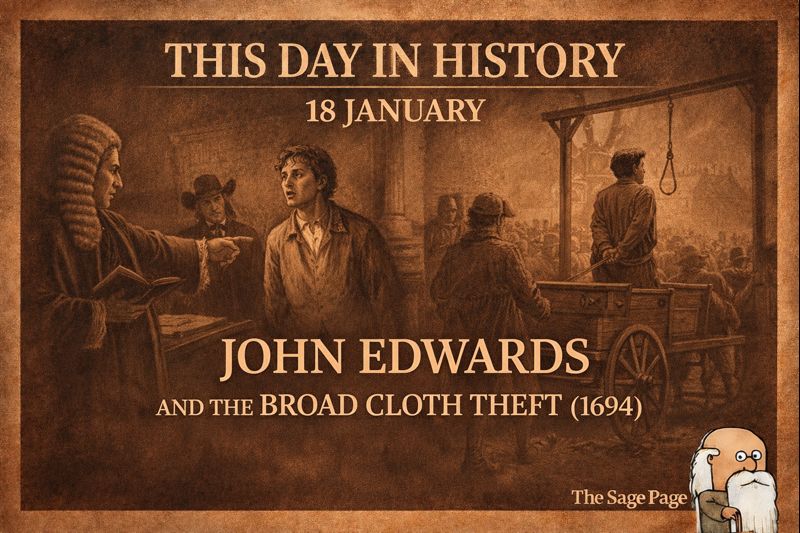
On 18 January 1694, a tradesman named John Edwards, a plasterer of Aldgate Parish, took part in a theft that would ultimately cost him his life.
Alongside others, Edwards was indicted for felony, accused of stealing forty yards of white broad cloth belonging to John Evans. Broad cloth was among the most valuable textiles of the period, used for coats and outer garments, and its theft was treated as a serious crime.
The offence
The indictment stated that the cloth was stolen on 18 January. When brought before the court, Edwards did not deny his involvement. His defence was limited and unconvincing.
He claimed that the cloth had been left in his care by one Henry Oxton, who, he said, was “now in Their Majesties Service.” Crucially, Edwards could not prove this claim, nor produce any witness to support it.
The court was unconvinced.
His co-accused — J– S– and Richard Colehampton — were found not guilty. Edwards alone bore the full weight of the charge.
Verdict
The jury found John Edwards guilty of felony.
In the legal climate of the 1690s, theft of valuable cloth crossed the threshold into capital crime. Edwards was condemned to die.
Awaiting death
Following sentence, Edwards was held in Newgate Prison, where he was visited repeatedly by the Ordinary of Newgate, whose duty was to prepare the condemned for death.
The Ordinary’s published account provides a rare and intimate glimpse into Edwards’ final weeks.
Edwards was 25 years old, and by trade a plasterer. He openly confessed:
“He denied not that he joined with others in stealing broad cloth, and that he had 25 shillings of the money for which it was sold.”
When asked why he wept, Edwards replied:
“For his sins.”
He told the Ordinary that he now hated sin more than he had loved it, and declared that if his life were spared, he would return to his honest trade and never again commit an unlawful act.
Execution at Tyburn
There would be no reprieve.
On Wednesday 28 February 1694, John Edwards was taken from Newgate to Tyburn, along with six other condemned men. Before execution, he prayed, acknowledged God’s justice, and showed visible penitence.
The Ordinary recorded that Edwards:
- Wept greatly
- Acknowledged the justice of his punishment
- Died penitently
After prayers were concluded, the cart drew away, and Edwards was executed.
Why this case matters
John Edwards’ story illustrates the brutal certainty of late-seventeenth-century justice:
- Theft of valuable goods could still mean death
- Only one participant needed to be convicted for the sentence to fall
- Expressions of repentance did not mitigate punishment, only shaped how death was recorded
It also shows how Old Bailey cases did not end at verdict. Through the Ordinary’s Accounts, we can trace the condemned from crime, to confession, to scaffold — a rare continuity in early modern criminal history.
For John Edwards, 18 January 1694 marked the beginning of the end.
Sources
- John Edwards et al., Old Bailey Proceedings, offence dated 18 January 1694, case ref t16940221-14
- A True Account of the Behaviour, Confession, and Last Dying Speeches…, Ordinary of Newgate, executions at Tyburn, 28 February 1694 (OA16940228)
Thank you for reading my writings. If you’d like to, you can buy me a coffee for just £1 and I will think of you while writing my next post! Just hit the link below…. (thanks in advance)

 The Sage Page