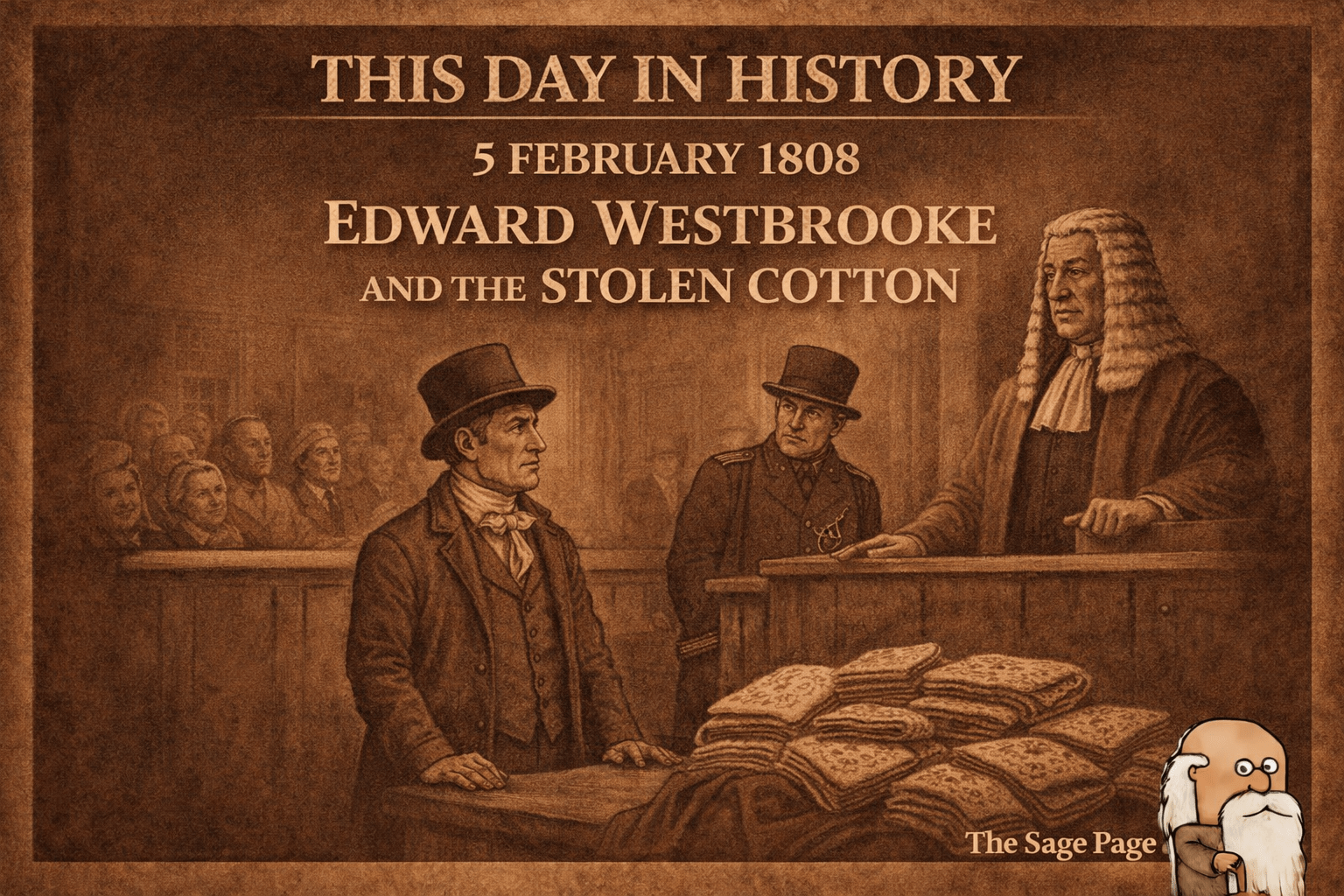
On 5 February 1808, London’s highest criminal court, the Old Bailey, heard the case of Edward Westbrooke, who stood accused of stealing hundreds of printed cotton handkerchiefs and other textiles — goods of considerable value in the commercial heart of Georgian England. His trial, conviction and ultimate fate reveal much about how property, punishment and mercy operated in the early nineteenth century.
The Alleged Theft
Westbrooke was indicted for feloniously taking:
- Three hundred dozen printed cotton handkerchiefs
- A wrapper
- Other textile goods
These were worth a significant sum and were described in the indictment as the property of local merchants. Cotton textiles were central to Britain’s burgeoning trade economy, traded in bulk and regarded as commodities of real worth.
The Trial at the Old Bailey
On 17 February 1808, Westbrooke’s trial began at the Old Bailey. Prosecutors produced testimony identifying the stolen goods, while defence arguments — if any were recorded — failed to sway the jury.
The judge and jurors, stern in posture and deliberate in their duty, considered whether the evidence met the standards of the day. With property crime seen as a threat to economic order, juries were often unsympathetic unless doubt was overwhelming.
Here is the actual trial transcript:
EDWARD WESTBROOKE was indicted for feloniously stealing on the 5th of February , three hundred dozen of printed cotton handkerchiefs, value 40 l. and a wrapper, value 6 d. the property of James Hartwell and William Behman , in the dwelling house of James Hartwell .
JAMES HARTWELL . My partner’s name is William Behman ; we are warehousemen ; I have no other partner.
Q. In what parish is the house in which you carry on your business. – A. In St. Stephens, Walbrook ; I inhabit the house, and sleep there; Mr. Behman lives in Hackney-road.
Q. He only comes in the house for the purpose of business. – A.Just so.
Q Did you at any time lose a truss containing three hundred dozen of printed cotton handkerchiefs. – A. Yes, on Friday the 5th of February, between six and seven in the evening, from the house in Walbrook; they were enclosed in a canvas wrapper.
Q.Do you know from what circumstance they were lost. – A. Yes; this truss was delivered at my house, after the warehouse was closed; our warehouse is at this time of the year closed at dusk; this truss was deivered about six o’clock; it was delivered into my dwelling house, but not in the warehouse.
Q. Did you see it in your dwelling house before it was taken away. – A. I did not. About twenty minutes or half after six o’clock, my servant was called to the house door in consequence of a knock; the prisoner at the bar said, I hear that your master wants a porter; in consequence of this my servant came up into the dining room to me and said a man wanted me; he said he heard I wanted a porter; I said it is a mistake, I do not want any porter. When she had got half way down stairs she screamed out, observing the man absent and the truss missing; that moment I run out of the dining room.
Q. Did you catch sight of the prisoner. – A. No; the moment I got out of the street door, I called out stop thief; I ran to the corner of Cannon-street, but did not see any thing particular; finding things quiet, I returned and found a terrible scuffle at that end of Walbrook that comes into Bucklersbury, and as I came gently up I found a man a running very fast indeed, coming towards me, with several others following of him.
Q. Had that man any bundle with him. – A. No. In Walbrook, opposite the end of a court, I secured the prisoner at the bar; he said what do you want with me; I replied you have stolen a truss of mine; and I requested some one or two who were near me to assist me to take him up to my own door; they assisted me in taking him up.
Q. By that means you secured him in your house. – A. Yes. When I got within three yards of my own door, I met my servant whom he asked the question of; she said I will swear that is the man.
Q. That was in his hearing. – A. Yes. The prisoner made no reply; when I got him into the passage of my house, he acknowledged that he was the person that came to enquire about a porter’s place. The moment he was in the passage I desired they would be kind enough to secure the prisoner; I went and found a man coming with the truss at the corner of Buckler’sbury, he said he found the truss on a post; I said where are you going with that truss; he replied, sir, I am going to bring it to you. He delivered it to me. I requested they would keep the prisoner in custody till I got a constable.
Q. You had never seen the truss before. – A. No.
SUSANNAH ABBOTT . Q. Were you servant to Mr. Hartwell on the 5th of February. – A. I was.
Q. Do you know whether he had any truss delivered. – A. On the 5th of February, a little after seven, there came a rap at the door, and the truss was delivered.
Q. Is the man here that delivered the truss. – A. No; the truss was delivered to me; it was left in the passage, and the man went away.
Q. How long after that did you see any other person. A. About a quarter of an hour afterwards there came another knock at the door; the prisoner came in and asked for Mr. Hartwell.
Q. Are you quite sure he is the man. – A. I am quite sure, my lord, he is the man; he asked for Mr. Hartwell by name, he said he was informed he wanted a porter; I told him I did not know, but if he would come in I would enquire of my master, he was in the sitting room.
Q. Where was your master’s sitting room. – A. Above stairs. I went up to my master, and delivered the message that the man sent me with.
Q. At the time that you left the prisoner with the street door in his hand, whereabouts was this truss. – A. It was very near the prisoner.
Q. Was it a large truss. – A. Yes, I delivered the prisoner’s message to my master, and returned down stairs almost immediately, I was not a minute with my master; my master said, he did not want one, he must be misinformed; as I went down I saw the prisoner was gone and the truss, I saw that before I got down stairs by the light of the candle, and the door was left open; I called out for my master before I got to the bottom; I ran into the street calling out stop thief.
Q. Did you get sight of the prisoner. – A. I did not at that moment, a man in the street told me he had gone down the street; another man told me he had told me wrong, he had gone up the street; I returned again towards the Mansion house; I met the prisoner by the church going down the street; he had got rid of the truss and was running down the street; I called out that was the man.
Q. Did you lay hold of him. – A. No, I catched at him but I could not hold him, I followed him; I did not lose sight of him till my master stopped him.
Q. Did you see the truss of goods again. – A. I did, they came into the house again, a strange man brought it in from the corner.
Q. Did that man give you any account how he came by it. – A. No; I have not seen him since.
Q. Do you know it to be the same truss as was there when you went up stairs. – A. I did: my master’s name was on it in large letters.
Q. I suppose that is all you know of it. – A. Yes.
Q. Have you any doubt that he is the man. – A. I am confident that he is the man that came and asked for the porter’s place.
DANIEL LEADBEATER . Q. You are a constable. – A. I am.
Q. Do you know any thing more than taking charge of this man. – A. No farther; I was sent for to take charge of him in company with Cartwright; I searched him and fond nothing about him but a knife; he had an apron about him near in the same way he has got that now.
CARTWRIGHT. I produce the truss; I have had it in my possession ever since.
Jury. What do you suppose it to weigh. – A. Between eighty and ninety pound.
Q. to prosecutor. Is your name upon that truss. – A. Yes, it is the same truss, it contains the same articles as the invoice, and before the lord mayor I had it cut open; I saw the contents, it was such a truss as I expected.
Q. Had you given any intimation that you wanted a porter. – A. No, we have a man that suited us exceeding well; I had no thought of changing.
Q. Who had sent you these goods. – A. Ashton and Shipley, at Manchester.
Q. They are persons that supply you with goods. – A. Yes.
Q. What is the value of the contents of that truss. – A. Forty-pounds; the invoice is forty eight.
Prisoner’s Defence. I was coming down Newgate street, I met with a young fellow, he told me that if I was to apply to Mr. Hartwell he believed that they wanted a porter; I went to Mr. Hartwell’s, to know if they wanted one; the servant went to her master; I stood at the corner of the stairs for an answer and just as the time the maid went up stairs a young fellow took the bale and handed it to another; they ran away, I ran after them calling out stop thief; Mr. Hartwell when he came up to me he knocked me down; he said, that I was the man that was in the entry, while the maid went up stairs to ask if he wanted a porter.
GUILTY – DEATH , aged 24.
[The prisoner was recommended to his Majesty’s mercy by the jury and the prosecutor on account of his youth.]
Second Middlesex jury, before Mr. Common Serjeant.
Sentence, Reprieve and Transportation
The jury returned a guilty verdict. Westbrooke was initially sentenced to death, reflecting the harsh penalties prescribed for felony theft. Yet his sentence came with a recommendation — indicating either mitigating circumstances or judicial mercy.
On 18 May 1808, his execution sentence was respited, sparing his life. Instead, Westbrooke was transported to New South Wales as a convict for a term of seven years, a common alternative to execution during this period.
He arrived in Australia in early 1812, aged about 28, beginning a new — if forced — chapter in the distant colony.
Why This Case Matters
The story of Edward Westbrooke’s trial and transportation highlights:
- The centrality of textile commerce in Georgian London
- The severity of legal penalties for property crime
- How capital sentences were sometimes commuted in favour of transportation
- The global reach of British punishment systems
Westbrooke’s life arc — from accused felon at the Old Bailey to convict in Australia — illustrates how justice, mercy and empire intertwined in the early 1800s.
Sources
- Old Bailey Proceedings Online, 1808 trial of Edward Westbrooke (indictment dated 5 Feb).
- The Digital Panopticon – life record of Edward Westbrooke, including sentencing, respital and transportation history.
Thank you for reading my writings. If you’d like to, you can buy me a coffee for just £1 and I will think of you while writing my next post! Just hit the link below…. (thanks in advance)

 The Sage Page