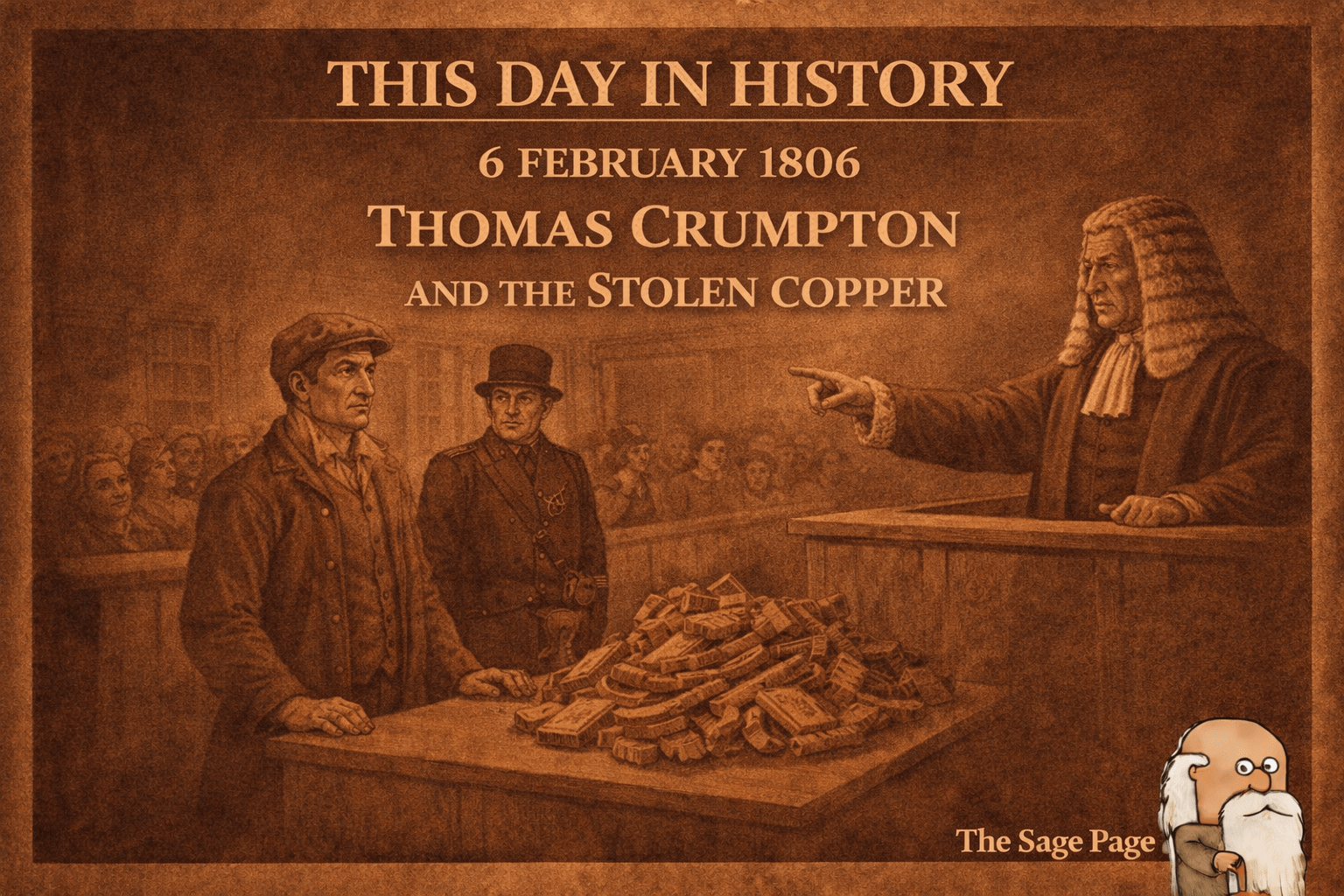
On 6 February 1806, the criminal court at the Old Bailey heard the case of Thomas Crumpton, accused of stealing quantities of copper and metal — materials of everyday importance in an industrialising London. Though modest in value, the case reveals how even small acts of theft were pursued with seriousness under Georgian law.
The Theft
Crumpton was indicted for feloniously stealing:
- Twenty-seven pieces of copper, valued at 18 shillings
- Six pieces of metal, valued at 5 shillings
These materials were not luxury items. Copper was widely used in domestic goods, tools, fixtures, and industrial work, and was routinely stolen for resale or reuse. Even small quantities could be easily converted into ready cash.
How the Matter Arose
According to the trial transcript, the theft was detected when the owner noticed the disappearance of the copper and metal items from their rightful place. Suspicion soon fell upon Crumpton, who was alleged to have taken the goods without consent.
As was typical in such cases, the matter moved swiftly from accusation to prosecution. Property owners relied heavily on the courts to enforce order and deter further losses, particularly in trades where materials were stored communally or accessed by multiple workers.
Evidence at the Trial
At the Old Bailey, witnesses gave evidence identifying the missing materials and linking them to Crumpton. The court focused closely on possession, opportunity, and intent — the standard pillars of proof in property crime cases of the period.
Many defendants in minor theft cases either denied the charge briefly or relied on character references, though such pleas rarely outweighed clear testimony.
Here is the actual transcript from the trial:
THOMAS CRUMPTON was indicted for feloniously stealing on the 6th of February , twenty-seven pieces of copper, value 18 s. six pieces of metal, value 5 s. a pair of small shears, value 5 s. a screw wrench, value 5 s. a pair of gallopers, value 2 s. a screw-driver, value 1 s. a chisel, value 1 s. 6 d. a tap, value 1 s. 6 d. a candlestick and stand, value 2 s. 6 d. and three pieces of metal, value 4 s. the property of John Braithwaite .
JOHN WILLIAMS sworn. I am clerk to Mr. Braithwaite, engine-maker , New Road, Fitzroy-square . On the evening of the 6th of February, Charles Lee , foreman to Mr. Braithwaite, informed me that he had missed two metal bushes (a term used in the trade for that article); I instantly ran after Crumpton (the prisoner worked for Mr. Braithwaite), I stopped him and brought him back, he threw something down Mr. Braithwaite’s area, I did not see what it was, I took him in the gateway, while I was locking the gate to prevent his escaping, he threw two more pieces away in the yard; I went to Keene the constable; and told him the circumstance, and he searched his house; we found there a great deal of metals and tools.
CHARLES LEE sworn. Hearing that Mr. Braithwaite had been robbed, I took particular notice of two pieces of metal laying on the prisoner’s bench; I saw these two pieces of metal laying there, before seven o’clock at night.
Q. When did you miss them. – A. A few minutes after seven, I went to the place and found they were gone.
Q. Did you afterwards search the yard and the area. – A. I found one piece of metal in the yard, and one piece in the area.
Q. Were they the pieces of metal that you missed. – A. No; I believe they belong to the prosecutor, I will not swear it.
Q. Do you know any thing about the small shears. – A. No, the candlestick I know that was found at his house on the same evening,
Q. It could not be taken on that day. – A. I cannot say.
Q. Was the metal that was missing the same that you found. – A. One piece I believe to be the same, I did not pick it up.
– WILLIAMS sworn. I picked up one piece of metal bush.
Q. What is the use of a metal bush. – A. It is used to part of a pump.
WILLIAM KEENE sworn. Q. Did you search the prisoner’s house. – A. Yes, and found a candlestick, I produce it and the metal; the major part of them was found in a chest of drawers down stairs.
Q.(to Lee) Is that your master’s candlestick. – A. Yes, I can swear to it by the rod being broke, I broke it myself: I can swear to this metal joint screw that goes to a pump.
Prisoner’s Defence. May it please your lordships, and gentlemen of the jury; I am a poor young man slow of speech and much confused: I think you will suffer this to be read as my defence, I have lived with the prosecutor two years; the tools as is usual in the trade, were taken only to be used at my own home on private concerns, which I believe every journeyman usually does, the brass is my own, and though it has been admitted that it belongs to the prosecutor, yet there is no marks to distinguish it from others; the patterns are similar at various engineers, and however at first sight and the pattern may correspond, I submit that they are one and the same only. My master is a good man, it is his servants that are against me, I do not wish to speak against them, but they may be mistaken; I have three children and a wife now pregnant, and I am their only support; I shall not be able to provide for them if the sentence is against me; I throw myself upon you lordship’s mercy and the jury, I pray god to appear for me at this awful moment; the witnesses at the back of the bill promised to forgive me if I could discover any person taking any property from the prosecutor; I in consequence told them of two, and though he never noticed them, he has acted strange against me.
GUILTY, aged 27.
Of stealing the candlestick and the screw only .
Confined Twelve Months in the House of Correction, and fined One Shilling
Verdict and Sentence
The jury found Thomas Crumpton guilty.
Unlike some theft cases of the era — which could result in transportation or even capital sentences — the court treated this offence as serious but limited in scale. Crumpton was sentenced to:
- Twelve months’ confinement in the House of Correction
- A fine of one shilling
The House of Correction was intended not merely as punishment, but as a place of hard labour and moral reform. Prisoners were expected to work, often under harsh conditions, as a means of discipline and deterrence.
Why This Case Matters
Though small in scale, the case of Thomas Crumpton illustrates several key features of early nineteenth-century justice:
- The importance of raw materials in everyday economic life
- How even low-value thefts were formally prosecuted
- The court’s use of imprisonment and fines as alternatives to harsher punishments
- The role of the Old Bailey in regulating ordinary, working-class crime
Crumpton’s sentence reflects a justice system beginning to distinguish between grand theft and minor property offences — a shift that would continue throughout the nineteenth century.
Sources
- Old Bailey Proceedings Online, trial of Thomas Crumpton, offence dated 6 February 1806.
Thank you for reading my writings. If you’d like to, you can buy me a coffee for just £1 and I will think of you while writing my next post! Just hit the link below…. (thanks in advance)

 The Sage Page