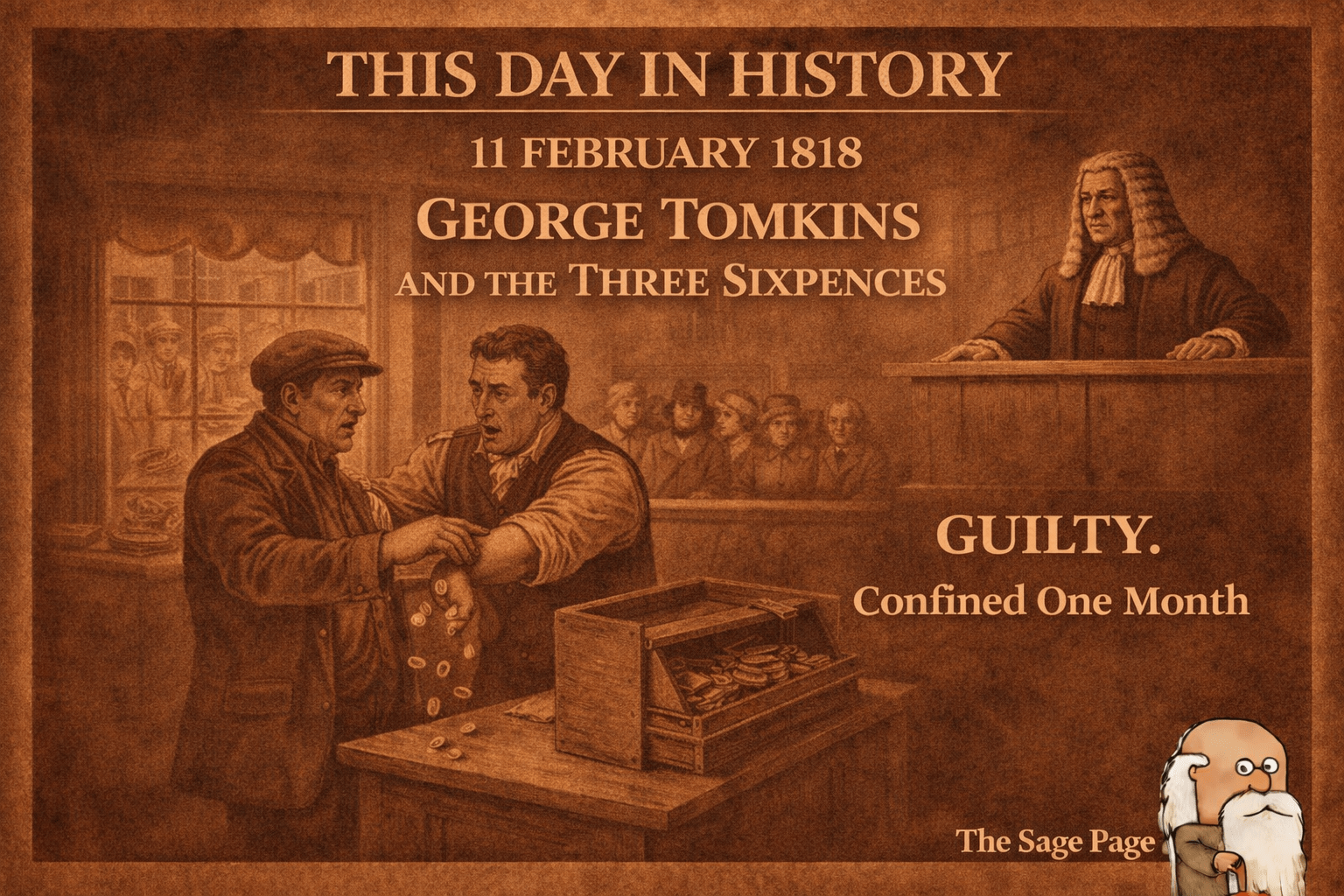
On 11 February 1818, a small but telling case came before the Old Bailey. The accused was George Tomkins, aged thirty-six, charged with stealing three sixpences from his employers.
The sum was small — just eighteen pence — but the consequences were immediate and public.
The Accusation
Tomkins was indicted for stealing:
- Three sixpences, valued at 18d
- The property of Robert Potts and William Maurice
The prosecutors, linen-drapers in partnership, conducted their business on Holborn Hill, a busy commercial thoroughfare in early nineteenth-century London.
Robert Potts testified plainly:
“On the 11th of February we lost three sixpences out of the till.”
In a world of hand-counted coin and daily cash transactions, even small losses were noticed.
The Evidence
The key witness was Mitford Patrick, shopman to the prosecutors.
He described the moment suspicion arose:
“While I was hanging the things in the window I heard silver rattle, and looking round I saw the prisoner’s arm coming from the till.”
Patrick acted at once.
“I took hold of him, and shook three sixpences out of his hand.”
The detail is striking: the coins literally falling from Tomkins’ grasp. There was no ambiguity about possession.
Patrick added:
“He had no business at the till — He was the porter.”
The prisoner claimed:
“He said he did not take them out of the till but off the desk.”
But the distinction carried little weight.
The Prisoner’s Response
When called upon, Tomkins offered no elaborate defence.
His recorded words were brief:
“I am sorry for it.”
It was an admission of wrongdoing, or at least an acceptance of the inevitable.
The Verdict
The jury — a London Jury before Mr. Recorder — returned their decision:
GUILTY.
Tomkins was noted to be aged 36.
Sentence
For stealing three sixpences, George Tomkins was sentenced to:
- One month’s confinement
Unlike many theft cases of the era that resulted in transportation or lengthy imprisonment, this was treated as a minor but punishable breach of trust.
Yet even a month’s confinement carried consequences. Time spent imprisoned meant lost wages, damaged reputation, and public disgrace. In small commercial communities, that could linger far longer than thirty days.
Why This Case Matters
The case of George Tomkins illustrates several features of everyday justice in Georgian London:
- The seriousness with which even small thefts were treated
- The vulnerability of shopkeepers to internal theft
- The reliance on immediate witness testimony
- The gradation of punishment — distinguishing petty theft from major felony
Three sixpences was not a fortune. But in a world where trust underpinned trade, even eighteen pence could land a man in the dock at the Old Bailey.
Money Then & Now
Three Sixpences (18d) in 1818
- Value in 1818: 1 shilling and 6 pence
- Modern inflation equivalent: approx. £6–£9 today
But inflation only tells part of the story.
In 1818, a labouring man might earn 10–15 shillings per week, meaning:
- 18d could represent close to a full day’s wages
In relative earning power, that might feel more like £70–£100 in today’s terms.
Small coin.
Serious consequence.
Sources
- Old Bailey Proceedings Online, trial of George Tomkins, 11 February 1818.
Thank you for reading my writings. If you’d like to, you can buy me a coffee for just £1 and I will think of you while writing my next post! Just hit the link below…. (thanks in advance)

 The Sage Page