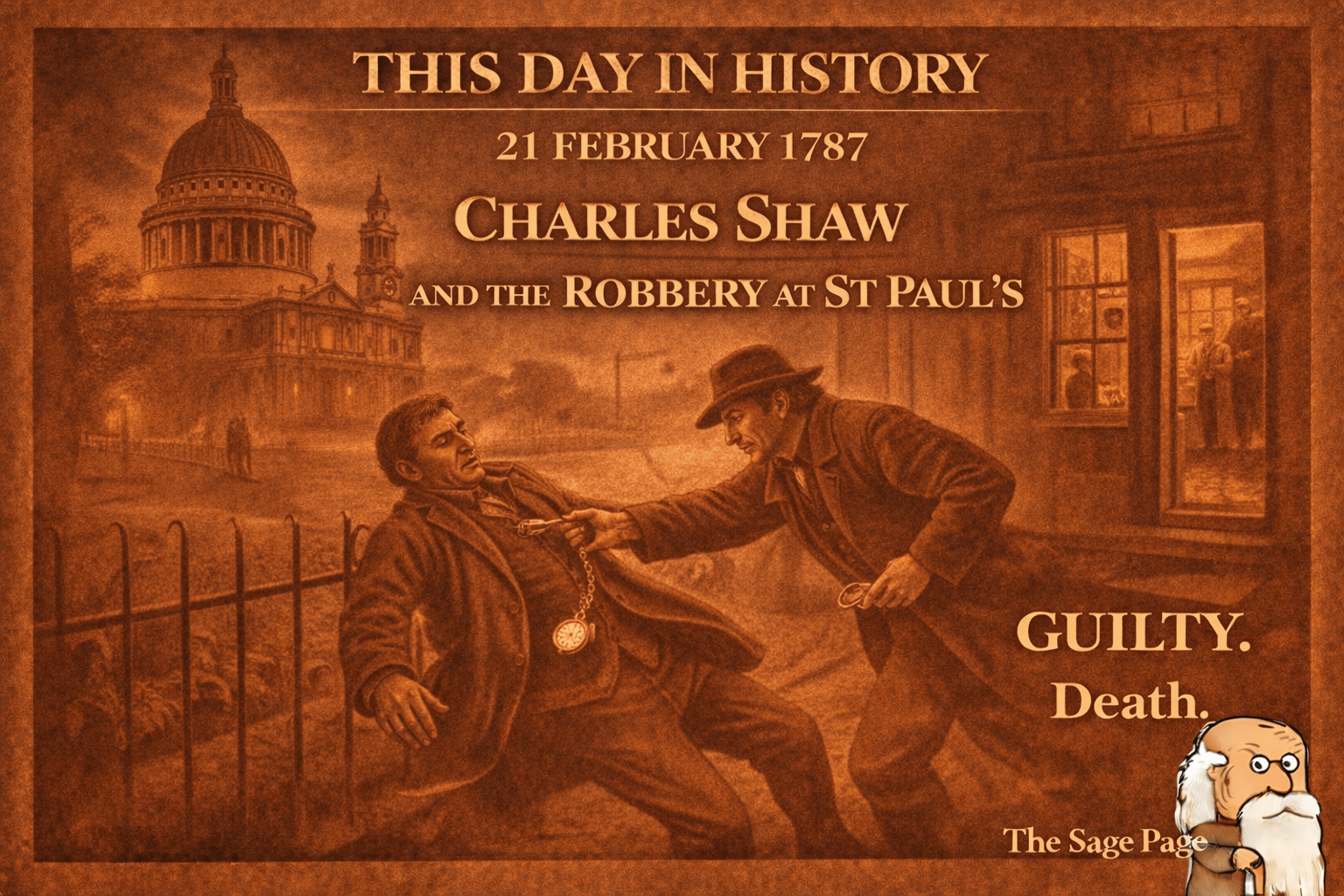
On 21 February 1787, Charles Shaw stood before the Old Bailey, charged with feloniously assaulting John Hughes on the King’s highway and stealing his watch and personal effects.
He was found guilty.
He was sentenced to death.
He was hanged at Newgate Prison on 26 April 1787.
The Victim: A Ship Caulker Abroad in the City
John Hughes, a ship caulker of Ratcliffe Cross, had been to Chelsea earlier that day to receive rent.
At about seven in the evening, he was walking near the south side of St Paul’s Cathedral, near St Paul’s Churchyard and the Old Change.
He was accompanied by Jane Winter and her young child.
As they passed through Watling Street and crossed towards Ludgate Hill, Hughes was suddenly tripped.
“I had my heels tripped up… and he took my watch out of my pocket.”
He fell against the iron rails of a cellar window, losing his breath.
The Theft
The items taken were substantial:
- A silver watch, valued at 40 shillings
- A steel chain
- Two seals
- A silver-mounted cane
Forty shillings represented a considerable sum — roughly two pounds — a significant amount for a working man.
Hughes felt the watch being drawn from his pocket.
He cried out immediately.
When he struggled to his feet, he seized Shaw by the collar.
“I never quitted my hold till he was in custody.”
Shaw attempted to wrest the silver-mounted cane from him as they grappled.
Assistance came quickly.
He was taken into Mr Holland’s oil shop.
Was He Drunk?
The defence leaned heavily on Hughes’ condition.
Had he been drinking?
Hughes admitted to perhaps “a glass of punch,” but insisted he was compos mentis.
Jane Winter testified he was “rather in liquor,” but sober enough to know what had happened.
The constable agreed: “very little in liquor.”
The jury clearly accepted that he knew his watch had been taken.
Here is John Hughes’ actual Testimony:
“I live at Ratcliffe-cross; I am a ship caulker ; I was robbed on the 21st of February, on the fouth side of St. Paul’s church-yard , within two doors of St. Paul’s chain; as I was going from Watling-street towards Ludgate-hill, about seven on Wednesday evening; I had my heels tripped up, by I believe the prisoner at the bar, and some more that were with him; I do not know whether the prisoner or his accomplices tripped up my heels; I cannot say how many were with him; I know there was more than himself; he fell upon me; I felt some person or persons upon me, and he took my watch out of my pocket; as soon as I felt my watch go out of my pocket, I called out; I felt him draw my watch out of my pocket; it was a silver watch; there was a steel chain and seals, as described in the indictment; I have never seen the watch since; when I found the watch go, I cried out, and the prisoner attempted to take my cane; my cane was mounted with silver; I cried out, you have got my watch; the prisoner strove to wrestle the cane out of my hand; I held fast, and got up by this time, and seized him by the collar; I never quitted my hold till he was in custody; when I seized him by the collar he wrestled for the cane; before I got up the watch was drawn from me; I cannot say whether I was on my legs or down when I collared him; assistance came immediately and seized him; it was a woman named Jane Winter that was with me; he was taken into a gentleman’s shop named Holland; and they sent for Mr. Stretton; I cannot tell how many men there were; I had such a fall on the iron rails; I fell on my short ribs, and it deprived me of my breath.
The prisoner never got away after you collared him? – No, Sir, I will be bound if I collared him he would not get away from me.
Did he? – No, he did not.
Had you been any where that day? – I had been to Chelsea receiving some rent.
Had you been drinking? – I might have been drinking a glass of punch, but I was compos mentis; I was in a state of mind that I knew how to take care of myself very well if I had not been interrupted by these rascals.
Do you recollect when you last saw your watch? – Yes, I recollect very well I saw it about three o’clock; I am sensible.
I had the watch in my pocket at the time I was tripped up; I did not see it after three, but I saw the trinkets afterwards.“
Here is the Prisoner’s Defence:
“I was coming along the back of St. Paul’s, this gentleman was so much in liquor that he ran against me; he fell to the ground, and said, I had robbed him of his watch and cane; he found his cane under him; he took me into a gentleman’s house and searched me; there was no watch found about me; I am in the butchering way; and I could have sent for some witnesses if it had not been Saturday.
Are you an apprentice? – No, Sir; I only work along with them as a journeyman with my father.“
The Missing Watch
No watch was found upon Shaw when searched.
He claimed Hughes had simply fallen against him.
But the prior jostling by multiple men, the tripping, and the attempt to seize the cane told another story.
Jane Winter was firm:
“He never lost sight of him after the dispute about the cane.”
Verdict and Sentence
The London Jury returned:
Guilty.
The sentence:
Death.
Charles Shaw was executed at Newgate Prison on 26 April 1787.
Highway Robbery in the City
Robbery “on the King’s highway” was among the gravest offences under the eighteenth-century Bloody Code.
Even without murder, violent theft in public streets could carry a capital sentence.
St Paul’s Churchyard, though central and well-trafficked, was no guarantee of safety after dark.
Urban robbery was treated as a threat to public order itself.
Money Then & Now
Hughes’ silver watch was valued at 40 shillings (£2).
In 1787:
- £2 could equal several weeks’ wages for a labouring man
- A skilled tradesman might earn 12–15 shillings per week
In modern equivalent purchasing power:
- Roughly £250–£350 today
A watch was not a mere ornament. It was a valuable possession and symbol of reliability.
Why This Case Matters
The Shaw case illustrates:
- The severity of eighteenth-century robbery law
- The role of bystander testimony in street crime
- The importance of immediate accusation
- The thin line between drunken misfortune and violent assault
It also shows how quickly the justice system could move:
Robbed in February.
Executed in April.
The city offered little mercy.
Sources
- Old Bailey Proceedings, 21 February 1787, trial of Charles Shaw
- Execution record, 26 April 1787
Thank you for reading my writings. If you’d like to, you can buy me a coffee for just £1 and I will think of you while writing my next post! Just hit the link below…. (thanks in advance)

 The Sage Page