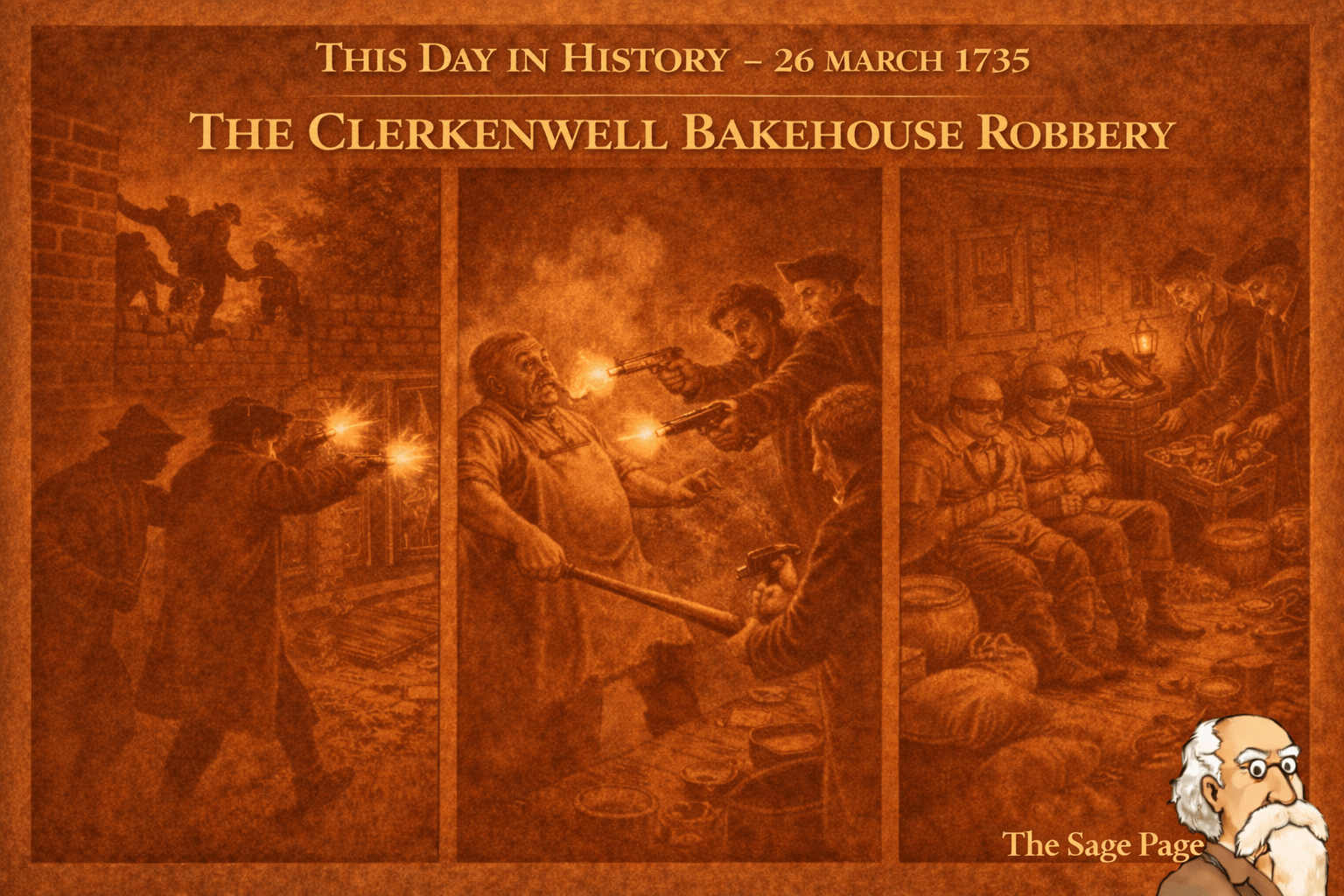
The Clerkenwell Bakehouse Robbery – George Ward and the Midnight Attack
Two in the Morning
In the early hours of 26 March 1735, while most of London slept, Thomas Gibson, a baker of St. James’s Clerkenwell, was already at work.
The ovens were lit. The bread was underway.
Beside him was his servant, Bryan Bird, tending to the routine of the bakehouse.
Then came the interruption.
Bird stepped into the yard to fetch a shovel.
Moments later—
a noise, a rush, and figures in the dark.
The Assault
Bird barely had time to react.
“They rush’d upon me, and knocked me down…
they put a Sword to my Throat, and held Pistols to my Breast.”
As he was subdued, the gang surged into the bakehouse.
Gibson, hearing the commotion, seized a long pole and ran to the door.
What followed was swift and violent.
A pistol was fired.
“A Man fired a Pistol at me, and wounded me in my Arm and Breast.”
A second shot followed.
“Another fir’d and wounded me in the Face, and beat me backwards.”
The attackers—three, perhaps more—closed in.
They forced him down, tore open his clothing, and robbed him of his money.
“If You Speak, I’ll Blow Your Brains Out”
The man identified as George Ward stood over Gibson as the others plundered the house.
“Swearing with horrid Oaths… if I spoke a Word, he would blow my Brains out.”
Meanwhile:
- The servant was dragged inside
- Blindfolded
- Bound hand and foot
The gang moved methodically through the house, breaking locks, forcing drawers, and stripping the property of valuables.
Silver, clothing, money—
everything of worth was taken.
An Inside Job
The robbery was no random act.
Ward later confessed that the crime had been orchestrated by Patrick Hall, a former servant of Gibson.
Hall knew:
- The layout of the house
- The habits of its occupants
- And crucially, that money was kept there after market dealings
He proposed the robbery.
The others agreed.
On that March night, Hall led them in—over the wall, through the back, and straight into the heart of the house.
The Confession
Ward was eventually captured in Bridgewater, Somerset, where he made a full confession before the Mayor and a Justice of the Peace.
He admitted:
- His role in entering the house
- His participation in restraining Gibson
- His share in dividing the stolen goods
He described how:
- The gang waited for the servant to emerge
- Overpowered him
- Then rushed the master
The stolen goods were sold, the money shared.
The crime, at least in their minds, complete.
The Trial
At the Old Bailey, the evidence was overwhelming:
- Direct identification by Gibson
- Testimony from the servant
- Ward’s own confession
The violence of the attack—particularly the use of firearms—left little room for mercy.
The jury returned its verdict:
GUILTY.
The Sentence
For burglary combined with armed assault, the punishment was inevitable.
Death.
The Ordinary’s Account – A Life of Crime
If the trial revealed the crime, the Ordinary of Newgate revealed the man.
George Ward was:
- Born in Dublin
- Raised by “honest parents”
- Given an education and apprenticed as a carpenter
But he chose another path.
He fell in with violent gangs—groups who:
- Broke prisoners out of custody
- Beat constables
- Committed robberies and riots
His life became a catalogue of crime:
- House-breaking
- Highway robbery
- Theft, violence, and disorder
Even at the end, he showed little remorse.
When asked to prepare for death, he refused.
When questioned about shooting Gibson, he declared:
he was sorry they had not shot him “more effectually.”
A Defiant End
Ward remained defiant to the last.
He:
- Threatened those who had helped capture him
- Boasted of other crimes
- Showed little concern for judgment or eternity
The Ordinary described him as:
“a poor obdur’d, unthinking, obstinate Creature.”
A man unmoved by repentance—even at the gallows.
A Prisoner’s Strange Last Letter to his Cousin
“To Mr. William Davis at the Sign of the White Sheafe, in St. Patrick-street, near Patrick’s-Church, Dublin, in Ireland, with Care.
May 22d, 1736.
YOU blind squinty Son of a Hore, how durst you heave the Impedence to report upon me that I was hanged. I I gave you a nough all ready, but if I did not, I hope I will before I am much older; you and Billy Williams, and Guiss, you are all three Roagues, and I will meake Roagues of you very soon I hope. I heave heard from Dublin how you expoessed me there, you shall know very soon whether I am hanged or us, for the next Time I teake you in Hand, I will serve you and the rest of your Curst Crew, as the mad Bulls is served, so I will you aspesily, that is, hgh’s you; no more at present, but Dm you and your Curst Funkson all together; go and tell my Mother now that I am not hanged yet, to meake you a Lyer very soon I will. No more,
From your Cusin,
GEO. WARD.”
Why This Case Matters
This case is a stark reminder of the violence of early 18th-century crime:
- Burglary was rarely quiet—it was often brutal
- Firearms were used freely
- Insider knowledge made homes vulnerable
But perhaps most striking is the portrait of Ward himself:
A man given opportunity—education, trade, family—
who instead chose a life of escalating crime, ending in execution.
Not every criminal story is one of desperation.
Some, like Ward’s, are stories of deliberate descent.
Thank you for reading my writings. If you’d like to, you can buy me a coffee for just £1 and I will think of you while writing my next post! Just hit the link below…. (thanks in advance)

 The Sage Page