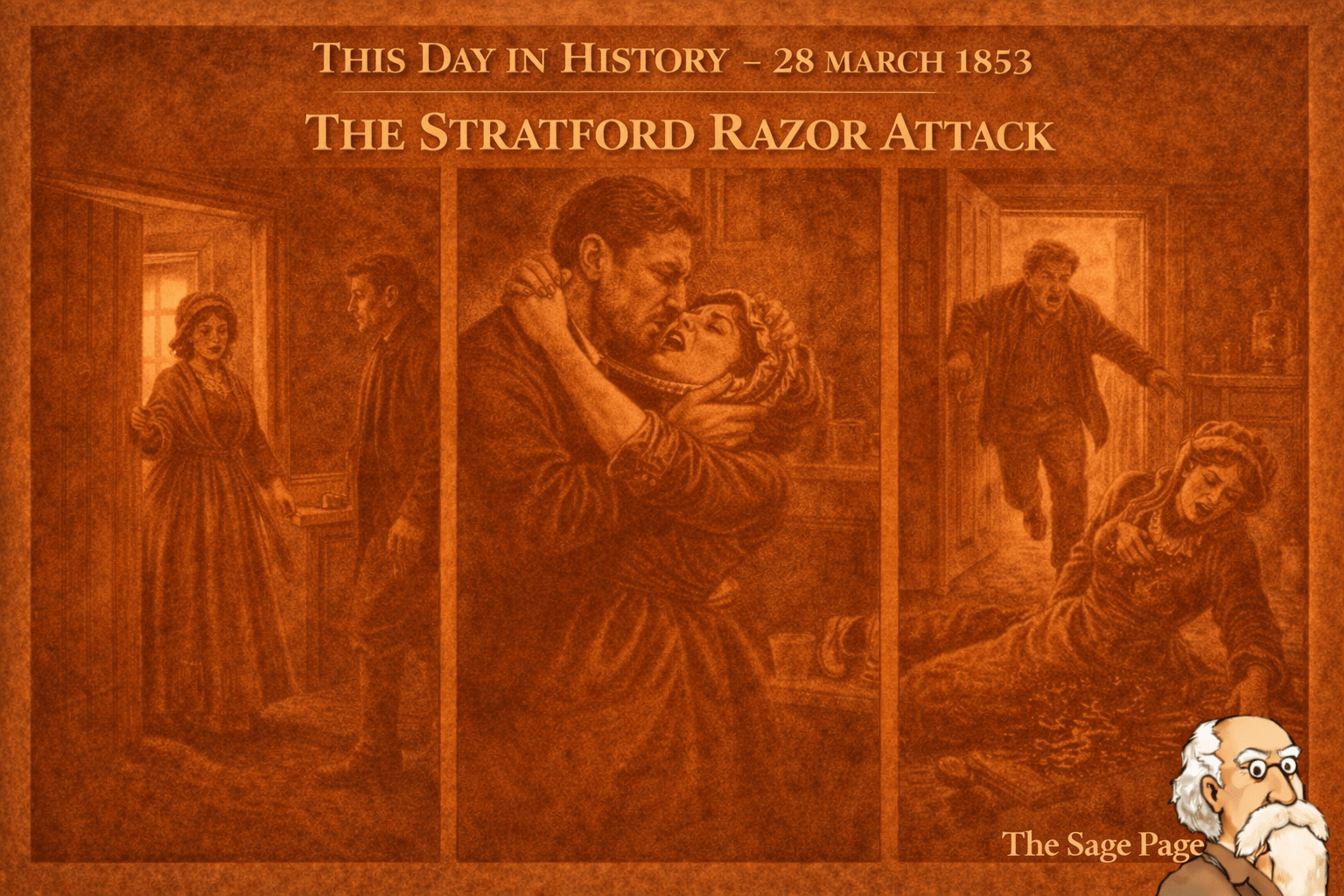
The Stratford Razor Attack – Thomas Rolls and Charlotte Carter
A Relationship Turned Sour
For four years, Charlotte Carter had lived with Thomas Rolls as his partner.
But by March 1853, that life was over.
She had left him—
not quietly, but, as she told the court:
“Through your ill-usage.”
Two weeks later, their paths crossed again.
What followed would nearly cost her life.
The Morning Visit
On the morning of 28 March, Carter called at the house of Mark Barker, in Stratford, to collect ribbon for trimming caps.
A simple errand.
But Rolls was already there.
He rose when she entered and calmly asked her to step into the kitchen to read a letter—supposedly from her uncle.
Nothing about the request seemed immediately threatening.
She agreed.
“Are You Unhappy?”
Inside the kitchen, they were alone.
Moments later, Rolls followed her in.
He placed his arm around her neck.
Then, quietly, he asked:
“Are you unhappy?”
She replied:
“No.”
His answer came just as calmly:
“I am.”
Then he drew a razor.
The Attack
Without warning, Rolls cut her throat.
The blade tore into the left side of her neck—
deep, deliberate, and dangerously close to a fatal artery.
Carter fought back.
She screamed:
“Murder!”
In the struggle:
- Her hands were slashed
- Her cheek and chin were cut
- Blood poured from the wound
A Narrow Escape
Hearing the cries, Mark Barker rushed into the kitchen.
He found Rolls gripping Carter, her neck bleeding heavily.
He pulled them apart.
Carter collapsed, badly wounded.
Barker ran into the street shouting:
“Murder!”
When he returned, the scene had shifted again.
Rolls stood there, now holding a chopper, attempting to calm the situation:
“Hold your noise; don’t say anything; it is all right.”
It was anything but.
The Prisoner Turns the Blade on Himself
Moments later, Barker found Rolls in the yard.
He had turned the razor on himself.
His throat was cut.
The blade still in his hand.
The handle lay behind, in the kitchen.
The Medical Evidence
At the London Hospital, surgeon Alfred Adams Mantill examined Carter.
Her condition was grave:
- A wound three-quarters of an inch long
- Nearly an inch deep
- Just half an inch from the carotid artery
Had the blade gone slightly further:
“It would most probably have killed her.”
She remained in danger for two weeks.
Rolls, too, had seriously injured himself—but not fatally.
The Defence
Rolls offered little in explanation.
He did not deny the act.
Instead, he blamed drink:
“I was in liquor, and that caused me to do it.”
But witnesses disagreed.
Barker stated he had only had “a little.”
The surgeon confirmed:
He was not intoxicated when examined.
The Verdict
The facts were clear:
- A deliberate act
- A lethal weapon
- A wound that narrowly avoided death
The jury returned their verdict:
GUILTY.
The Sentence
Rolls was sentenced to death.
But in this case, the punishment was tempered:
Death Recorded.
A legal mechanism that spared him execution, typically resulting in transportation or imprisonment instead.
Why This Case Matters
This case is a stark example of domestic violence escalating into attempted murder—a pattern as recognisable today as it was in Victorian London.
It also highlights:
- The danger of private spaces
- The speed at which violence can erupt
- And how survival can hinge on inches
Charlotte Carter lived—
not through chance alone, but through resistance, interruption, and sheer proximity to help.
A fraction closer, and this would have been a very different story.
Thank you for reading my writings. If you’d like to, you can buy me a coffee for just £1 and I will think of you while writing my next post! Just hit the link below…. (thanks in advance)

 The Sage Page