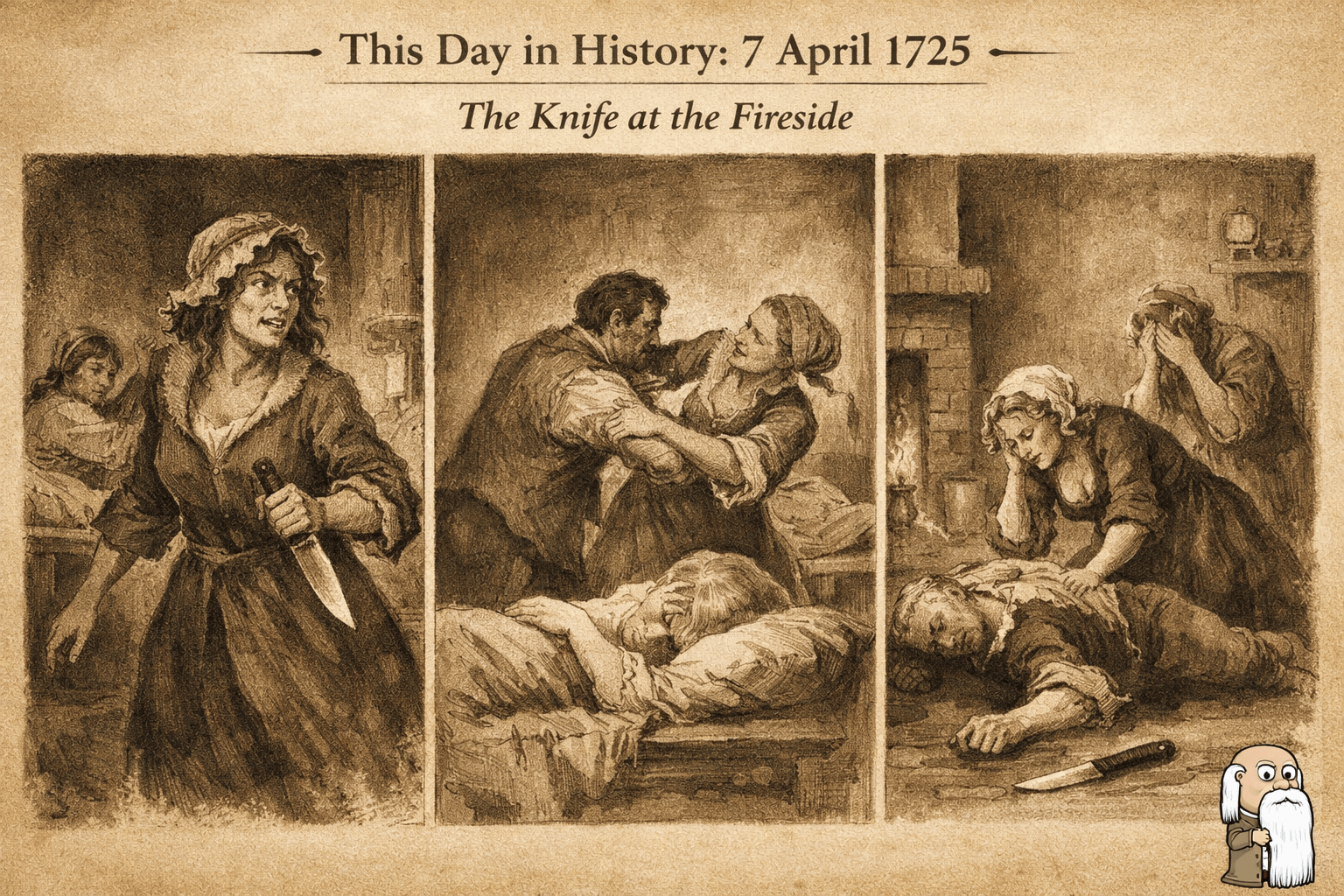
The Knife at the Fireside
A Domestic Evening Turns Deadly
On a quiet Sunday evening in March 1725, a small room in St Katherine’s, near the Tower of London, held nothing more unusual than a family gathered indoors.
A woman lay resting after a recent miscarriage.
Her husband dozed beside her.
Her brother sat by the fire.
It was, by all appearances, an ordinary domestic scene.
Then Mary Hanson entered the room.
The Prisoner
Mary Hanson was not a stranger.
She was:
- Sister to Martha Hanson
- Sister-in-law to the deceased, Francis Peters
- A woman known to the household
But on this night, she was also:
👉 Very drunk
👉 Holding a knife
Witnesses would later describe her pacing the room, agitated, demanding food, and speaking with growing hostility.
“If There’s Victuals, I’ll Have It”
Matthias Hanson, husband to Martha, recalled the moment clearly.
Awoken from rest, he saw Mary:
“Walking about the Room with a Knife in her Hand.”
Her demand was simple:
“If there’s any Victuals in the House, I’ll have it.”
Francis Peters attempted calm.
“Molly… here’s enough for us all.”
But reason did not prevail.
Escalation
Mary’s temper sharpened.
When urged to quiet herself—or leave—she replied:
“If Right took place, you ought to go out first.”
The tension thickened.
Francis rose to remove her from the room.
What followed happened in seconds.
The Fatal Blow
As Peters moved to push her out, Mary struck.
The knife entered his chest:
- One inch long
- Three inches deep
A wound near the right breast.
He fell almost immediately.
Chaos in the Room
Martha Hanson, weak and bedridden, tried to intervene.
Mary turned on her:
“I think it’s no Sin to cut your Throat.”
She struck her sister.
Moments later, as Mary Peters (the victim’s wife) attempted to separate them, she too was cut across the hand.
Then came the cry:
“You have kill’d my Husband!”
Mary Hanson’s reply was chilling:
“I wish I had stab’d ye all.”
She threw the knife against the wall.
A Death in Minutes
Francis Peters did not linger long.
He sank to his knees.
Within half an hour—
He was dead.
A surgeon was called.
But there was nothing to be done.
No Motive, No Quarrel
What makes this case particularly stark is its lack of premeditation.
Witnesses were consistent:
- No prior quarrel
- No long-standing grievance
- No plotted intent
Only drink.
Only temper.
Only a moment.
The Trial
The evidence was overwhelming:
- Multiple eyewitnesses
- Consistent accounts
- Immediate identification of the act
The jury did not hesitate.
👉 GUILTY
Sentence:
👉 Death
The Ordinary’s Account
In the weeks before her execution, Mary Hanson underwent a transformation familiar in the records of the time.
She expressed:
- Deep remorse
- Religious reflection
- A desire for salvation
Most strikingly, she did not excuse herself.
Instead, she said:
👉 Her drunkenness was not an excuse—but an aggravation
She warned others:
To avoid drunkenness, “the leader to various Misfortunes.”
And accepted her fate as just.
Why This Case Matters
This is not a tale of conspiracy or calculation.
There was:
- No financial gain
- No hidden scheme
- No long-nursed revenge
Only a moment of uncontrolled violence.
And yet—
That moment was enough.
The case stands as a stark reminder of a truth well understood in the 18th century:
👉 A single act, committed in passion, may carry the full weight of the law
And perhaps more unsettling still—
That such acts often begin not with hatred…
But with something as ordinary as drink, pride, and a refusal to yield.
Thank you for reading my writings. If you’d like to, you can buy me a coffee for just £1 and I will think of you while writing my next post! Just hit the link below…. (thanks in advance)

 The Sage Page