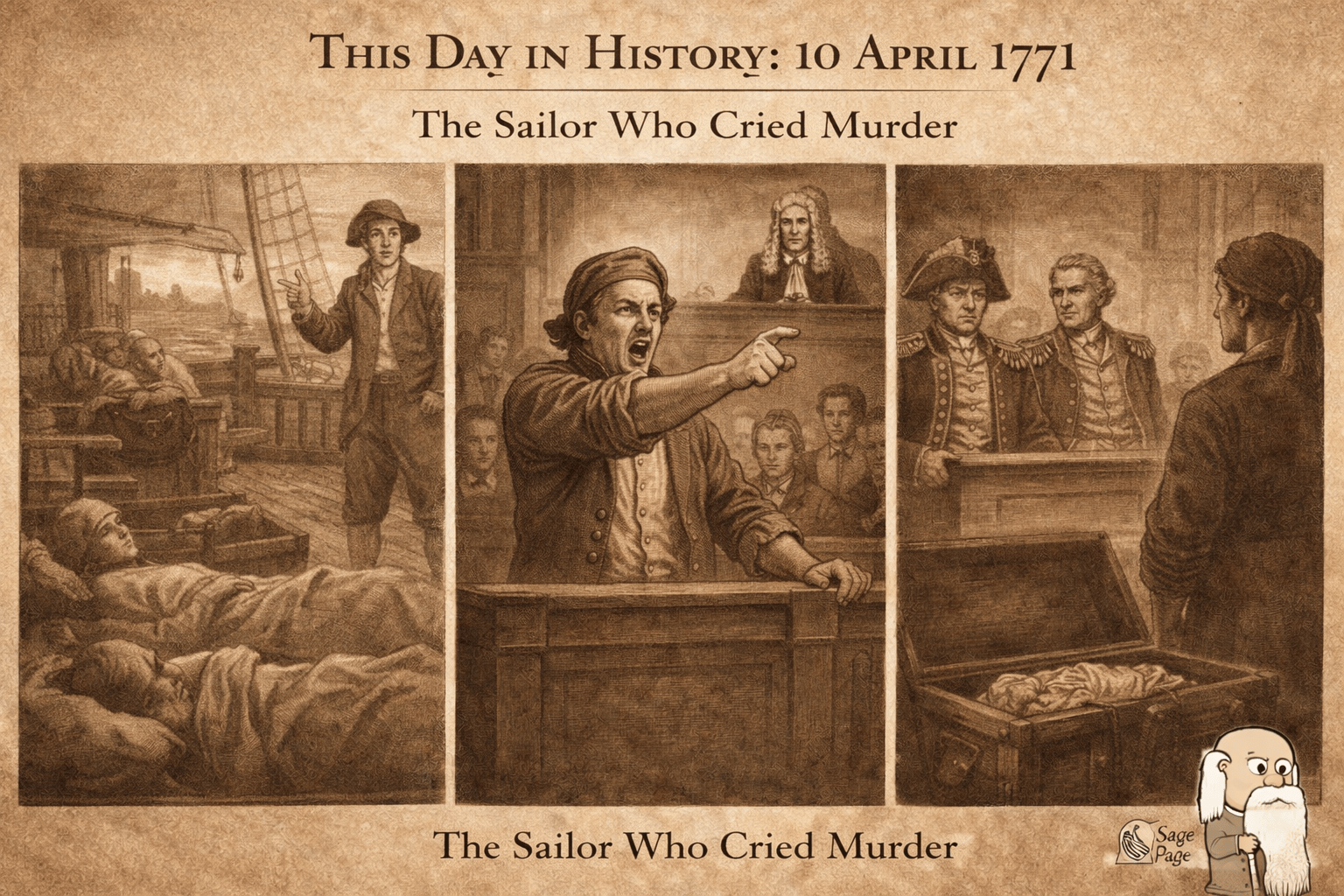
The Sailor Who Cried Murder
A Trial About a Trial
On 10 April 1771, the Old Bailey heard a case that had already cast a long shadow over the court.
It was not, at least on the surface, a murder trial.
That had come earlier.
Instead, this was the prosecution of John Commings, a sailor, accused of wilful and corrupt perjury for the evidence he had given at the Admiralty Sessions the previous December, when Captain Richard Broad had stood charged with the murder of Thomas Scott aboard the King David.
At the heart of the matter was a simple but devastating question:
Had Commings told a terrible truth… or an extraordinary lie?
The Original Accusation
At Captain Broad’s earlier trial, Commings had painted a scene of almost theatrical brutality.
He claimed that aboard the King David he had seen Broad:
- knock Scott down with a blunderbuss,
- strike him again with the cock of the gun,
- punch him repeatedly with the butt end,
- and then drive the muzzle into his belly.
According to Commings, Scott never recovered. He lay helpless on deck, unable to speak, denied assistance, and died within a day or two from the blows.
It was a vivid story, rich in violence, fear, and cruelty. Commings even claimed that others, including Richard Osgood, had seen it happen.
But the problem with dramatic evidence is that it must remain steady under pressure.
His did not.
A Witness Unravels
The shorthand notes of the earlier trial were read back in court, and with them came the full extent of Commings’s contradictions.
At one moment, Scott died within twenty-four or twenty-eight hours. Then it became forty-eight.
At one moment, Scott was speechless from the instant he was struck down. Then, somehow, he later spoke movingly of his wife and family, and blamed Captain Broad for his death.
At one moment, Commings said he begged the captain to allow the surgeon to bleed Scott. Then he admitted the captain’s refusal had actually concerned another man entirely.
At one moment, he claimed he had reported the whole affair to Admiral Parry at Jamaica. Then no one could remember hearing a word of it.
By the end, his story had become a patchwork of emphatic certainties and sudden revisions. It did not merely wobble. It came apart in his hands.
The Officers Speak
The prosecution then called the men whom Commings had placed at the scene.
Richard Osgood, chief mate of the King David, flatly denied it all.
He had never seen Broad strike Scott with a blunderbuss.
He had never heard of such an assault.
He had never heard Scott complain of Broad.
As far as he was concerned, Scott died of fever and ulcers in his legs, the miserable companions of a hard voyage.
Samuel Harris, another officer, supported the same account. There had been sickness aboard. Men had died. But there had been no such murderous beating.
The blunderbuss, Harris said in effect, had not been used in that fashion at all.
What Commings had presented as a witnessed killing now looked more and more like a tale he had embroidered out of shipboard misery.
Admiral Parry Remembers Nothing
One of the most striking parts of Commings’s original evidence was his insistence that he had told the whole story to Admiral Parry, not once, but repeatedly, in Jamaica and again on the voyage home.
The Admiral himself was then called.
He did not know the man.
He did not remember any such complaint.
And more importantly, he made clear that had such a charge been laid before him, he would have acted on it immediately. A captain accused of murder would not have been left to drift home unchallenged if a proper complaint had truly been made.
That denial was ruinous.
Commings had not merely accused Broad of murder. He had tried to anchor his tale to the authority of a senior naval officer. When that officer denied all knowledge, the story lost one of its last supports.
What He Told the Owner
The final blow came not from a sailor or an admiral, but from Mr Miller, one of the principal owners of the King David.
Miller described meeting Commings in Bristol after the voyage. The sailor had come to ask for his wages, and during their conversation complained in general about the hardships of the voyage and the mortality aboard.
But when Miller pressed him specifically about Captain Broad’s conduct, Commings, by Miller’s account, said something devastating:
he had never been ill-used by Captain Broad in his life, nor seen anything in him but what was humane.
When Miller challenged him for having previously said otherwise, Commings reportedly admitted:
“what I said was false; we must say something to make our story good.”
It is difficult to imagine a sentence more fatal in a perjury trial.
Commings’s Defence
Faced with this, Commings tried to wriggle free in the only way left to him.
He insisted that what he had sworn at the first trial was true, and that the later contradictions had come because Captain Broad’s friends had made him drunk. He also claimed that other witnesses, absent at sea, could have supported his original accusation if only they had been present.
It was not enough.
The jury had before them not a man confused by one unfortunate inconsistency, but a witness who had shifted his ground repeatedly and whose story had been contradicted by nearly every solid source around him.
The Verdict
The jury found him:
Guilty.
Not of murder, but of something the court plainly regarded as serious enough: corrupt perjury in a capital case.
A false oath in an ordinary civil quarrel was one thing.
A false oath in a murder prosecution was another.
The Sentence
John Commings was ordered:
- to pay a fine of one shilling,
- to be imprisoned for one year in Newgate,
- and, after that term, to be transported for seven years.
It was a heavy sentence, and meant to be.
The law could tolerate many things. It had far less patience for a man who might send another to the gallows by invention.
Why This Case Matters
This is a superb Old Bailey case because it reveals how fragile justice could be when it depended on testimony alone.
There was no forensic science here. No medical certainty worthy of the name. No photographs, no recordings, no neat paper trail. Instead there were voices:
- a sailor with a shocking story,
- officers denying it,
- an admiral disclaiming all knowledge,
- and an owner recalling a confession.
What the court punished in the end was not simply lying, but the danger of lying well enough to kill.
Commings’s crime was not that he spoke wildly in a tavern or grumbled on a quay. It was that he entered a court of law, took an oath, and told a story capable of hanging a man.
That, in the eyes of the Old Bailey, was a crime of its own.
Thank you for reading my writings. If you’d like to, you can buy me a coffee for just £1 and I will think of you while writing my next post! Just hit the link below…. (thanks in advance)

 The Sage Page