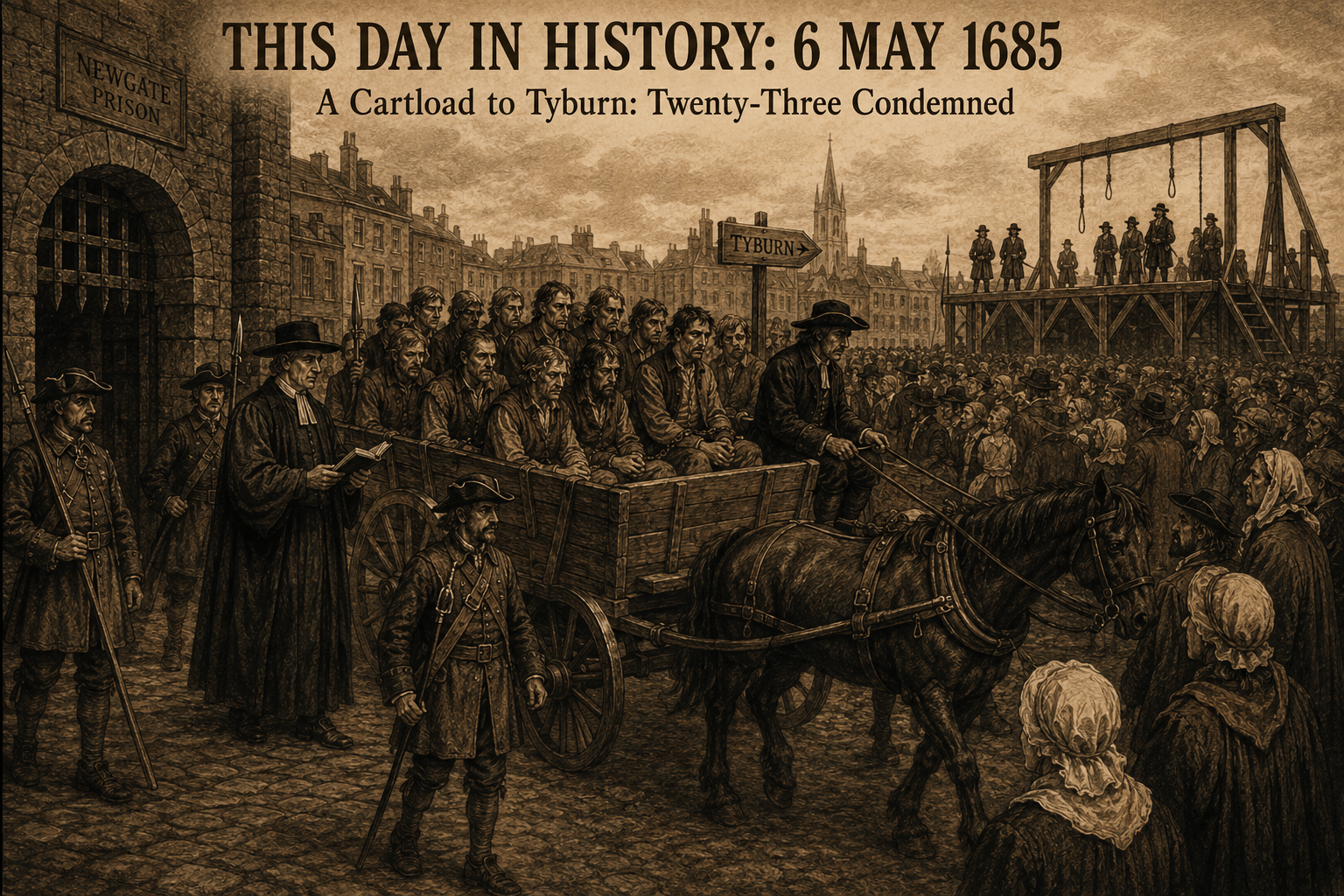
A Cartload to Tyburn
On 6 May 1685, one of the most sombre sights of the Old Bailey era unfolded: a mass execution at Tyburn following a session in which twenty-three prisoners had been sentenced to death.
There is no single dramatic crime to focus on today—no lone villain or shocking act—but rather something quieter, and perhaps more unsettling: a procession of condemned men and women, many of them resigned, some defiant, and others simply unprepared for what awaited them.
The Ordinary’s Frustration
The account is dominated not by the prisoners themselves, but by the voice of the prison chaplain—the Ordinary of Newgate—who struggled to prepare them spiritually for death.
He describes a troubling scene:
many prisoners remained “obdurate”, clinging to the hope of a last-minute pardon rather than confronting their fate.
Despite repeated sermons, prayers, and personal exhortations, some refused even to speak with him:
“Some refused it with greater obstinacy than ever any did… presuming they should be pardoned.”
For the Ordinary, this was not just disobedience—it was spiritual peril. To die unrepentant was, in his view, far worse than the execution itself.
A Few Who Listened
Not all resisted.
Among those who did engage was William Peddington, a soldier condemned for desertion. His story is brief but telling: a poor man, burdened by debt, who enlisted out of necessity and fled out of discontent.
He expressed regret:
- for abandoning his duty
- for disappointing both God and King
In a day filled with hardened silence, even this modest confession stood out.
The Final Journey
By late morning, the condemned were brought out from Newgate Prison and placed into carts.
This was the final ritual.
The journey through London to Tyburn was public—deliberately so. Crowds gathered to watch, reflect, or simply be entertained. The condemned, now visible to all, became living warnings.
The Ordinary records that:
- many appeared “very penitent” along the route
- prayers were said openly
- psalms were sung
At the gallows, the prisoners addressed the crowd:
urging them to “take warning” from their fate
It was a familiar formula—part confession, part performance, part moral theatre.
The Moment at Tyburn
At Tyburn, the ritual reached its end.
- Final prayers were offered
- The condemned prayed individually
- They asked the crowd to pray for them
Then, without further ceremony:
they were all executed.
A Quiet Kind of Tragedy
What makes this account striking is not violence, but absence:
- No detailed crimes
- No vivid final declarations
- No singular narrative
Instead, we are left with a procession—twenty-three lives reduced to a single paragraph of conclusion.
It is tragedy not in spectacle, but in scale.
Final Reflection
The Ordinary closes his account with a familiar moral: sin leads to ruin, and repentance must not be delayed.
But reading between the lines, another truth emerges.
Some hoped for pardon.
Some refused reflection.
Some prayed.
Some did not.
And in the end, all met the same fate.
Thank you for reading my writings. If you’d like to, you can buy me a coffee for just £1 and I will think of you while writing my next post! Just hit the link below…. (thanks in advance)


