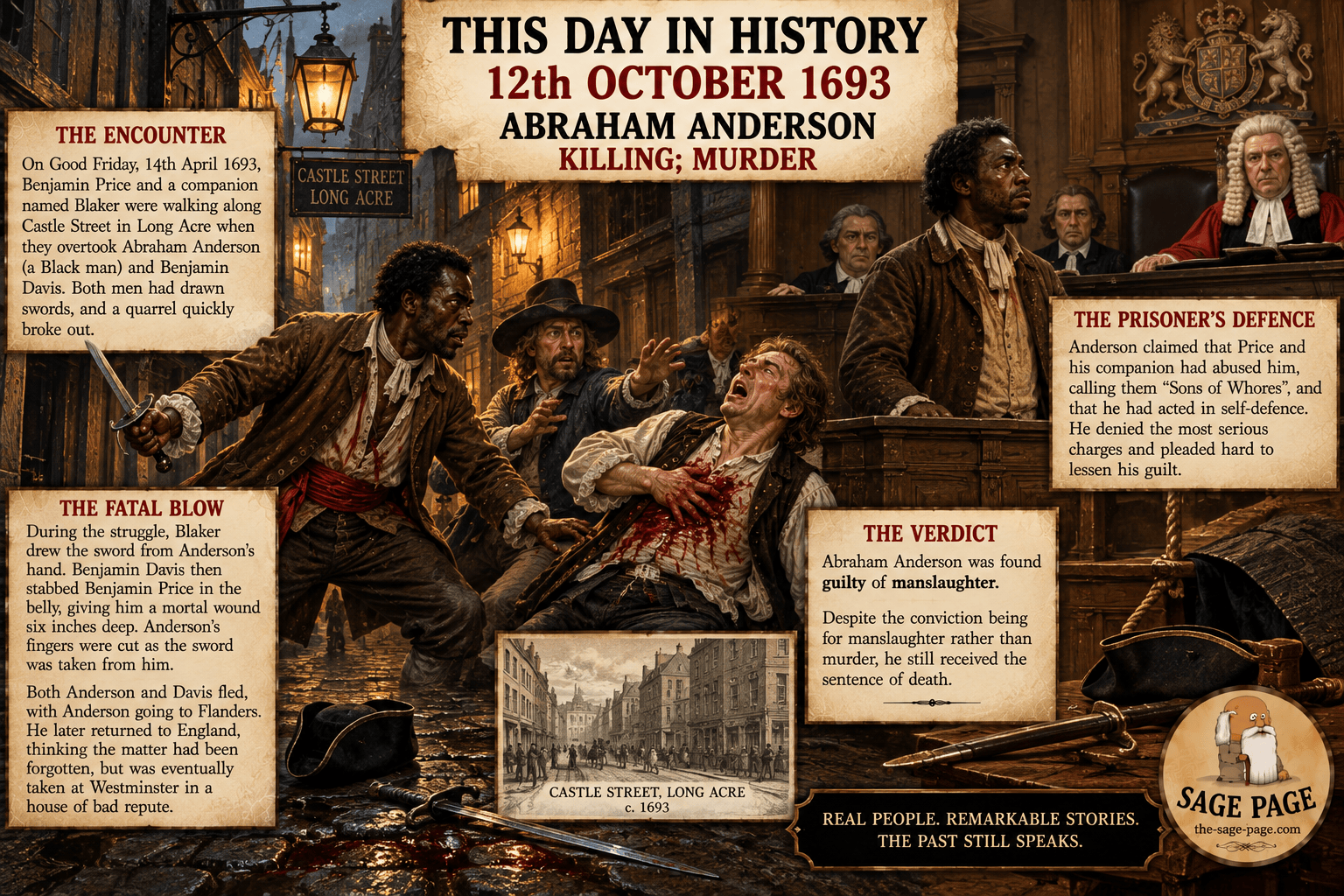
A Swordfight, a Fatal Stabbing and a Fugitive’s Return
On 12th October 1693, Abraham Anderson appeared at London’s Old Bailey charged with the murder of Benjamin Price, who had died following a violent confrontation in Castle Street, Long Acre, six months earlier.
It was a case involving drawn swords, an exchange of insults, a fatal wound and a suspect who fled overseas, apparently believing he could eventually return to England without facing justice.
But perhaps the most surprising detail was the outcome: although Anderson was found guilty of manslaughter rather than murder, he was nevertheless sentenced to death.
A Good Friday Confrontation
The trouble began on the evening of Good Friday, 14th April 1693.
Benjamin Price and a companion named Blacker were walking along Castle Street in Long Acre when they overtook two men carrying drawn swords. They were Abraham Anderson and Benjamin Davis.
Anderson, whom the Old Bailey proceedings described simply as “a Black”, apparently took offence at something said as the men approached.
According to the prosecution, he shouted:
“Damn you, who do you call Jack-a-napes?”
The expression jackanapes was an insult implying that someone was an impertinent or conceited fellow. Evidently, Anderson believed it had been directed at him.
What might have ended as an exchange of unpleasant words quickly escalated into a confrontation.
Two Swords and One Fatal Wound
The court heard that Anderson attempted to provoke Price and Blacker into a fight.
Blacker managed to seize Anderson’s sword and wrest it from his hand. In the struggle, Anderson’s fingers were cut.
But while Anderson was being disarmed, his companion Benjamin Davis struck a far more serious blow.
Davis stabbed Benjamin Price in the abdomen, inflicting a wound six inches deep.
Price subsequently died from his injuries.
It was Davis, therefore, who was identified in the trial account as having inflicted the fatal wound, not Anderson himself.
Nevertheless, Anderson had been an active participant in the confrontation, and both men fled following the incident.
A Flight to Flanders
Anderson apparently decided that remaining in England was too dangerous.
According to his own account, he escaped to Flanders, then a region of considerable military and political importance in continental Europe.
His companion, Benjamin Davis, also disappeared and had not been apprehended by the time Anderson stood trial.
Anderson remained abroad for some time before making what proved to be a serious miscalculation.
Believing the affair had been forgotten, he returned to England.
It had not.
He was eventually arrested in Westminster, in premises described by the court as a “House of bad Repute”.
The Old Bailey record provides no further explanation of the establishment or the circumstances of his capture.
Anderson’s Defence
At his trial, Anderson presented a rather different account of the original confrontation.
He claimed that Price and his companion had insulted him and Davis, calling them “Sons of Whores”.
He insisted that he had not wanted to fight and that whatever actions he had taken were purely in self-defence.
His argument was essentially that he had been provoked and had acted to protect himself, rather than deliberately participating in a murderous attack.
He also attempted to minimise his responsibility for the death.
This was an important distinction. The evidence identified Davis as the man who actually stabbed Price, while Anderson’s involvement concerned the quarrel and the struggle with Blacker.
But the prosecution evidently persuaded the jury that Anderson bore criminal responsibility for the fatal confrontation.
Guilty – But Not of Murder
After hearing the evidence, the jury returned a verdict of guilty of manslaughter.
Anderson had escaped a murder conviction, but the result was not the reprieve that a modern reader might expect.
The court record concludes with the stark words:
“He was found guilty of Manslaughter. Received Sentence of Death.”
It is worth remembering that the distinction between murder and manslaughter did not operate in precisely the same way as it does today.
In seventeenth-century England, manslaughter was a felony for which the death penalty could be imposed. Some offenders could escape execution through the legal privilege known as benefit of clergy, but eligibility depended on the circumstances and applicable law.
The surviving account does not explain why Anderson received a death sentence or whether he subsequently obtained a reprieve.
We therefore know his conviction and recorded sentence, but not from this account whether he was actually executed.
The Sage’s Reflection
What makes this case particularly interesting is the contrast between the person who delivered the fatal wound and the man who ultimately appeared before the court.
Benjamin Davis, identified as the actual stabber, remained at large.
Abraham Anderson, who had lost his sword during the confrontation, was the man who returned to England, was arrested and received a death sentence.
There is also the tantalising detail of Anderson’s background. The court explicitly identified him as a Black man, making this a surviving example of a Black defendant appearing in London’s criminal courts in the late seventeenth century.
Unfortunately, the brief proceedings reveal almost nothing about his origins, occupation or circumstances. We cannot establish from this account whether he was born in England, arrived from overseas or had any particular connection with Flanders beyond his flight there.
His story survives largely because of a quarrel that turned deadly.
One insult, two drawn swords, a fatal stabbing and a return from exile that ended at the Old Bailey.
And in the end, it was not necessarily the man who struck the fatal blow who faced the consequences.
Historical Footnote – Why Was Manslaughter Punishable by Death?
In 1693, manslaughter was a serious felony and could attract the death penalty. However, some offenders could claim benefit of clergy, a legal privilege that had evolved from protecting members of the clergy into a means of avoiding execution for certain crimes.
Eligible first-time offenders might be branded on the thumb instead of being hanged.
The precise reason Abraham Anderson received a death sentence despite his manslaughter verdict is not explained in the surviving trial report. Nor does the account establish whether the sentence was ultimately carried out.
Thank you for reading my writings. If you’d like to, you can buy me a coffee for just £1 and I will think of you while writing my next post! Just hit the link below…. (thanks in advance)


