Thought of the Day: Blinking

If everybody blinked in sync, nobody would know that other people blinked.
Yes, it’s true! If everyone blinked in perfect synchronization, it’s unlikely that anyone would notice that others blinked because everyone’s eyes would be closed simultaneously. Each person’s perception of time would be interrupted during the blink, so they wouldn’t be aware of the precise moment when others blinked. Therefore, it would seem as if everyone’s eyes remained open continuously. However, achieving such perfect synchronization among a large group of people would be practically impossible.
Thank you for reading my writings. If you’d like to, you can buy me a coffee for just £1 and I will think of you while writing my next post! Just hit the link below…. (thanks in advance)

This Day in History: March 25th

Here are 10 historical events that took place on March 25th, listed in chronological order:
- 1306: Robert the Bruce becomes King of Scotland.
- 1584: Sir Walter Raleigh is granted a patent to colonize Virginia.
- 1655: Christiaan Huygens discovers Titan, the largest moon of Saturn.
- 1807: The British Parliament abolishes the slave trade in the British Empire.
- 1911: The Triangle Shirtwaist Factory fire in New York City kills 146 garment workers, leading to significant changes in workplace safety regulations.
- 1957: The Treaty of Rome establishes the European Economic Community (EEC), which later evolves into the European Union.
- 1965: Civil rights activists lead the successful Selma to Montgomery marches for voting rights in Alabama, USA.
- 1975: King Faisal of Saudi Arabia is assassinated by his nephew.
- 1988: The Candle demonstration in Bratislava, Slovakia, marks the beginning of the Velvet Revolution against Communist rule in Czechoslovakia.
- 1995: The WikiWikiWeb, the world’s first wiki, is established by Ward Cunningham.
These events span a wide range of historical and cultural significance across different parts of the world.
Thank you for reading my writings. If you’d like to, you can buy me a coffee for just £1 and I will think of you while writing my next post! Just hit the link below…. (thanks in advance)
Clever Maths Jokes Collection for Number Enthusiasts | Math Mirth

Welcome to Math Mirth, your go-to site for clever and witty maths jokes! Whether you’re a number enthusiast or just love a good pun, our collection of maths humour is sure to tickle your funny bone. From algebraic antics to geometric gags, we’ve got jokes that add up to a lot of laughs. Dive in and discover the lighter side of mathematics!
Atheists don’t solve exponential equations because they don’t believe in higher powers.
If the number 666 is considered evil…
Is 25.8069758 the root of all evil?
I collected a lot of data trying to disprove observation bias.
The results were exactly as I expected.
I asked my German friend if he knew the square root of 81.
He said “No”.
I once tried to quickly make a square but I ended up with an octagon…
That’s what happens when you cut corners.
Did you hear about the mathematician who was afraid of negative numbers?
He would stop at nothing to avoid them.
My geometry teacher has lost his parrot.
Polygon.
I used to be a big Robbie Williams fan but that all changed when I started to study geometry and found that more interesting.
I’m loving angles instead…
I had a threesome with a scalene and an isosceles.
It was a love triangle.
My maths teacher called me average.
How mean!
What do you get if you divide 22 sheep into 7 pens?
A shepherd’s pi…
3.14% of sailors are Pi Rates.
Why didn’t 4 ask out 5?
Because he was 2².
6 was scared of 7 because 7, 8, 9 but why did 7 eat 9?
Because you’re supposed to eat 3 squared meals a day.
If Dave has 50 chocolate bars and eats 45, what does he have left?
Diabetes. Dave has diabetes.
I was in a shop the other day, and they put the heating on full blast.
I complained to the manager ‘It’s over 90 degrees in here’
He said ‘Stop being so obtuse!’
Why is it that so many Kings are named after fractions?
I, for one, like Roman numerals.
95% of people are idiots. I’m glad I’m in the other 15%.
There’s a thin line between a numerator and a denominator.
Only a fraction of people will find this funny.
Mental maths.
It’s the thought that counts.
I asked my dog what’s two minus two.
He said nothing.
I’ve just seen an advert in my local newspaper. ACCOUNTANT NEEDED! £35,000 – £40,000
So I rang them and said, “The answer is -£5,000”
7/5th of all people do not understand fractions.
There are only 10 kinds of people that understand binary – those that do, and those that don’t.
f(x)=2×1 walks into a bar.
The barman says, “Sorry, we don’t cater for functions”.
If I got 50 pence for every math exam I failed…
I’d have £7.35 now.
Not all maths puns are bad. Just sum
My wife said she would leave me because of my obsession with algebra.
Now she is my X.
I know a mathematician who can’t afford lunch.
He’s binomial.
I challenged the number 1 to a fight, but he brought his friends 3, 5, 7, and 9.
The odds were against me.
I’ve decided to become a maths teacher, but I’m only going to teach subtraction.
I just want to make a difference.
We all know Albert Einstein was a genius…
But his brother Frank was a monster.
I just broke up with my mathematician wife.
She was still obsessed with her x.
Maths and alcohol don’t mix.
Please don’t drink and derive.
Why do math teachers make good dancers?
Because they have algorithm.
Never discuss infinity with a mathematician.
If 2×2 makes 4, and 3×3 makes 9, how come 0x0 makes gravy?
I know every single digit of pi.
Just not in the right order.
My stats professor told me that the larger the sample size, the more trustworthy the data.
I guess the N’s justify the means.
Bit nervous about my maths exam.
Think my chances of passing it are 40-40.
Got stopped by customs with a calculator, an exercise book, and a slide rule.
Apparently, they’re instruments of maths instruction.
I wear glasses during maths because it improves division.
Improper Fraction Helpdesk.
Now open 24/7
When I eat a rack of ribs I only eat ribs 2, 3, 5, 7 and 11
I prefer prime ribs.
I ordered some Avocado Toast at a cafe, but imagine my surprise when I was given 602214076000000000000000 pieces of toast.
It was then I realized…
I’d accidentally ordered Avogadro’s Toast.
Math puns are the first sine of madness.
Without geometry, life is pointless.
If a male mathematician sunbathes outside a lot, are they a real tan gent?
What did the mermaid wear to math class?
An algae-bra.
I got thrown out of math class for one too many infractions.
Mathematicians are sum worshippers.
I did so much geometry study today that I’m exhausted.
I’m all out of shape.
Did you now that mathematicians are always reluctant to cosine a loan?
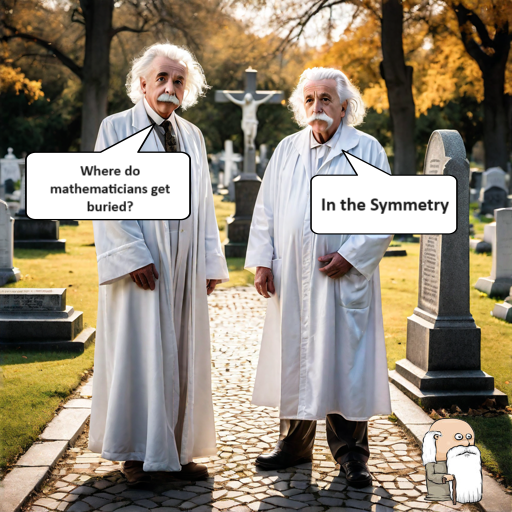
How do deaf mathematicians communicate?
Through sine language.
Old mathematicians never die.
They just disintegrate.
Why did the mathematician work at home?
Because he could only function in his domain.
Did you hear what happened to the mathematician who couldn’t stop adding up, until it finally all got too much for him?
He had an incremental breakdown.
I used to hate math until I realised that decimals have a point.
Why is advanced geometry class boring?
Because it’s full of squares.
What did the arrogant math teacher do when he was wrong?
He ate a slice of humble pi.
When math teachers retire, how do they cope with the aftermath?
I’m struggling in math class.
It just feels like we’re going in circles.
Why should you wear glasses during math class?
It improves division.
What do organic mathematicians throw on their fire?
Natural logs.
I don’t really like math, but I’m partial to fractions.
I tried studying negative numbers but I became nonplussed.
What happens to mathematicians who don’t practise safe sex?
They get binarial disease.
I read a math book the other day.
To be honest, I thought a lot of it was rather derivative.
Can bad mathematicians not count on their friends?
I should never have become a math teacher.
It was a miscalculated move.
Why will we never run out of math teachers?
Because they always multiply.
And that’s not all …..


Thank you for reading my writings. If you’d like to, you can buy me a coffee for just £1 and I will think of you while writing my next post! Just hit the link below…. (thanks in advance)
Joke of the Day: Maths
Thank you for reading my writings. If you’d like to, you can buy me a coffee for just £1 and I will think of you while writing my next post! Just hit the link below…. (thanks in advance)
Joke of the Day: Darth Vader
This Day in History: March 15th
Here are 10 historical events that took place on March 15th, listed in chronological order:
- 44 BC: The assassination of Julius Caesar by a group of Roman senators, including Brutus and Cassius, takes place in the Theatre of Pompey in Rome.
- 493: The Ostrogoths under Theodoric the Great defeat the forces of Odoacer at the Battle of Verona, establishing Theodoric as ruler of Italy.
- 1493: Christopher Columbus returns to Spain after his first voyage to the Americas, concluding his expedition.
- 1781: During the American Revolutionary War, British forces under General Cornwallis defeat the Continental Army under General Greene at the Battle of Guilford Courthouse in North Carolina.
- 1820: Maine becomes the 23rd state of the United States.
- 1917: Tsar Nicholas II of Russia abdicates the throne, marking the end of the Romanov dynasty and the start of the Russian Revolution.
- 1939: Germany occupies Czechoslovakia, violating the Munich Agreement and escalating tensions leading up to World War II.
- 1972: The United Kingdom imposes direct rule over Northern Ireland, suspending the Northern Ireland Parliament and government.
- 1985: The first Internet domain name, symbolics.com, is registered by the Symbolics Computer Corporation, marking the beginning of the commercial Internet era.
- 2011: Syrian civil war begins with protests against President Bashar al-Assad’s government erupting in several cities across the country.
Thank you for reading my writings. If you’d like to, you can buy me a coffee for just £1 and I will think of you while writing my next post! Just hit the link below…. (thanks in advance)
Thought of the Day: Lies and Truth
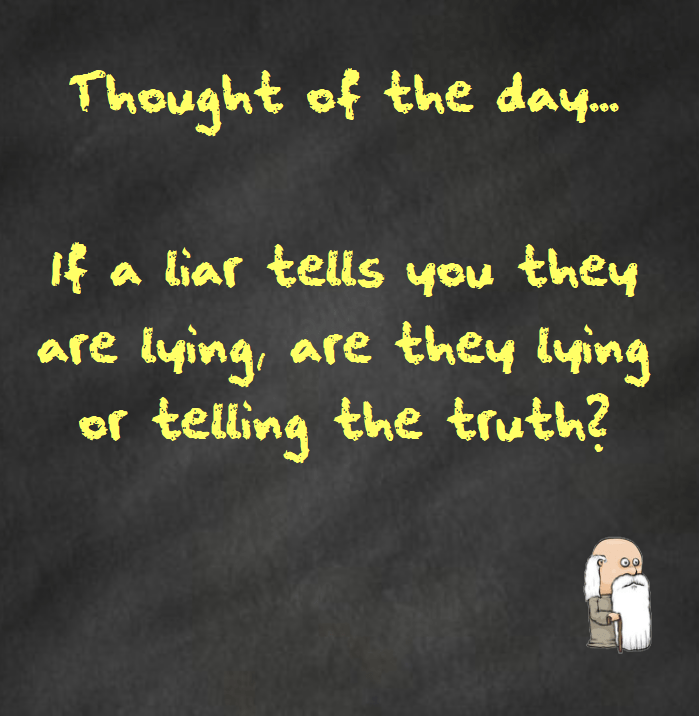
If a liar tells you they are lying, are they lying or telling the truth?
This scenario presents a classic paradox known as the liar paradox. If a liar claims they are lying, it creates a contradiction because if they are indeed lying, then they are telling the truth about lying, which means they are not lying. Conversely, if they are telling the truth about lying, then they are not actually lying, which contradicts their initial statement.
In essence, the statement creates a logical loop without a clear resolution, highlighting the inherent complexity and ambiguity that can arise in certain self-referential situations. It’s a playful reminder of the intricacies of language and logic.
Thank you for reading my writings. If you’d like to, you can buy me a coffee for just £1 and I will think of you while writing my next post! Just hit the link below…. (thanks in advance)
Joke of the Day: Pizza
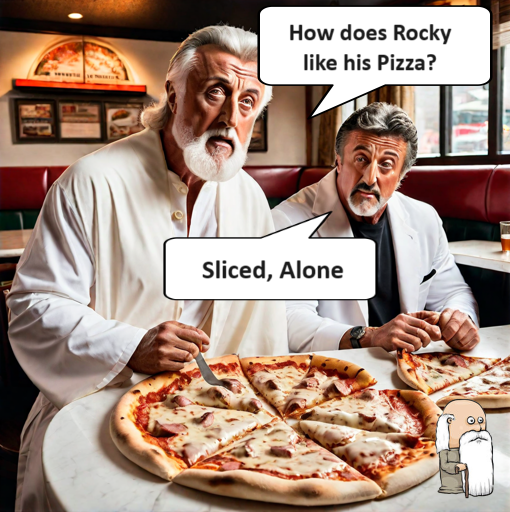
I wasn’t expecting the pizza delivery guy to turn up tonight wearing a Gloria Gaynor face mask!
At first, I was afraid…
What’s the difference between a simple person and a pizza?
One is easy to cheat, and the other is cheesy to eat.
“I’m here to collect my pizza”
“Would you like olives?”
“No, just mine.”
Did you hear about the lobster that got a job at Pizza Hut?
He works in the crust station.
How did the hipster burn his mouth?
He ate pizza long before it was cool.
I was arguing with a friend in Pizza Hut the other day when my best mate came over, grabbed the garlic bread and coleslaw from our table, and ran off. I wish he would stop taking sides.
My local pizzeria has just made the world’s largest pizza base. I’d like to see someone top that.
Burnt my Hawaiian pizza.
Should have used aloha temperature.
I have been trying to write a new pizza joke but I can’t work out the delivery…
I had a goat’s cheese pizza the other day. He wasn’t happy.
Chap goes to collect his pizza and asks if he wants it cut into six or twelve pieces.
“Six”, he says, “I could never eat twelve”.
I would tell you a joke about pizza toppings but it’s too cheesy.
The best way to stop a pizza curling is to hide its brush.
I called a local pizza place the other night and said,
“Do you do takeaways?”
They said “Yes”, so I said “What’s 23452 minus 345?”
Thank you for reading my writings. If you’d like to, you can buy me a coffee for just £1 and I will think of you while writing my next post! Just hit the logo below…. (thanks in advance)

Thought of the Day: Strangers
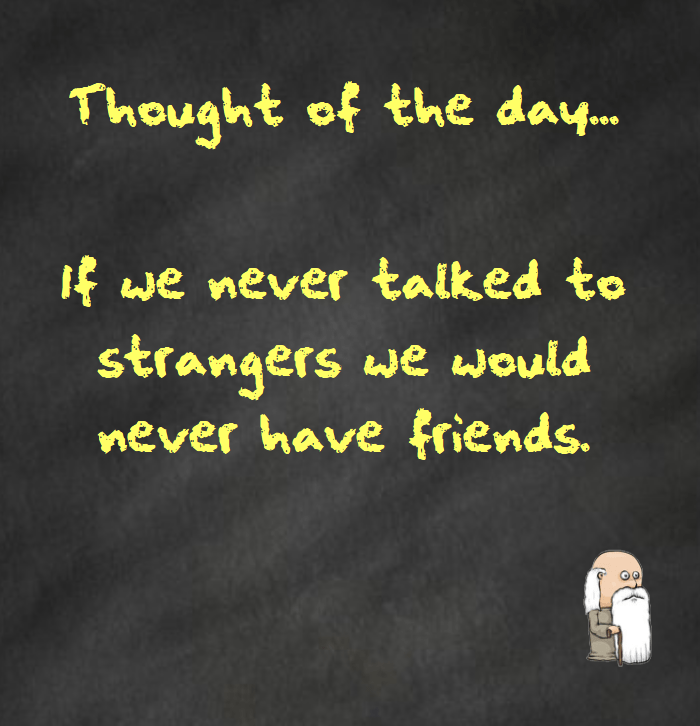
If we never talked to strangers we would never have friends.
While it’s true that many friendships begin with interactions between strangers, it’s not a strict rule that you must talk to strangers to make friends. Friendships can also develop through mutual acquaintances, shared interests, activities, or common experiences. However, being open to meeting new people and engaging in conversations with strangers can certainly broaden your social circle and increase your chances of forming new friendships. Ultimately, the key is to be open-minded and receptive to the possibility of connecting with others, whether they are strangers or not.
Thank you for reading my writings. If you’d like to, you can buy me a coffee for just £1 and I will think of you while writing my next post! Just hit the link below…. (thanks in advance)

