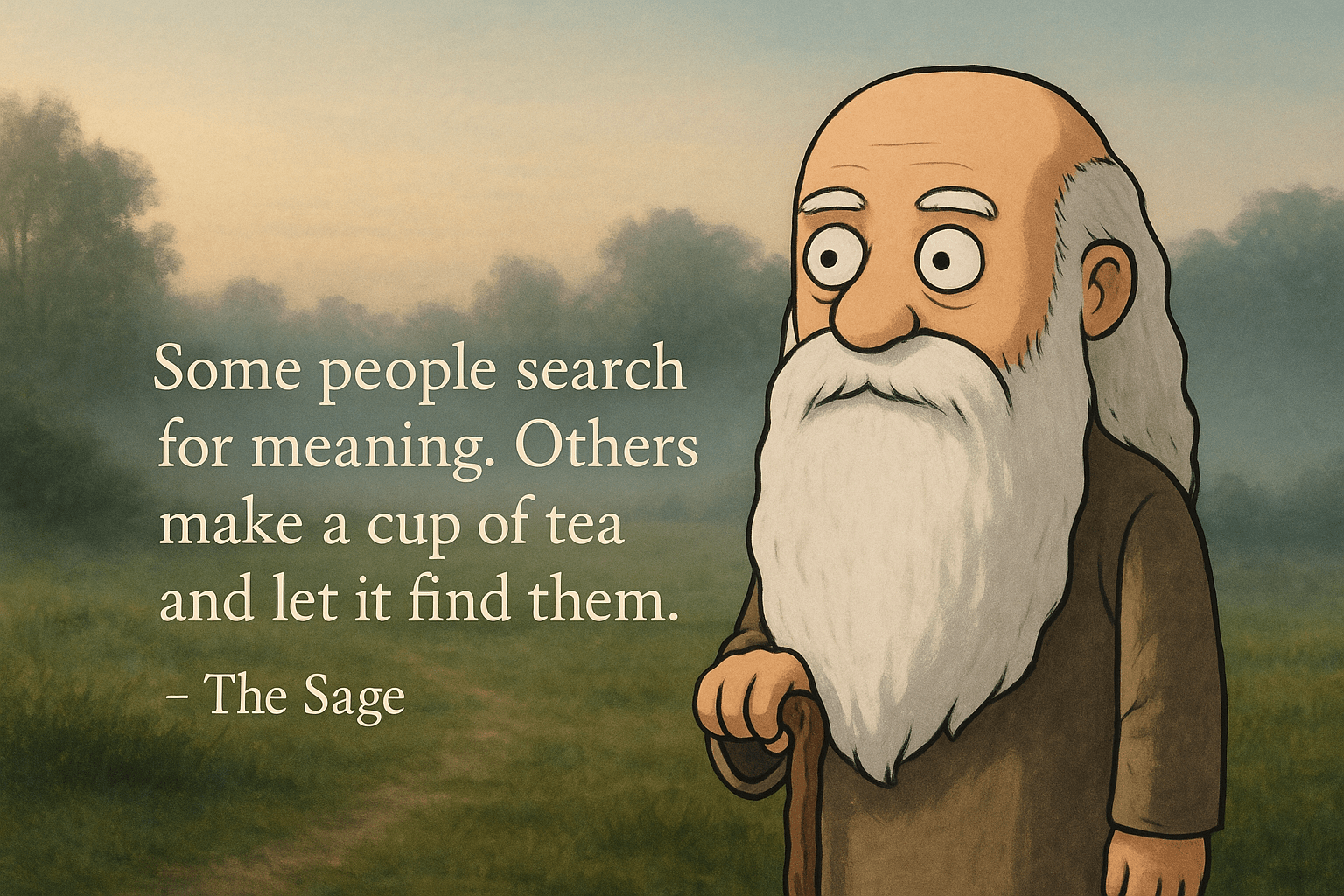
In today’s Quote of the Day, The Sage muses on life’s quiet simplicity: “Some people search for meaning. Others make a cup of tea and let it find them.” A warm, humorous reflection on patience, peace, and how sometimes wisdom arrives not through effort — but through stillness.
Tag Archives: philosophy
Quote of the Day: Patience
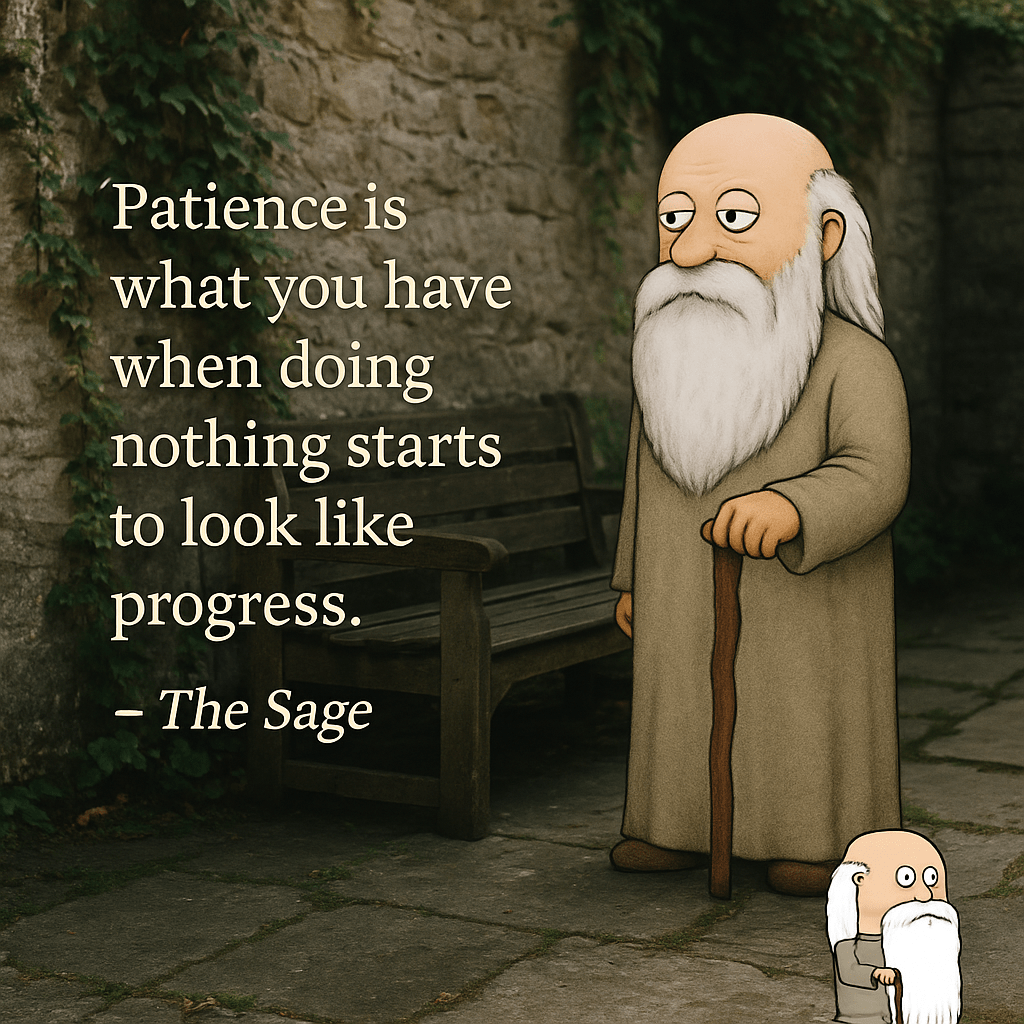
In today’s Quote of the Day, The Sage reflects on the quiet art of patience: “Patience is what you have when doing nothing starts to look like progress.” A gentle, witty reminder that stillness can be strength, and sometimes the best way forward is to wait with grace — and a smile.
Quote of the Day: Wisdom

In today’s Quote of the Day, The Sage muses that wisdom isn’t about answers but about patience and humour. “Wisdom isn’t knowing the answer — it’s remembering the question long enough to laugh at it.” A light-hearted reflection on curiosity, humility, and the joy of not knowing.
About The Sage

Discover the remarkable story of The Sage, Dorchester’s most eccentric philosopher. From his biscuit-based enlightenment to his wildly impractical wisdom, The Sage blends British humour, tea, and quiet confusion into a philosophy that proves enlightenment can happen anywhere — even in Dorset.
A measure for pleasure?

Can pleasure be measured in terms of quantity as well as quality? What’s more pleasurable to a ten-year-old – a kitten, a teddy bear, or a bar of chocolate? Can we turn a subjective concept like pleasure into an objective measure or comparison? A man called “Jeremy” thought so. Jeremy Bentham (1748–1832) was an EnglishContinue reading “A measure for pleasure?”
Remembering and forgetting in Ireland.

Where does tradition meet collective memory? In considering this question it is important to clarify the terms “tradition” and “collective memory”. The Oxford English Dictionary defines tradition as ‘A belief, statement, custom, etc., handed down by non-written means (esp. word of mouth, or practice) from generation to generation; such beliefs, etc., considered collectively.’ The keyContinue reading “Remembering and forgetting in Ireland.”
How did Sartre and Beauvoir explain the philosophy of existentialism?

Did Simone de Beauvoir improve on Sartre’s views? Jean Paul Sartre (1905-1980) was the leading light in the philosophy of existence known as existentialism and an award-winning author. Together with Simone de Beauvoir (1908—1986) – herself a preeminent French existentialist philosopher and writer – he would hang out in Parisian Cafes in the 1940s withContinue reading “How did Sartre and Beauvoir explain the philosophy of existentialism?”
What was Marx’s problem with capitalism?

Is greater state control of the economy the solutuon to a post Covid recession? Karl Marx (1818 – 1883) is best know as the father of Marxism. He was a philosopher, author, and economist and is renowned for his manifestos on capitalism and communism. In describing Marx’s objections to capitalism it is necessary to defineContinue reading “What was Marx’s problem with capitalism?”
What was Rousseau and Hobbes’ view of the ‘state of nature’?

Did Rousseau undermine Hobbes’ views on absolute rule? Thomas Hobbes (1588-1679) was an English philosopher who wrote at a time of great civil unrest and turbulence in his own country, his major works were written in exile in France during the English Civil War. Hobbes described the “state of nature” in his Tetralogy of BooksContinue reading “What was Rousseau and Hobbes’ view of the ‘state of nature’?”
Quote of the Day: Opinion
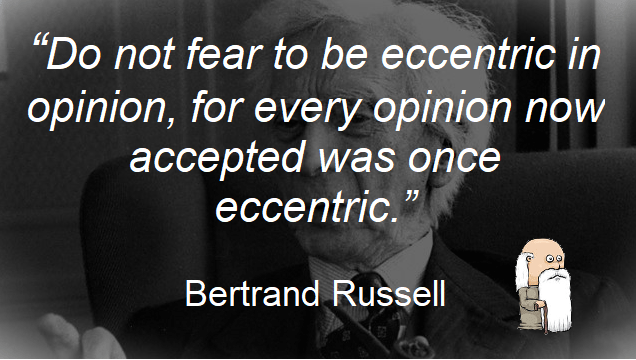
“Do not fear to be eccentric in opinion, for every opinion now accepted was once eccentric.” Bertrand Russell Bertrand Russell is perhaps my favourite of the “modern-day” philosophers as he made philosophy available to a wide audience through his books, lectures, and broadcasts. This quote will surely resonate with all the scientists, academics, inventors, andContinue reading “Quote of the Day: Opinion”
 The Sage Page