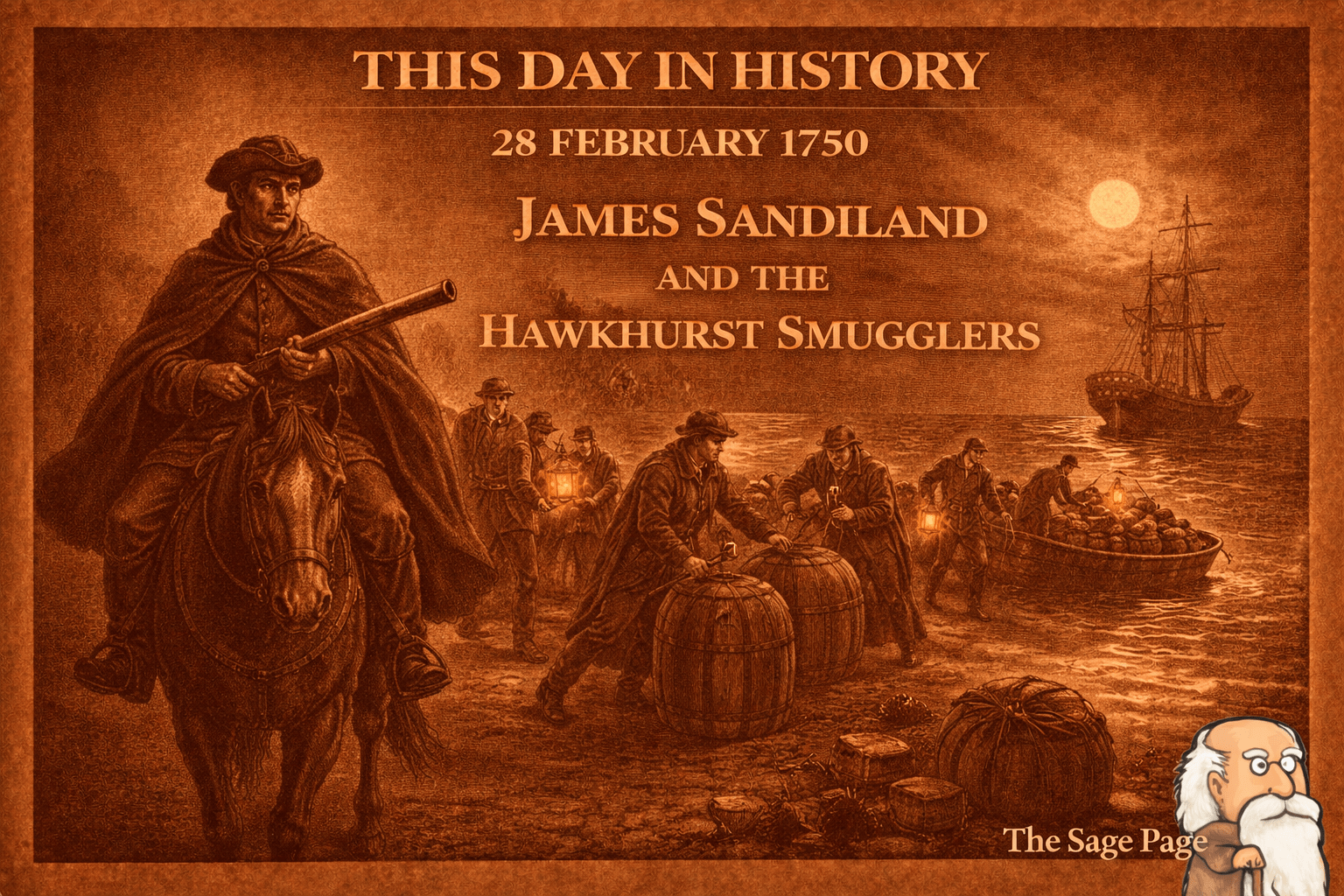
James Sandiland and the Hawkhurst Smugglers
On 28 February 1750, James Sandiland — also known as James Scot — was convicted at the Old Bailey for aiding and assisting in the landing of smuggled goods in Kent.
A month later, he was executed at Tyburn.
His crime?
Not murder.
Not highway robbery.
Smuggling.
But not ordinary smuggling.
This was the age of the Hawkhurst Gang.
The Smugglers of Kent
Mid-18th century Kent was a frontier in all but name.
Heavy duties on tea, brandy and other imports made smuggling immensely profitable. Entire coastal communities were entangled in it.
The Hawkhurst Gang were not furtive runners slipping through hedgerows.
They were:
- Armed
- Organised
- Mounted
- Public
- Intimidating
Witnesses described them riding openly through Lydd:
- 10 to 15 strong
- Horses laden with oilskin bags
- Half-anchors of brandy
- Carbines and blunderbusses slung over shoulders
This was not stealth.
This was dominance.
The Evidence Against Sandiland
John Pelham swore he saw Sandiland:
- On horseback
- Armed with a carbine or blunderbuss
- Carrying a bag of tea
- Among armed men landing goods from a cutter off Dungeness
Humphry Hatton confirmed:
- He had known Sandiland for seven years
- He recognised him instantly
- He belonged to the Hawkhurst Gang
Another officer recorded the date carefully in his journal:
13 August 1746.
Four years later, that memory would hang a man.
The Defence: The Butcher of Westerham
Sandiland denied everything.
He claimed:
- He had never been to Lydd in his life
- He was a butcher in Westerham
- He killed his beasts himself
- He was always present on market days
- He had wife and small children
- He was no smuggler
He even suggested that when witnesses saw him in Maidstone Gaol, they marked him by accident — because a cat ran up his shoulder.
It is one of the more unusual courtroom defences in Old Bailey history.
But then came character witnesses.
And they were divided.
Some called him:
- Industrious
- Respectable
- A steady tradesman
Others called him:
- “A great smuggler”
- Known “all over the country”
- Armed
- Connected to the Hawkhurst Gang
In 1750, reputation could be fatal.
Why Smuggling Was a Capital Crime
Smuggling itself was common.
Armed smuggling was not tolerated.
Parliament had passed severe statutes:
- Being armed in numbers of ten or more
- Rescuing goods from officers
- Intimidating excisemen
- Landing contraband in force
These were treated as attacks on the Crown’s revenue.
And Crown revenue was sacred.
The state could forgive petty theft.
It would not forgive organised defiance.
The Ordinary’s Account: A Moral Biography
After his conviction and before his execution on 26 March 1750, the Ordinary of Newgate recorded Sandiland’s final narrative.
The tone shifts.
We see:
- A journeyman butcher
- A man who admitted buying and selling tea and brandy
- A man “in his sober hours quiet enough”
- But violent and intimidating when drunk
He admitted:
He was a smuggler “in general,”
but never of any particular gang.
A convenient distinction.
The Ordinary painted him as a man whose fire, once dampened by imprisonment, later burned hotter.
It is moral theatre — but also revealing.
Execution at Tyburn
On 26 March 1750, James Sundiland (as recorded in the Ordinary’s list) was executed at Tyburn among a group of condemned prisoners.
Smuggling had made him prosperous.
It did not save him.
The Wider Context: The Hawkhurst Gang
Arthur Gray, named in Sandiland’s trial, had already been executed in 1748.
The Hawkhurst Gang were infamous for:
- Brutality
- Public intimidation
- Murder of informers
- Organised coastal landings
By mid-century, the government had resolved to crush them.
Sandiland’s conviction was part of that wider suppression.
The Irony
He was not executed for:
- Personally killing anyone
- Robbing travellers
- Setting houses alight
He was executed for standing armed with tea and brandy.
Revenue was empire.
And empire was law.
Sources
- Old Bailey Proceedings, 28 February 1750, trial of James Sandiland alias James Scot.
- Ordinary of Newgate’s Account, execution of 26 March 1750.
- Contemporary records concerning the Hawkhurst Gang and Kent smuggling operations (mid-18th century).
The Hawkhurst Gang
Britain’s Most Violent Smugglers
If James Sandiland was merely a butcher with a sideline in tea and brandy, he would likely have been fined.
If he had carried contraband quietly through hedgerows, he might have escaped notice.
But the name attached to him in court changed everything:
The Hawkhurst Gang.
Who Were They?
The Hawkhurst Gang operated primarily in:
- Kent
- Sussex
- Hampshire
During the 1730s and 1740s, they became the most feared smuggling organisation in Britain.
They were not furtive coastal traders.
They were:
- Armed in numbers
- Organised across counties
- Openly defiant
- Socially embedded in local communities
They landed tea, brandy and other taxed goods on the Kent coast — especially near Dungeness and Lydd — often in broad daylight.
Smuggling as Industry
Heavy duties on tea and spirits made smuggling immensely profitable.
At times:
- Tea could be smuggled for half the legal price.
- Entire villages benefitted.
- Local inns provided shelter.
- Farmers lent horses.
- Ostlers knew when to look away.
Smuggling was not fringe criminality.
It was alternative commerce.
But the Hawkhurst Gang Went Further
Many smugglers avoided confrontation.
The Hawkhurst men embraced it.
They were known for:
- Riding armed with carbines and blunderbusses
- Rescuing seized goods from customs officers
- Assaulting excisemen
- Intimidating witnesses
- Murdering informers
They carried contraband like soldiers on campaign.
Their very presence was theatrical.
Public Terror
The most notorious example of their brutality was the murder of customs officer William Galley and informer Daniel Chater in 1748.
Chater was brutally tortured and killed after identifying gang members.
The case shocked the nation.
Parliament responded with determination:
The gang would be broken.
Executions followed.
Why Sandiland’s Case Mattered
When James Sandiland was identified as riding armed with oilskin bags and tea behind him, he was not being judged as a lone trader.
He was being judged as part of a movement.
By 1750, the Crown was no longer willing to tolerate:
- Armed landings
- Open defiance
- Gang solidarity
Smuggling in numbers of ten or more while armed was treated as an attack on state authority.
And state authority, in the age of empire, was not negotiable.
The End of an Era
Through:
- Informers
- Military patrols
- Public executions
- Transportation
The Hawkhurst Gang was gradually dismantled by the early 1750s.
The message was clear:
You may evade taxes.
You may not challenge the Crown.
The Broader Significance
The story of the Hawkhurst Gang reveals something important about 18th-century Britain:
The line between community hero and capital felon was thin.
To locals, smugglers could be:
- Benefactors
- Employers
- Protectors
To the state, they were:
- Armed rebels in miniature
- Economic insurgents
- Threats to imperial finance
James Sandiland died at Tyburn not simply for tea and brandy —
but for standing in that fault line.
Thank you for reading my writings. If you’d like to, you can buy me a coffee for just £1 and I will think of you while writing my next post! Just hit the link below…. (thanks in advance)

 The Sage Page