Old Bailey Trial: The Fire in Little Pultney Street
A Fire in the Night
In the early hours of Monday, 24th March 1788, as London slept beneath a clear spring sky, a quiet street in St James, Westminster, began to fill with the unmistakable scent of smoke.
It was not flame that came first—but smell.
From within a modest tailor’s house in Little Pultney Street, a faint but growing odour crept through walls and floorboards. Then came the sound: the sharp, unnatural cracking of wood under heat.
By the time the neighbours realised what was happening, it was already too late.
The Accused
At the centre of the case stood:
- David Clary, a tailor by trade
- Elizabeth Gombert, his housekeeper and companion
They were accused not merely of setting fire to a house—but of doing so deliberately, and with intent to burn the neighbouring property of John Imray, a grocer whose premises adjoined Clary’s.
Under English law, this distinction mattered greatly.
A man burning his own house was not necessarily guilty of felony.
But if that fire spread?
Then it became something far darker.
A Suspicious Blaze
The fire began in a small, cramped space described as a “ware-room”—a narrow, windowless area beneath the stairs.
There was no fireplace.
No candle.
No reason for fire at all.
Yet witnesses described something else entirely.
Sarah Bishop, a lodger, recalled waking to:
“A smell of oil, very strong and powerful… and the cracking of wood.”
When she opened her door, smoke poured in so thick it nearly suffocated her.
A Strange Calm
What struck many witnesses was not panic—but composure.
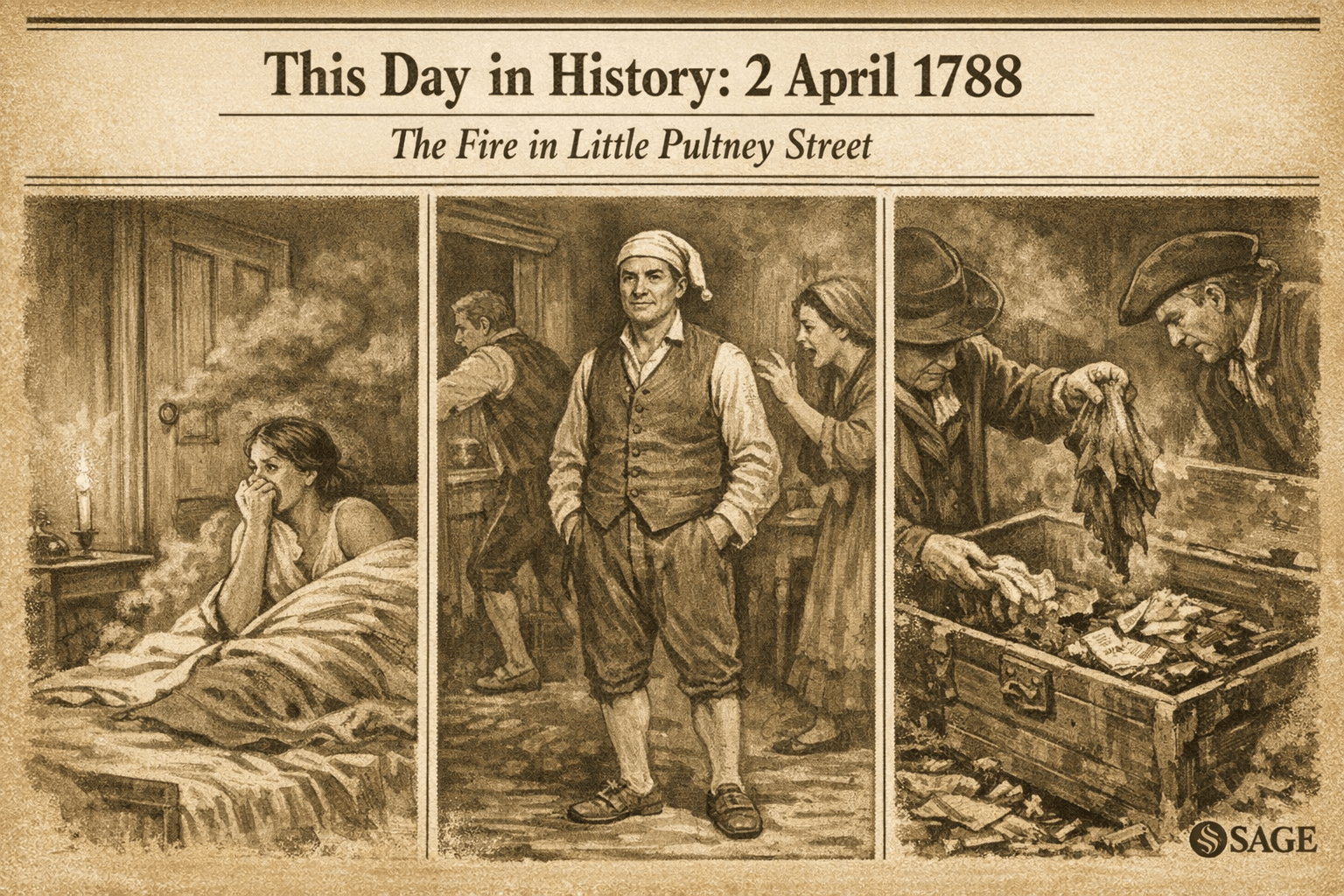
When lodgers rushed upstairs in alarm, they found Clary:
- Fully dressed
- Standing calmly
- Hands in his pockets
He made no attempt to save his goods.
No effort to open the shop shutters.
Instead, he reassured others.
“Do not alarm yourself.”
Meanwhile, Elizabeth Gombert told neighbours the fire was likely “in the next house.”
“Hush! Hush!” in the Dark
Outside, the mystery deepened.
A neighbour, roused by the smell of smoke, called out into the night:
“For God’s sake, tell me where the fire is!”
The reply came—not as help, but as warning:
“Hush! hush!”
No alarm was raised.
No cry of fire.
Only silence—and smoke.
The Vanishing Goods
Clary had recently insured his property for £900.
After the fire, he claimed losses far exceeding that:
- Hundreds of pounds in bank notes
- Dozens of coats and waistcoats
- Thousands of buttons
- Large quantities of silk and nankeen
Yet when the ruins were searched, almost nothing was found.
No melted metal.
No cloth.
No silver.
No bank notes.
Instead, investigators uncovered something else.
The Chest
At the centre of the fire’s origin lay a partially burned chest.
Clary identified it immediately:
“That is the chest where my property was.”
Inside, they expected to find wealth.
Instead, they found:
- Hay-bands
- Paper soaked in oil
- Combustible material carefully arranged
A fire waiting to happen.
The Evidence of Poverty
Witness after witness painted a consistent picture of Clary’s circumstances:
- Unable to pay rent
- Unable to pay taxes
- Frequently in debt
- Little visible stock in his shop
One lodger observed bluntly:
“I wonder how Mr. Clary lives in this manner.”
Yet suddenly—just weeks before the fire—he insured his goods.
And after the fire?
He claimed riches no one had ever seen.
The Fatal Logic of Circumstance
There were no eyewitnesses to the act itself.
No one saw a flame lit.
But the prosecution did not need one.
They relied on circumstantial evidence, carefully layered:
- A fire in a place where no fire should be
- Combustible materials hidden in a chest
- Missing goods that had likely never existed
- A man in debt, recently insured
- Suspicious behaviour before, during, and after the fire
As the prosecutor told the jury:
“No man sets fire to a house in the presence of another… it must depend on circumstances.”
The Verdict
After hearing extensive testimony, the jury delivered its decision:
- David Clary — GUILTY
- Elizabeth Gombert — NOT GUILTY
Clary was sentenced to death.
Why This Case Matters
The Clary case is not merely a story of arson.
It is an early example of something distinctly modern:
👉 Insurance fraud
But more than that, it reveals a deeper truth about justice in the 18th century:
- Guilt did not require direct proof
- Behaviour could condemn as surely as action
- A man’s character, debts, and contradictions could form a noose as tight as any rope
And perhaps most chilling of all—
The fire itself did not need to be seen.
Only understood.
Thank you for reading my writings. If you’d like to, you can buy me a coffee for just £1 and I will think of you while writing my next post! Just hit the link below…. (thanks in advance)

 The Sage Page