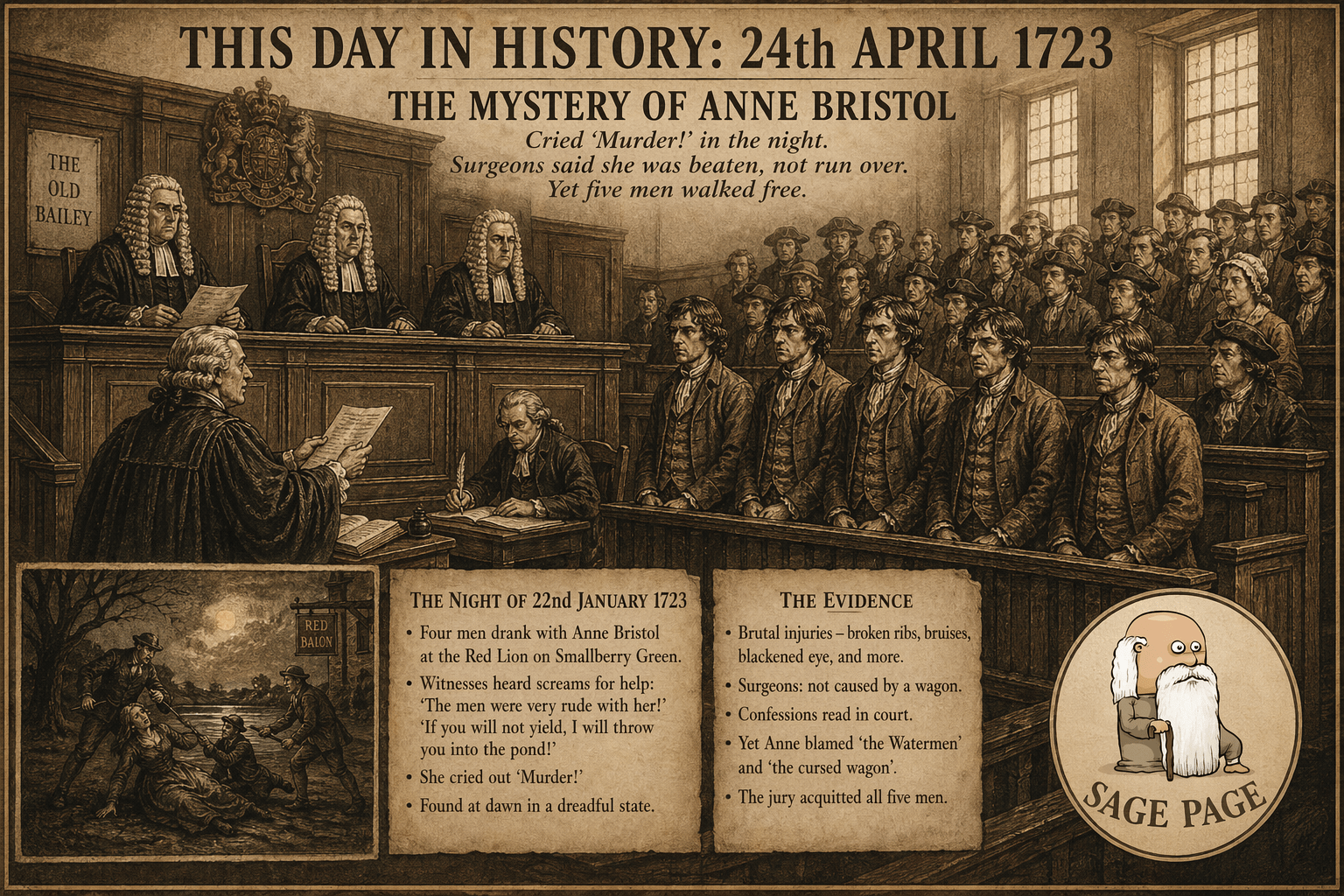
The Mystery of Anne Bristol on Smallberry Green
On 24 April 1723, five men stood at the Old Bailey accused of the murder of Anne Bristol, a woman found dying on Smallberry Green near Isleworth after a night of drinking, arguments, and desperate cries for help in the darkness.
Witnesses heard her scream for mercy. Surgeons found broken ribs, bruises, and injuries they believed could not have been caused by a wagon accident. Confessions were read in court. Yet, after hearing everything, the jury acquitted all five men.
It remains one of the most troubling and uncertain cases of the eighteenth-century Old Bailey.
A Night at the Red Lion
Anne Bristol spent the evening of 22 January 1723 at the Red Lion on Smallberry Green, drinking with four watermen: George Smith, Joseph Buckingham, James Simpkin, and Samuel Loyd.
Witnesses described the men as being extremely familiar with her. Buckingham reportedly kissed her repeatedly, calling her “his wife” and “his dear,” while Simpkin also kissed her. They remained drinking together until around eleven o’clock at night.
Elizabeth Ruffin, the landlady, later stated that Anne paid part of the reckoning herself before leaving the tavern with the four men.
This would be the last time she was seen well.
Cries in the Dark
Later that night, neighbours were disturbed by screams coming from Smallberry Green.
Susan Willis, who lived nearby, heard a woman crying out that “the men were very rude with her.” She then heard a male voice threaten:
“If you will not yield, I will throw you into the pond.”
Another man reportedly shouted that if she had consented, “it would have been all over by that time.”
When Susan called from her window asking what was happening, one of the men chillingly replied that they were abusing a woman against her will.
Then came the cry:
“Murder!”
Other witnesses heard similar cries between midnight and two in the morning. Waggoners passing through the darkness heard Anne begging for help.
“Waggoner, waggoner, for God’s sake help!”
One driver dismissed her as drunk and drove on.
Another heard her say she was lost and trying to get to Brentford.
No one stopped.
Found Dying on the Green
The next morning Anne Bristol was discovered on the ground in dreadful condition.
Her clothes were torn and filthy. She had no cap on her head. She was bruised, weak, and barely able to move.
When asked what had happened, she gave several desperate answers.
To some she cried:
“O, the Watermen! The Watermen!”
To others she blamed:
“The wagon! The cursed wagon has killed me!”
Witnesses later said she begged to be taken home and put to bed, saying the woman of the house had turned her out “to her destruction.”
She also told one woman that three men had held her down while a fourth tried to force himself upon her.
Within minutes of being carried into a barn for shelter, Anne Bristol died.
The Surgeons’ Verdict
The medical evidence transformed the case.
Surgeons James Bothune and Henry Parsons examined the body and found terrible internal injuries.
Her eye was blackened. Her elbow was broken. Her wrists, knees, and ankles were badly damaged. Her ribs—five of them—were broken, with one rib forced inward against the lungs. There was a pint of coagulated blood inside her chest.
There were bruises on her thighs and chest, scratches on her hands and knees, and signs of violent handling around her wrists and ankles.
Most importantly, both surgeons firmly stated that these injuries did not look like the result of a wagon wheel.
If a loaded wagon had run over her, they argued, the damage would have been far more obvious externally. Bones such as the collarbone would also likely have been shattered. Instead, the injuries looked more like the result of kicking, stamping, or deliberate violence.
That medical opinion gave the prosecution its strongest weapon.
The Confessions
The Crown also introduced statements allegedly made by the accused.
Joseph Buckingham reportedly admitted that George Smith had lain with Anne Bristol on the Green, while the others tried to do the same. He said Samuel Loyd kicked her when she refused him.
James Simpkin’s earlier examination similarly stated that Smith had lain with her and that he saw Loyd kick her while she was on the ground.
George Smith himself admitted being with Anne that night.
To the prosecution, this painted a clear picture of drunken assault leading to fatal injuries.
The Defence: It Was the Wagon
The defence insisted Anne’s death was an accident.
They argued she was heavily drunk, had been falling over all evening, and had even been pulled from a ditch earlier that day.
Several witnesses claimed they heard Anne herself repeatedly say that a wagon had run over her.
One wagon driver testified that she grabbed hold of his horse and refused to let go, despite warnings she would be dragged beneath the wheels. Another woman riding in the wagon said she felt the wheel pass over “something,” and feared it had been Anne.
Other local witnesses insisted she was known for drunkenness and disorderly behaviour and claimed she had said herself that the wagon was responsible.
The defence argued that the men had merely drunk with her and left her behind.
Nothing more.
An Unexpected Verdict
Despite the dramatic accusations, the cries for help, the medical evidence, and the supposed confessions, the jury acquitted all five men.
George Smith, Joseph Buckingham, Samuel Loyd, James Simpkin, and William Hassel all walked free.
Why?
Possibly because Anne herself gave conflicting accounts. Possibly because drunkenness clouded every witness. Possibly because the jury preferred the simpler explanation of a tragic wagon accident over a coordinated violent assault.
Or perhaps, as often happened in eighteenth-century justice, certainty simply could not be reached.
But the result leaves an uneasy feeling.
A woman died in agony on Smallberry Green.
Many heard her cry.
No one was punished.
William Hassel remains the most uncertain figure in the case. Unlike George Smith, Buckingham, Loyd, and Simpkin, he was not strongly identified as one of the men drinking with Anne Bristol at the Red Lion or as one of those heard threatening her on Smallberry Green. Instead, his name appears most clearly in the grim aftermath. Witnesses stated that when Anne was found badly injured the following morning, it was William Hassel who helped fetch the wheelbarrow, and he assisted Hardin Ruffin and George Ockram in lifting her into it and moving her towards the bridge. This placed him at the centre of the final moments before her death. The prosecution appears to have believed that either he had been involved in the assault itself, or that he had helped the others by removing Anne rather than seeking proper help for her. Yet no witness could firmly place him among the attackers, and no confession directly accused him of violence. In the end, like the other four men, he was acquitted, leaving his true role in Anne Bristol’s death one of the lingering mysteries of the case.
Why This Case Still Matters
This case reveals how difficult justice could be in early eighteenth-century England—especially when the victim was poor, female, and socially vulnerable.
Anne Bristol’s final hours were witnessed by many, yet no one intervened in time.
Even with surgeons giving strong evidence of violence, the legal system hesitated.
It is a haunting reminder that truth in the Old Bailey was not always enough to secure a conviction.
Sometimes, even with cries of murder in the night, nobody paid for the crime.
Thank you for reading my writings. If you’d like to, you can buy me a coffee for just £1 and I will think of you while writing my next post! Just hit the link below…. (thanks in advance)


