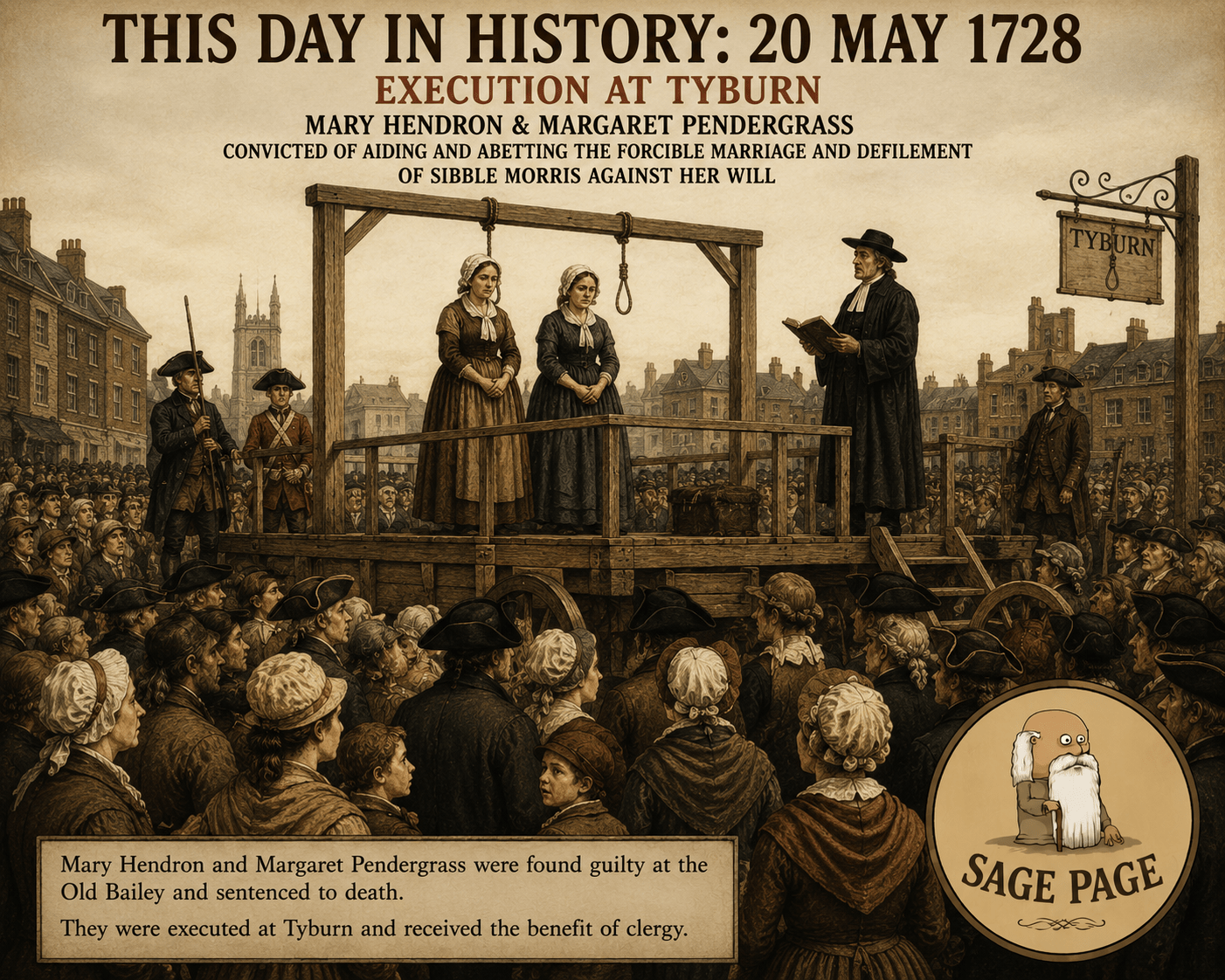
Execution at Tyburn: Mary Hendron & Margaret Pendergrass
On this day in 1728, Mary Hendron and Margaret Pendergrass were executed at Tyburn for their part in a deeply troubling case involving the coercion and exploitation of a young woman, Sibble Morris. Though they did not act alone, the law ultimately fell most heavily upon them.
The Victim: Sibble Morris
At the heart of the case was Sibble Morris, a young woman whose vulnerability was ruthlessly exploited. Evidence presented at trial suggested that she was lured under false pretences, manipulated, and effectively delivered into the hands of others against her will.
Accounts indicate that Morris resisted her situation, and her distress became a central feature of the prosecution’s case. Her testimony painted a picture not of consent, but of pressure, intimidation, and calculated deceit, carried out by those she might reasonably have trusted.
The Scheme
Mary Hendron and Margaret Pendergrass were portrayed as active facilitators in the plot. Rather than being peripheral figures, they were said to have:
- Encouraged Morris into their company
- Misled her about the circumstances she was entering
- Assisted in delivering her into a situation where her autonomy was stripped away
The crime was not a moment of impulse, but something that appeared pre-arranged and deliberate—a scheme in which Morris was treated as a means to an end.
The Man Who Escaped the Gallows
Crucially, the case also involved a male accomplice, widely understood to be the principal actor in the intended outcome of the plot. However, in a striking turn, he was acquitted at trial.
This outcome reflects a recurring pattern in early modern prosecutions:
- Evidentiary thresholds could differ sharply between defendants
- Juries were sometimes reluctant to convict where intent was less clearly proven
- Women, particularly those seen as morally suspect, could be judged more harshly when cast as enablers of vice
While the man’s role appeared central to the scheme, the jury ultimately found insufficient grounds to convict him of the capital charge—leaving Hendron and Pendergrass to bear the full weight of the law.
Trial and Conviction
At the Old Bailey, the prosecution emphasised the premeditation and coordination involved. The two women were depicted not as passive followers, but as knowing participants who helped orchestrate the events.
The jury agreed.
Both Hendron and Pendergrass were found guilty and sentenced to death—a punishment reflecting not only the crime itself, but the perceived moral corruption underlying it.
Execution at Tyburn
As was customary, the condemned women were carried from Newgate to Tyburn in a public procession, watched by crowds drawn to the spectacle.
At the gallows, they were given time for prayer and final reflection. Contemporary accounts suggest they acknowledged their fate with outward solemnity, urged to repentance by attending clergy.
Shortly thereafter, both were hanged.
Context and Reflection
This case reveals much about the justice system of the time:
- Coercion and exploitation, especially involving women, were treated with severe punishment
- Public morality played a powerful role in determining guilt and sentencing
- Outcomes could be uneven, with accomplices treated very differently depending on how their roles were perceived
The execution of Hendron and Pendergrass stands as a stark example of how the law sought to punish not only actions, but the perceived moral failings behind them.
Thank you for reading my writings. If you’d like to, you can buy me a coffee for just £1 and I will think of you while writing my next post! Just hit the link below…. (thanks in advance)


