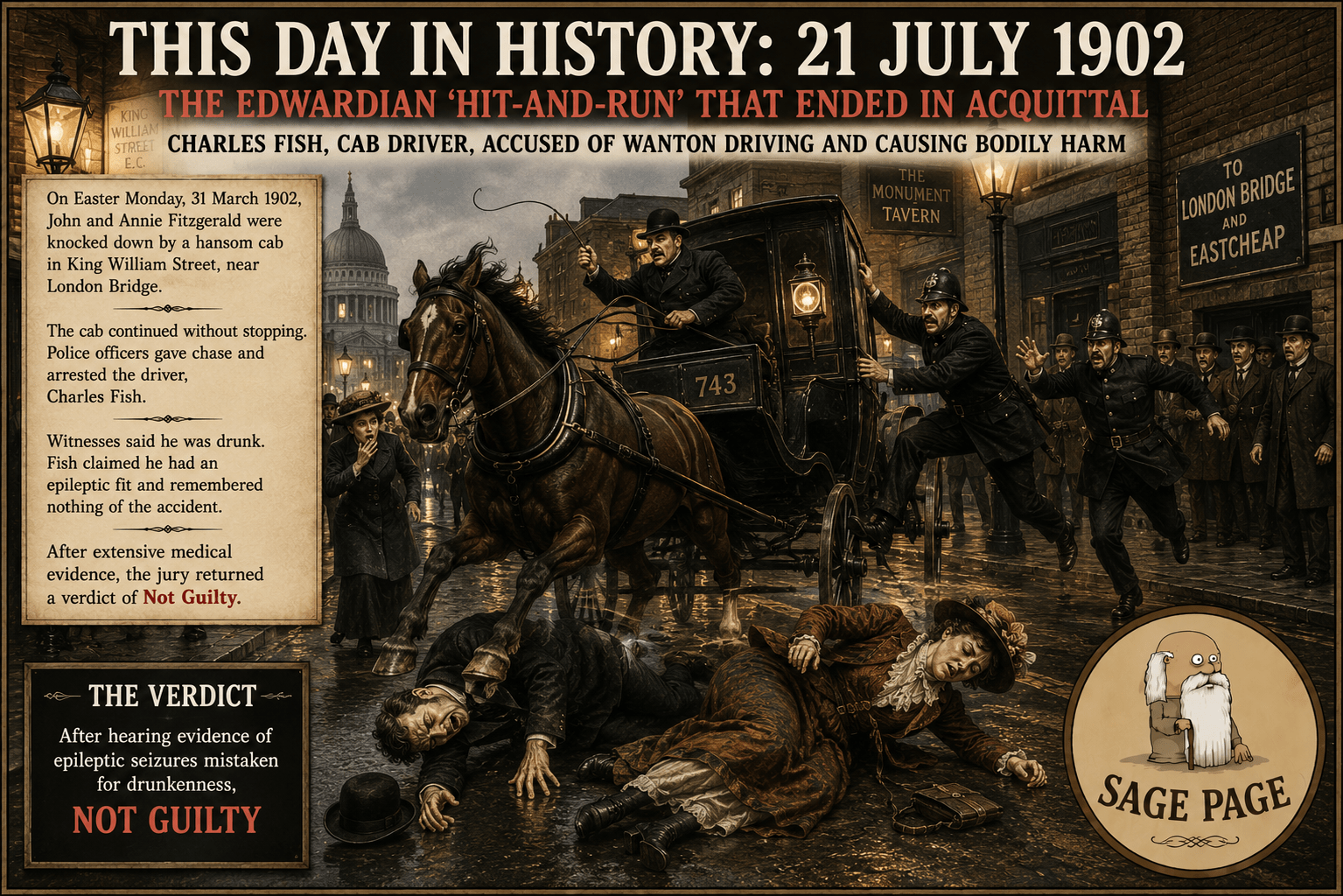
The Edwardian “Hit-and-Run” That Ended in Acquittal
Road traffic accidents are often thought of as a modern problem, but on Easter Monday 1902, London’s busy streets witnessed what would today be described as a serious hit-and-run collision. At the centre of the case was Charles Fish, a hansom cab driver whose horse-drawn vehicle struck a married couple before continuing down the road without stopping. The dramatic Old Bailey trial that followed became less about the collision itself than the difficult question of whether the driver was criminally responsible for his actions.
John and Annie Fitzgerald were crossing King William Street, near London Bridge, shortly before eleven o’clock at night when disaster struck. Without warning, a fast-moving hansom cab knocked them both to the ground. John suffered catastrophic injuries, fracturing the base of his skull and remaining unconscious for two days. Annie escaped with severe bruising to her ribs, hip and knee, but remembered how suddenly the cab appeared and how neither of them had any chance to avoid it.
Several witnesses immediately gave chase. Police Constable George Bayley saw the cab travelling quickly before it struck the couple and noted that it continued along Eastcheap without stopping despite repeated shouts. Plain-clothes officer Frank Knight leapt onto the moving cab and finally brought the horse under control some eighty yards further on. Both officers believed Charles Fish was drunk, describing him as smelling strongly of alcohol, appearing confused, and failing to respond when ordered to stop. Independent witness John William Sallabank also believed the cab was travelling unusually fast and thought the driver even whipped the horse after the collision.
The injuries proved devastating. Surgeon Dr George Hilliard told the court that John Fitzgerald’s fractured skull later resulted in mental illness requiring admission to the workhouse infirmary. He permanently lost much of his hearing, while his wife required lengthy treatment for multiple painful injuries.
Fish, however, denied being drunk. Giving evidence himself, he claimed he had suffered what he believed was a sudden fit while crossing London Bridge and remembered nothing of the collision or the pursuit that followed. His defence then produced an extraordinary number of witnesses. Fellow cab drivers, employers, friends and relatives all testified that Fish had long been regarded as sober, reliable and hardworking. Many had personally witnessed him collapse into unexplained “fainting fits” over a number of years, while members of his family described similar attacks affecting both his mother and sister.
The turning point came with expert medical evidence. Two respected surgeons concluded that Fish was almost certainly suffering from petit mal epilepsy, a condition little understood at the time. They explained that sufferers could appear intoxicated while actually being temporarily unconscious of their actions, continuing routine movements such as holding reins or walking without understanding what they were doing. They also stated that such attacks were easily mistaken—even by doctors—for drunkenness.
Faced with conflicting evidence between the police officers’ belief that Fish was drunk and the compelling medical testimony suggesting epilepsy, the jury decided there was reasonable doubt. Charles Fish was therefore acquitted.
Today, the case stands as one of Britain’s earliest courtroom examinations of the difficult relationship between medical illness, driving, and criminal responsibility—issues that remain highly relevant more than a century later.
Thank you for reading my writings. If you’d like to, you can buy me a coffee for just £1 and I will think of you while writing my next post! Just hit the link below…. (thanks in advance)


