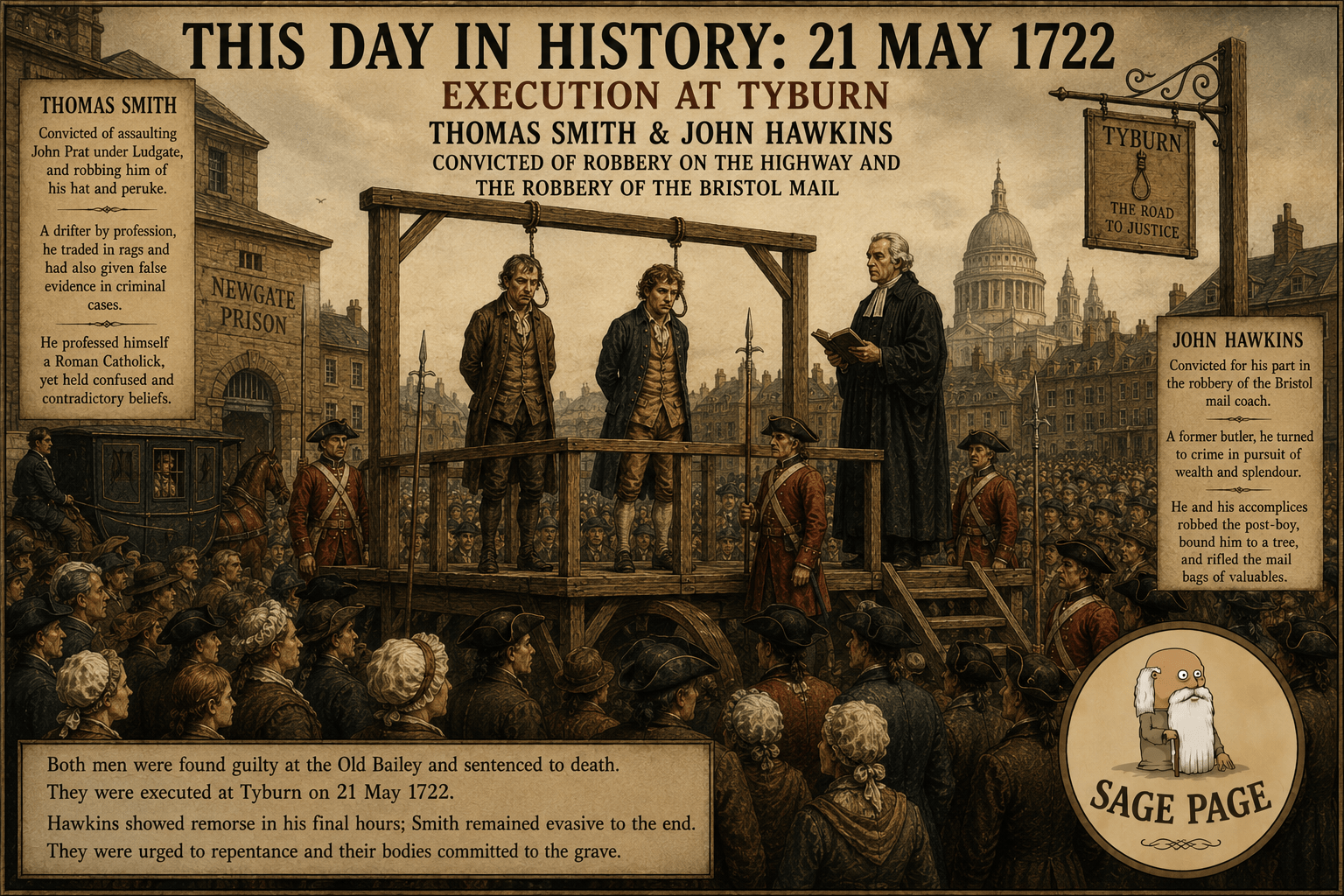
Execution at Tyburn: Thomas Smith & John Hawkins
On this day in 1722, Thomas Smith and John Hawkins were executed at Tyburn following convictions for violent robbery on the highway—crimes that struck at the very heart of public safety in early 18th-century London.
Both men came from very different backgrounds, yet were united by a shared descent into opportunistic crime, driven by restlessness, ambition, and ultimately, poor judgement.
Thomas Smith – A Drifter Turned Robber
Thomas Smith, around 44 years of age, was convicted of assaulting John Prat under Ludgate and robbing him of his hat and peruke. The crime itself was brazen rather than sophisticated.
Smith had approached the elderly victim before suddenly snatching the wig and hat from his head, fleeing with the goods concealed upon his person. His escape, however, was short-lived. He was quickly pursued and apprehended, with the stolen wig discovered hidden in his clothing.
His life, as he himself described it, had been marked by instability. Never settled in any trade, he drifted between occupations—servant, rag trader, and even, by his own admission, a provider of false testimony in criminal cases.
Despite professing religious conviction, his beliefs appeared inconsistent and unsettled. At times defensive, at others evasive, he offered little by way of explanation for his actions beyond a life poorly governed and lacking direction.
John Hawkins – Ambition, Crime, and the Mail Robbery
John Hawkins’s case was far more serious and far-reaching.
A man of 28, Hawkins had once held respectable employment, even serving as a butler in a reputable household. Yet beneath this surface lay a restless ambition—what he himself described as a desire for “great riches and splendour”—which ultimately led him into criminal enterprise.
He stood accused as part of a coordinated gang responsible for the robbery of the Bristol mail, a crime of national significance. The plan was elaborate:
- The gang tracked the mail coach route
- Disguised themselves to conceal identity
- Intercepted the post-boy in the early hours
- Bound both him and a companion to a tree
- Carried off the mail bags to be rifled for valuables
Testimony revealed that Hawkins played a strategic role—waiting at a distance due to his distinctive appearance, before joining in the division and destruction of the stolen correspondence.
The gang extracted banknotes and valuables, discarding the rest. Their actions disrupted not just private correspondence, but the functioning of national communication and commerce.
The Evidence and Trial
The prosecution’s case rested heavily on the testimony of an accomplice, who described the planning and execution of the robbery in striking detail.
Witnesses confirmed:
- The prisoners’ movements along the route
- Their presence at inns along the way
- Their return to London with horses matching descriptions
- Their suspicious behaviour after the crime
Despite attempts to discredit witnesses and provide alibis, the evidence was overwhelming. The jury returned a verdict of guilty.
Behaviour After Conviction
Following his conviction, Hawkins initially reacted with defiance—challenging the court and jury, and asserting irregularities in the proceedings. Yet this bravado did not last.
In private, his tone softened. He expressed:
- Acceptance of his fate
- Forgiveness toward those who testified against him
- A growing awareness of the gravity of his situation
By the time of his final days, he was described as deeply affected, reflective, and fearful, particularly as execution approached.
Smith, by contrast, remained a more ambiguous figure—less emotionally documented, but equally resigned to the consequences of his actions.
Execution at Tyburn
On the morning of 21 May, both men were taken from Newgate to Tyburn, where large crowds gathered to witness the spectacle.
As was customary:
- Prayers were offered
- Final exhortations were given by clergy
- The condemned were urged to repent and prepare their souls
Hawkins, in particular, showed visible signs of distress—his composure faltering as the reality of death drew near. Tears and solemn devotion marked his final hours.
Shortly thereafter, both men were hanged.
Context and Reflection
These cases illustrate two distinct paths to the gallows:
- Thomas Smith, a drifter undone by petty but reckless crime
- John Hawkins, a man of ambition who turned to organised robbery in pursuit of wealth
Together, they reflect the harsh realities of early 18th-century justice, where even a single act of highway robbery could result in death.
Their stories also serve as a reminder of a broader truth often repeated in the Ordinary’s Accounts:
that lives not governed by discipline or restraint could, with alarming speed, descend into ruin.
Thank you for reading my writings. If you’d like to, you can buy me a coffee for just £1 and I will think of you while writing my next post! Just hit the link below…. (thanks in advance)

 The Sage Page