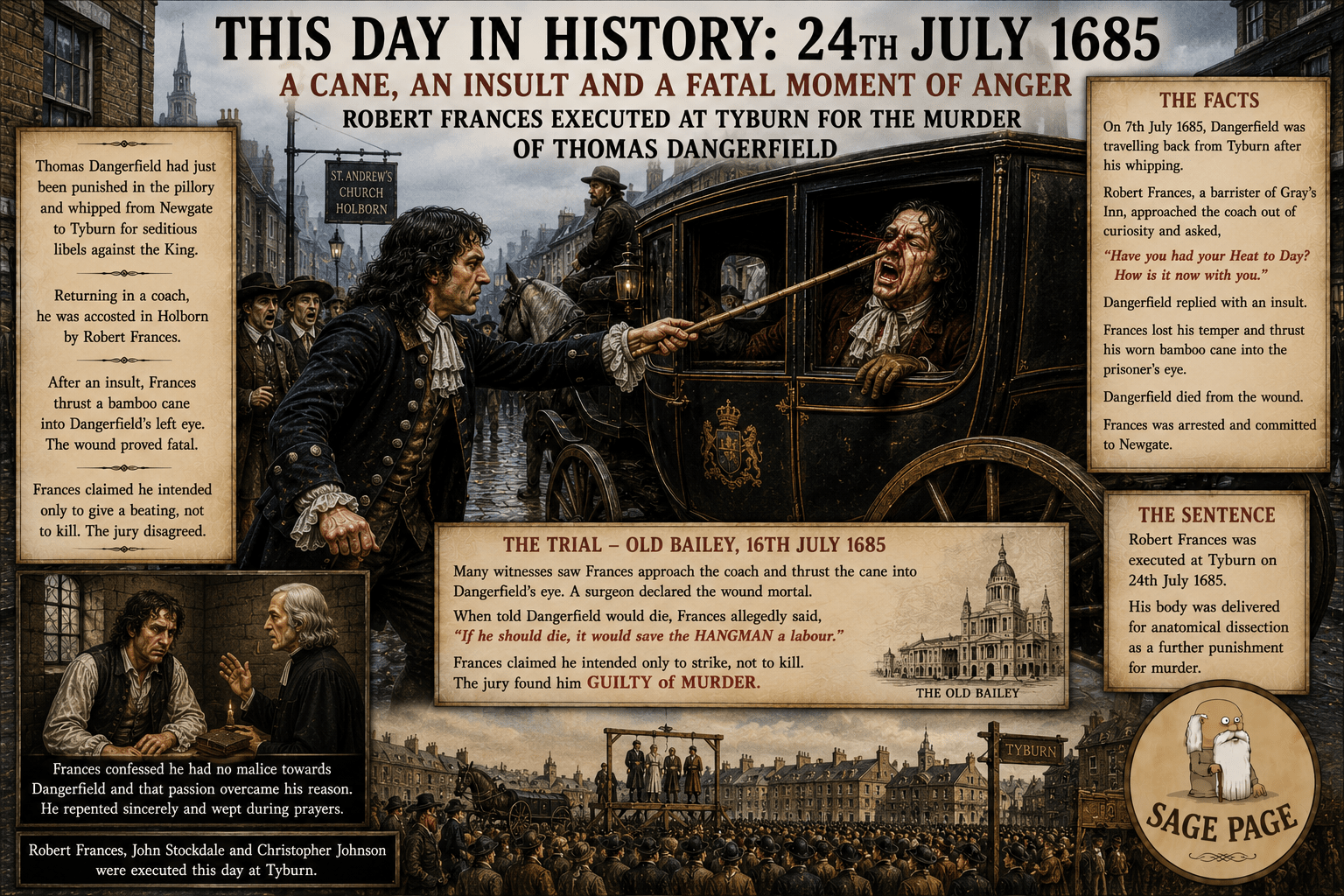
A Cane, an Insult and a Fatal Moment of Anger
On 24th July 1685, Robert Frances, a barrister of Gray’s Inn and former Oxford student, faced execution for killing one of the most notorious men in Restoration England: Thomas Dangerfield. What makes the case extraordinary is its suddenness. Frances maintained that he had never planned to kill Dangerfield and bore him no longstanding grudge. According to his confession, a moment of anger, a vicious insult and a thrust of a bamboo cane were enough to destroy two lives.
Dangerfield was already a deeply controversial figure. By July 1685 he had been convicted of publishing scandalous material concerning the Duke of York—by then King James II—and sentenced to a spectacular public punishment. He was placed in the pillory at Westminster and then whipped from Aldgate to Newgate and, two days later, from Newgate to Tyburn. It was while returning from the latter punishment that his path crossed fatally with Robert Frances.
Curiosity Turns to Confrontation
Frances had been at a coffee house near St Andrew’s Church in Holborn. He later told the Ordinary of Newgate that he had plans for the day: he was due to dine with a friend and afterwards conduct a client’s case at Guildhall. Then word arrived that Dangerfield’s coach was approaching on its return from Tyburn.
Frances went outside, he claimed, simply from curiosity to see how Dangerfield looked after his whipping.
As the coach passed, Frances approached its side and called to him:
“Have you had your Heat to Day? How is it now with you?”
Dangerfield was hardly in the mood for mockery. According to Frances, the battered prisoner responded by calling him a “Son of a Whore” and demanding to know what business Frances had with him.
Frances lost his temper.
He carried a bamboo cane, its end already frayed and worn. He later insisted that he intended merely to strike or prod Dangerfield in the breast. But the coach was moving. Instead, the cane entered Dangerfield’s left eye.
The injury was catastrophic.
“Oh My Eye! Oh My Head!”
Witnesses at Frances’s Old Bailey trial on 16th July 1685 were unequivocal. Several had seen him approach the coach and thrust the cane into Dangerfield’s eye.
Frances fled into nearby Thavies Inn, but was quickly apprehended and taken to Newgate.
Dangerfield, meanwhile, was in terrible distress. A physician found him desperately ill and vomiting heavily. A surgeon examined the wound and considered it mortal. Dangerfield subsequently died, and medical witnesses believed the injury inflicted by Frances had caused his death.
There was another particularly damaging piece of evidence. On entering Newgate, Frances was reportedly told that Dangerfield was likely to die. His alleged response was chilling:
“If he should die, it would save the HANGMAN a labour.”
That remark sat awkwardly beside Frances’s later insistence that he had never intended to kill him.
No Murderous Intention
Frances’s defence was straightforward. Dangerfield had insulted him; he had reacted impulsively and struck him with the cane. He had no intention of causing death and had acted without premeditation or previous malice.
There was one detail that appeared to support his claim.
Frances had been carrying a short sword.
Speaking later to the Ordinary, he pointed out that if he had genuinely intended to kill Dangerfield, he could have used the sword. Instead, he had used an old bamboo cane which he believed would merely administer a beating.
The argument did not save him.
The jury found Robert Frances guilty.
From Gray’s Inn to Newgate
The Ordinary’s Account provides an unusually detailed portrait of the condemned man.
Frances said he had been born to Protestant parents, received a good education and, approximately twenty years earlier, had studied at Christ Church, Oxford. He subsequently travelled abroad as an attendant to Sir Joseph Williamson, a former ambassador and prominent statesman.
For the previous fourteen years Frances had belonged to Gray’s Inn, where he practised law.
This was therefore no habitual street criminal or impoverished thief facing the gallows. He was an educated professional man whose respectable life had been destroyed by an extraordinary few seconds of uncontrolled anger.
Frances repeatedly insisted that he had held no malice or grudge against Dangerfield, nor had anyone encouraged him to attack him. He attributed what happened entirely to his own sudden passion.
The Ordinary did not allow him to minimise what he had done, describing the thrust against a man already suffering from severe public punishment as an “inhumane act toward a person in his distress.”
Frances appears to have accepted the rebuke. The Ordinary found him serious and composed, reporting that he wept during prayers and appeared deeply penitent as his execution approached.
The Extraordinary End of Thomas Dangerfield
There is a grim irony at the centre of the story.
Dangerfield had just survived a punishment deliberately designed to humiliate and physically torment him. He had endured the pillory and a lengthy public whipping and was being transported back through London when an apparently chance encounter with a curious barrister proved fatal.
Frances, meanwhile, had apparently set out that day expecting nothing more dramatic than dinner with a friend and an afternoon conducting legal business.
Instead, one insult provoked one impulsive act.
Within days Thomas Dangerfield was dead and Robert Frances was condemned to follow him.
On 24th July 1685, Frances paid the ultimate price for that moment of uncontrolled anger.
It is difficult to imagine a more brutal illustration of how quickly life could unravel in seventeenth-century London: a notorious prisoner, an educated lawyer, a passing coach, an insult and an old bamboo cane—and suddenly two men were doomed.
Thank you for reading my writings. If you’d like to, you can buy me a coffee for just £1 and I will think of you while writing my next post! Just hit the link below…. (thanks in advance)


