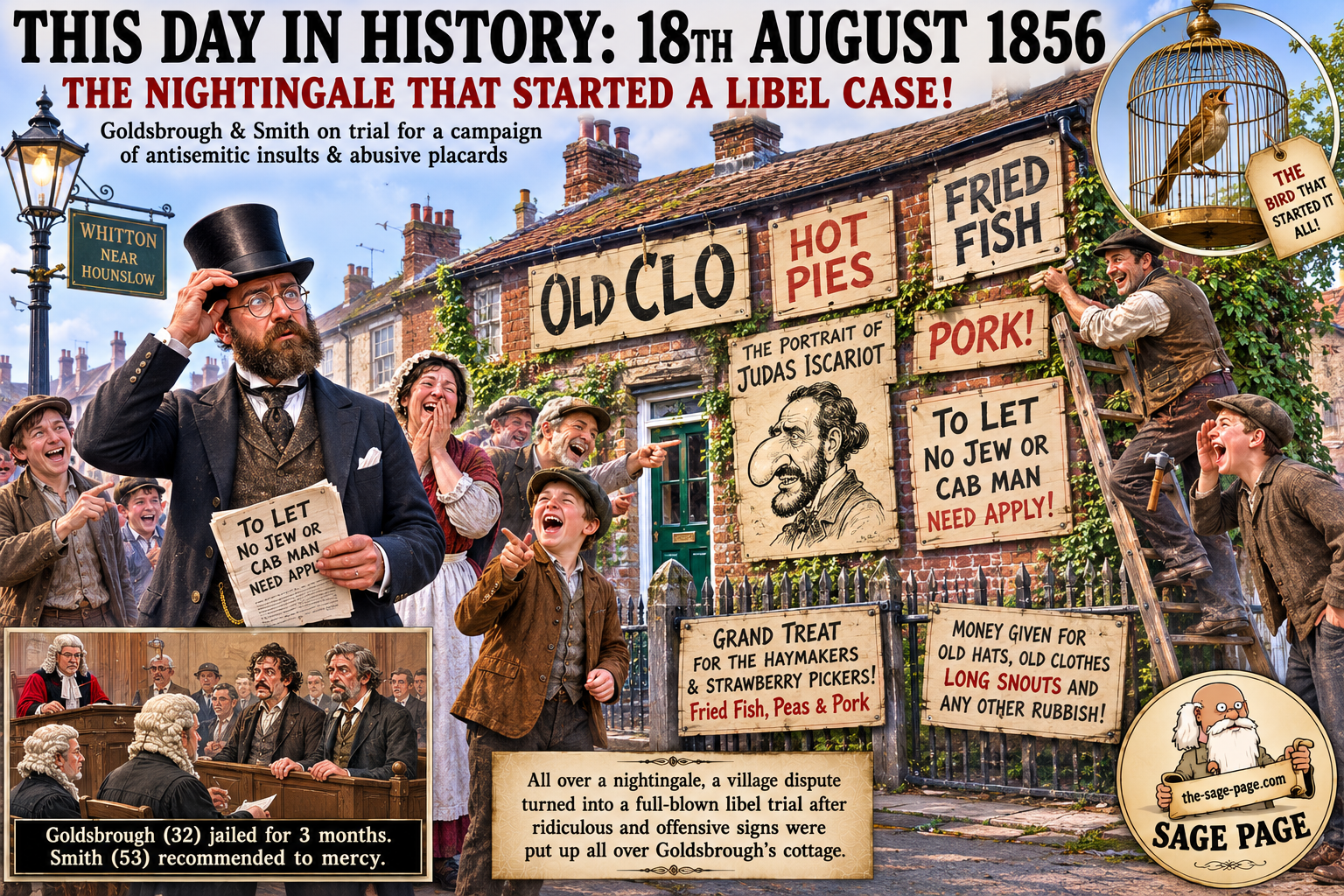
The Nightingale That Started a Libel Case
What began as an argument over a nightingale ended with insulting placards, caricatures, crowds jeering in the street and, eventually, a trial for libel at the Old Bailey. On 18th August 1856, Frederick Henry Goldsbrough and Henry Smith appeared at the Central Criminal Court following an extraordinary campaign directed against Joseph George, a Jewish man living at Whitton near Hounslow.
The trouble began when George bought a nightingale from a man named Walker. Goldsbrough subsequently claimed that the bird actually belonged to him. George did not simply refuse to return it: he said that if Walker confirmed Goldsbrough’s ownership, he would hand the bird back. During the disagreement, however, Smith subjected George to an antisemitic insult, and what should have been a fairly trivial dispute rapidly became something much nastier.
From a Bird to a Campaign of Abuse
The following day, George discovered that Goldsbrough’s cottage had effectively been turned into a public exhibition designed to ridicule him. Signs appeared bearing such phrases as “Old Clo,” “Hot pies,” “Pork,” and “Fried fish”, while a grotesque caricature was displayed under the title “The portrait of Judas Iscariot.”
But these were not merely silly signs arising from a neighbourly quarrel. The displays increasingly targeted George’s Jewish identity.
One notice declared that no Jewish person or cabman need apply. Another advertised a fictitious “Grand treat for the haymakers and strawberry pickers”, promising fried fish, peas and pork and directing people towards George’s home. Yet another offered money for “old hats, old clothes, long snouts, or any other rubbish.” There was even a separate caricature of a horse bearing the title “Portrait of Running Rein.”
The intention appears to have been not simply to insult George privately, but to make him an object of public ridicule.
And it worked.
Hooted Through the Village
George told the court that Goldsbrough had also shouted antisemitic abuse at him publicly as villagers were leaving church. He and his family began to be hooted at in the village, turning their everyday lives into an ordeal. The situation became so unpleasant that George put up a notice offering his newly built house to let, telling the court that he no longer intended to live there.
Witness Joseph Salisbury supported George’s account, confirming that after the signs appeared George and members of his family were regularly subjected to hooting.
Smith was not simply an innocent bystander to Goldsbrough’s campaign. Evidence was given that he helped return the offending boards to Goldsbrough’s cottage and assisted in hanging them up after they had been removed. Another witness recalled Smith saying that further information about George would emerge which would eventually drive him out of the village.
But Who Was Joseph George?
The trial then took an intriguing turn.
Rather than concentrating solely upon the behaviour of Goldsbrough and Smith, the defence launched into an extensive examination of George’s own past. He was questioned about his marriages, previous addresses, businesses, employment, finances and property, apparently in an attempt to undermine his character and credibility.
Even his name became an issue.
George acknowledged that his family surname was actually Joseph, making his correct name George Joseph, but explained that he had reversed the two names. Numerous other allegations and possible identities were put to him during cross-examination, most of which he denied.
Whatever questions might have existed about George’s background, however, they did not excuse the campaign mounted against him.
The Verdict
The jury found both Frederick Henry Goldsbrough and Henry Smith guilty of libel.
Goldsbrough, aged 32, received three months’ imprisonment and was required to enter into recognizances to keep the peace for twelve months.
Smith, aged 53, received rather different treatment. The jury recommended him to mercy, and he was ordered to enter into recognizances to keep the peace.
It was an extraordinary conclusion to a dispute that had begun with the ownership of one small bird.
The nightingale itself almost disappears from the story once the argument begins. What makes the case memorable is how rapidly an everyday disagreement became something much uglier: a sustained campaign of antisemitic ridicule intended to embarrass Joseph George publicly and, according to the evidence, ultimately force him from the village.
All over a nightingale.
Thank you for reading my writings. If you’d like to, you can buy me a coffee for just £1 and I will think of you while writing my next post! Just hit the link below…. (thanks in advance)


