Moses Gladwin and the Silk Handkerchiefs
On 5 May 1736, Moses Gladwin was sentenced to death at the Old Bailey for what, at first glance, appears a remarkably small crime: the attempted theft of a dozen silk handkerchiefs. Yet in eighteenth-century London, shoplifting goods valued above a certain threshold—typically 40 shillings—was a capital offence. Gladwin’s case is a stark reminder of how swiftly a petty crime could lead to the gallows.
A Suspicious Customer
The incident took place on 16 March 1736 in the shop of John Anderson, a dealer in ribbons and silk goods. Gladwin entered the shop with another man, posing as an ordinary customer. They began by “cheapening ribbons”—a common tactic used to distract shopkeepers while surveying goods.
Soon, their attention shifted to silk handkerchiefs.
John Dobey, a shop assistant, recalled that he showed them several items, including a freshly delivered dozen handkerchiefs. It was during this exchange that Gladwin made his move.
Dobey testified:
“I saw him clap three Lustring ones under his Coat… he had two great Coats on, besides his Wastcoat.”
The layering of coats was no accident. It was a known method among shoplifters to conceal stolen goods without immediate detection.
Caught in the Act
Dobey quickly grew suspicious and confronted Gladwin:
“What have you got under your Coat?”
Gladwin responded indignantly:
“Do you think I would steal any thing?”
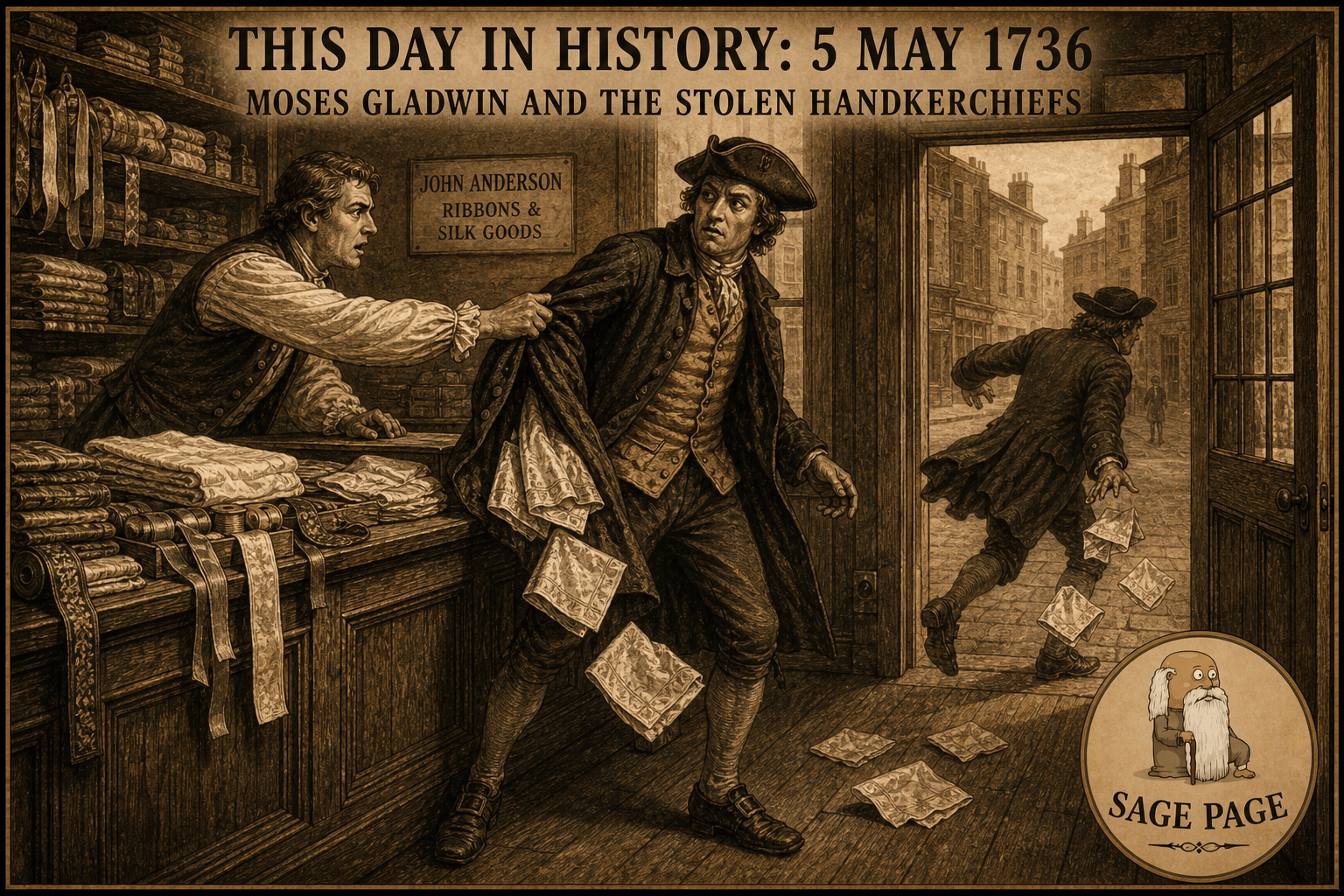
Rather than argue further, Dobey took action. Reaching across the counter, he unbuttoned Gladwin’s coat.
The result was immediate.
A bundle of silk handkerchiefs—more than just the three Dobey had seen—fell to the floor.
Another shop assistant, John Elstob, confirmed the moment:
“I saw the Dozen of Handkerchiefs drop from under his Great Coat to the Ground.”
At that instant, Gladwin’s companion reacted swiftly—snatching up the fallen goods and throwing them back into Dobey’s face before both men fled into the street.
A Bold and Defiant Defence
Despite being caught in such clear circumstances, Gladwin did not go quietly.
At trial, he protested loudly, accusing the witnesses of dishonesty and malice:
“Hark’e, my Boy, you need not grudge going to Hell, when you swear so.”
He also pointed to a discrepancy in the valuation of the goods:
“Before the Lord-Mayor, they valued the Goods at 30 s. and now they value them at 40 s. which shews ’tis a malicious Prosecution.”
This was no trivial detail. The difference between 30 and 40 shillings could mean the difference between a lesser punishment and death.
Gladwin attempted to argue that the case had been exaggerated deliberately to secure a capital conviction.
The Verdict
The jury was not persuaded.
The testimony of two witnesses, both of whom saw the goods concealed and fall from Gladwin’s coat, was considered decisive. The attempted theft, combined with his flight from the shop, left little room for doubt.
He was found:
Guilty of the Indictment.
Sentence:
Death.
A Crime Worth a Life?
By modern standards, the punishment seems extraordinarily harsh. No weapon was used. No violence was committed. The goods were recovered almost immediately.
And yet, under the laws of the time, shoplifting above a set value was treated as a serious threat to commerce and social order. London’s rapidly expanding retail economy depended on strict enforcement, and examples were made of those caught stealing.
Gladwin’s case sits squarely within what historians now refer to as the “Bloody Code”—a legal system under which hundreds of offences, many of them non-violent, carried the death penalty.
A Familiar Pattern
There is something almost routine about the structure of the case:
- A shopkeeper distracted by browsing customers
- Goods concealed beneath layered clothing
- Suspicion arising too late
- A dramatic discovery
- A desperate escape
- A defiant but ineffective defence
It is a pattern repeated again and again in the records of the Old Bailey.
What makes Gladwin’s case stand out is not the crime itself—but its consequence.
Final Reflection
Moses Gladwin risked his life for a handful of silk handkerchiefs.
Whether driven by desperation, opportunism, or habit, the outcome was the same: a capital conviction for a crime that, in another age, might barely warrant a fine.
His defiance in court—accusing witnesses, disputing values, and railing against injustice—suggests a man who believed, until the end, that the system had wronged him.
But in 1736, the law was clear.
And for Moses Gladwin, the price of failure was everything.
Thank you for reading my writings. If you’d like to, you can buy me a coffee for just £1 and I will think of you while writing my next post! Just hit the link below…. (thanks in advance)


