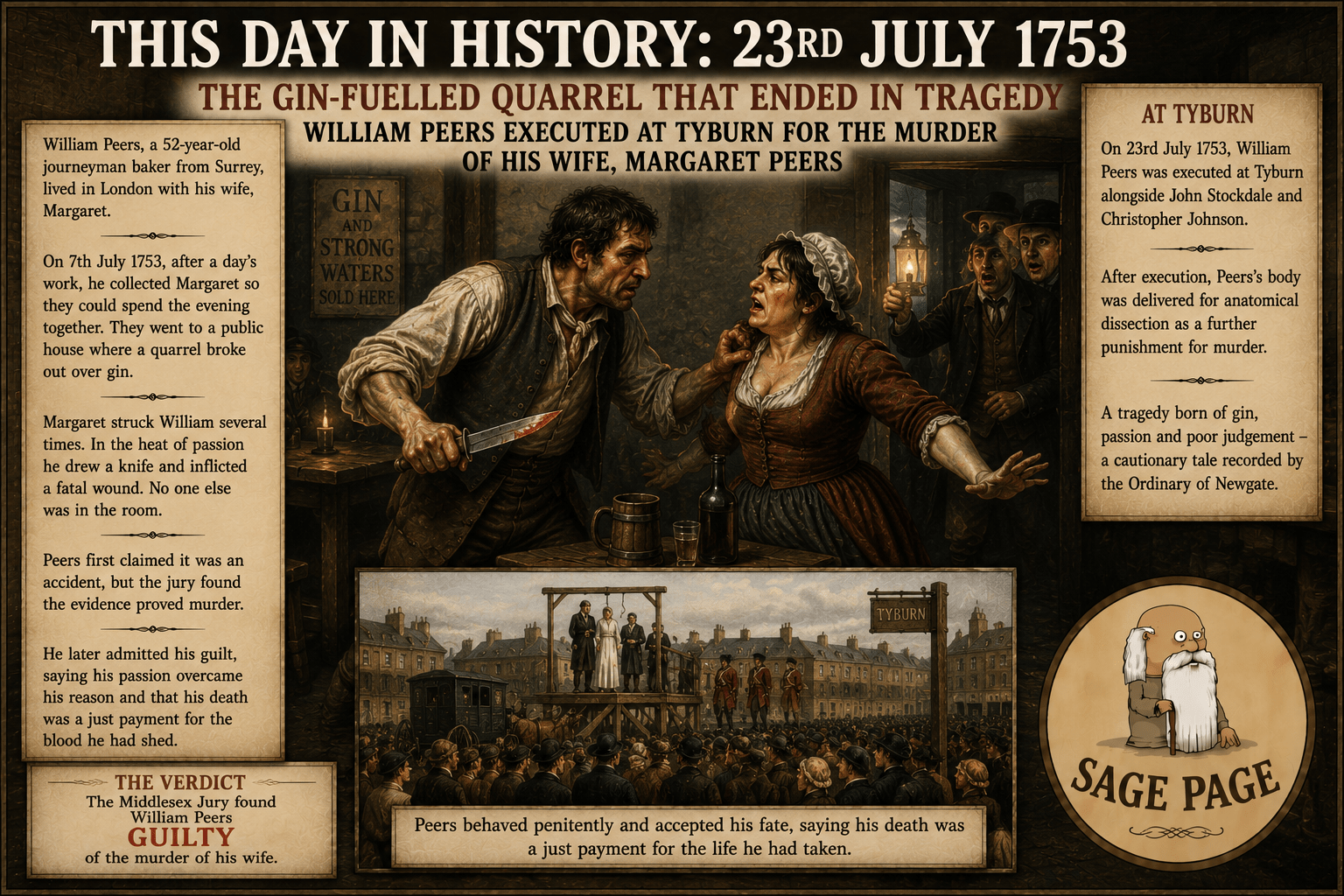
The Gin-Fuelled Quarrel That Ended on the Gallows
On 23rd July 1753, William Peers was executed at Tyburn for the murder of his wife, Margaret Peers, after what began as an ordinary domestic disagreement descended into irreversible tragedy. Unlike many Old Bailey executions involving highwaymen or professional criminals, this was the story of an ageing working couple whose lives were destroyed in a single drunken evening.
Peers, a 52-year-old journeyman baker from Surrey, had spent most of his life earning an honest living. Contemporary accounts described him as a simple man with limited education and little worldly understanding, but generally considered hardworking and respectable. He and Margaret had been married for several years and, despite the occasional quarrel, neighbours believed they lived together no worse than many working-class couples struggling through difficult circumstances in eighteenth-century London.
On the day of the murder, William had finished work and went to collect Margaret from her place of employment so they could spend the evening together. His intention, according to his later account, was simply to enjoy each other’s company. Instead, after returning home, the pair decided to continue the evening in a nearby public house, where alcohol transformed a domestic disagreement into catastrophe.
The quarrel centred on gin. William believed his wife had already drunk enough and refused to buy her another measure. Margaret, he claimed, became angry and struck him several times. Whether this account was entirely truthful could never be known, but witnesses later agreed that shortly afterwards only the couple remained alone in the public room. By the time anyone entered, Margaret had suffered a fatal knife wound.
William initially insisted the stabbing had been accidental, claiming Margaret had fallen against the knife while striking him. The explanation convinced neither the Coroner’s Jury nor the Old Bailey. As no one else had been present, and the first witness into the room found William still holding the knife, the jury concluded he alone had inflicted the fatal wound and convicted him of murder.
One particularly haunting detail recorded by the Ordinary concerned an incident just weeks before the killing. Margaret had spent an entire Sunday away from home, returning late and heavily intoxicated. After William complained, she reportedly replied:
“Let me die when I will, you will not live long after.”
Following her death, William regarded those words as a grim prophecy fulfilled.
Unlike many condemned prisoners who maintained their innocence until the end, William’s position gradually changed. Although he could never clearly explain exactly how the fatal wound had been inflicted, he eventually accepted that his own hand had caused Margaret’s death. He admitted that uncontrolled passion had overwhelmed his judgement, declaring that his life was a just payment for the blood he had shed.
The Ordinary of Newgate portrayed William as a man whose greatest failing was not innate wickedness but an inability to master his temper. He lamented a lifetime wasted through idleness and poor judgement, telling his spiritual adviser that what troubled him most was not death itself, but the shame and scandal he would leave behind.
On 23rd July 1753, William Peers was taken to Tyburn alongside John Stockdale and Christopher Johnson. After execution, Peers’ body was delivered for anatomical dissection, a further punishment reserved for convicted murderers under the Murder Act, intended to add disgrace even after death and deter others from committing similar crimes.
More than two and a half centuries later, the case remains a sobering reminder that many Old Bailey murder trials were not tales of hardened criminals, but of ordinary people whose inability to control a moment of anger ended two lives instead of one.
Thank you for reading my writings. If you’d like to, you can buy me a coffee for just £1 and I will think of you while writing my next post! Just hit the link below…. (thanks in advance)


