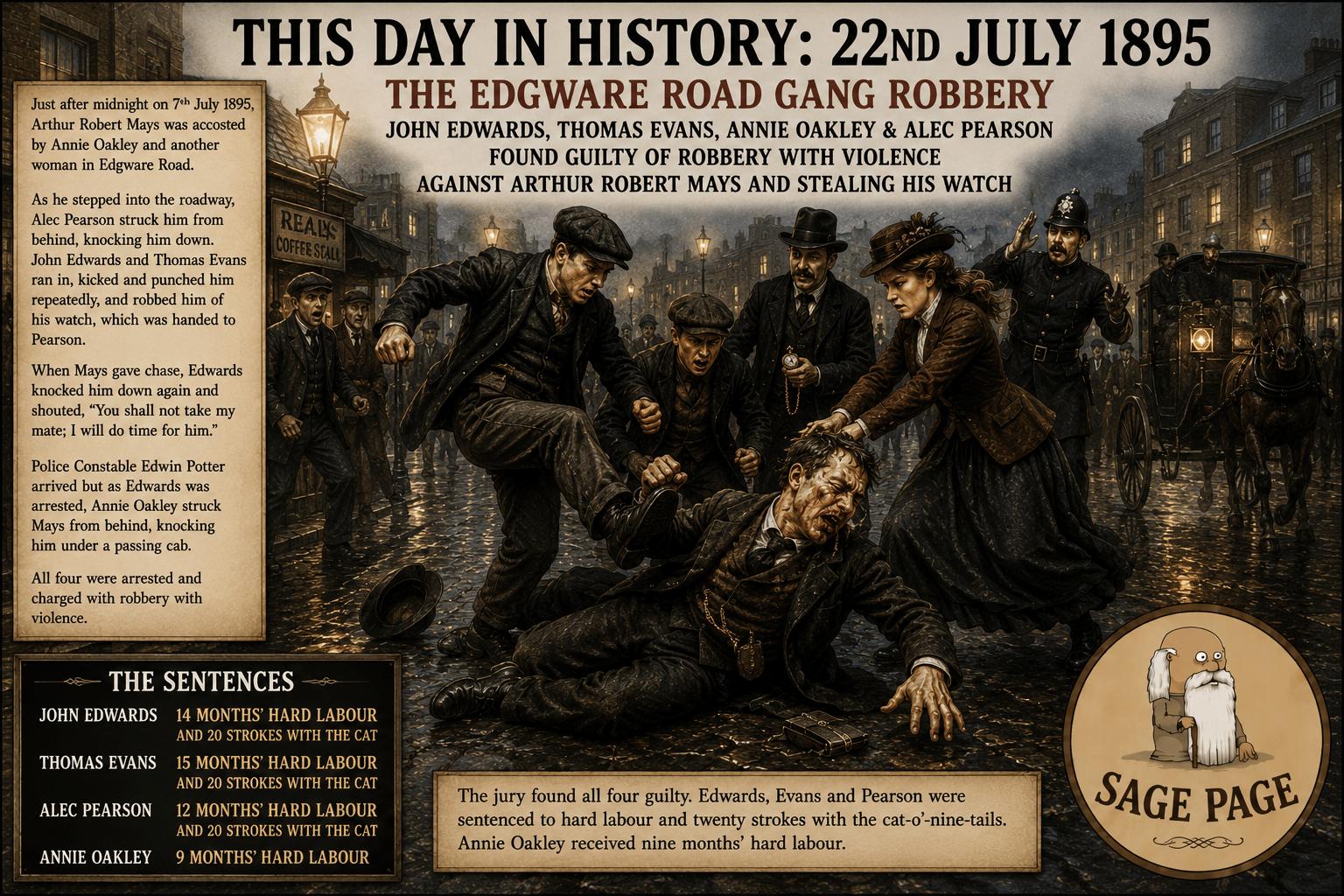
In the early hours of 7 July 1895, what began as a simple walk home along London’s Edgware Road ended in a violent street robbery that demonstrated how organised gangs preyed upon lone pedestrians in Victorian London. By the time the case reached the Old Bailey on 22 July 1895, four young defendants stood accused of carrying out a coordinated attack that left their victim battered, bloodied, and robbed of his watch.
Just after midnight, Arthur Robert Mays was approached by Annie Oakley and another woman. Attempting to avoid any conversation, he stepped into the roadway, only for Alec Pearson to strike him violently from behind, knocking him to the ground. Within seconds John Edwards and Thomas Evans rushed in, repeatedly kicking and punching the helpless victim while others crowded around. During the assault, Mays’ watch was removed from its chain and handed to Pearson before the gang fled.
Although dazed and bleeding, Mays immediately gave chase. Edwards deliberately blocked him, knocking him to the ground once more while shouting, “You shall not take my mate; I will do time for him.” When Police Constable Edwin Potter arrived, Mays pointed out the attackers, but the gang attempted to escape again. As Edwards was being arrested, Annie Oakley struck Mays from behind, knocking him beneath the path of a passing cab. Fortunately, the alert cab driver managed to stop before the wheels could run over him.
Independent witnesses painted a remarkably consistent picture. Painter Edward Henry Spooner saw Pearson knock Mays into the road before Edwards and Evans ran in to kick him while he lay on the ground. Coffee-stall owner Frederick James Real, whose stall stood opposite the attack, confirmed seeing the men stoop over the victim and scramble through his pockets before fleeing. Their evidence strongly supported Mays’ account of what had happened.
When arrested, Edwards showed little remorse. At the police station he openly admitted kicking the victim, declaring, “Yes, I kicked you, and I will kick you again.” While being escorted away he also warned Oakley not to “know nothing about the ticker”—Victorian slang for the stolen watch.
At trial the defendants attempted to portray the incident as nothing more than a drunken street fight. Pearson claimed Mays had started the trouble, Edwards insisted he had actually helped the victim, Evans denied taking part in the robbery, and Oakley denied striking anyone. Their version of events failed to convince either the jury or the witnesses, whose accounts closely matched each other throughout the proceedings.
All four defendants were found guilty. Edwards, Evans and Pearson each received terms of hard labour, but the court imposed an additional punishment that reflected Victorian attitudes towards violent robbery: twenty strokes of the cat-o’-nine-tails. Edwards received fourteen months’ imprisonment, Evans fifteen months, Pearson twelve months, while Annie Oakley was sentenced to nine months’ imprisonment with hard labour.
The case offers a vivid glimpse into London’s street crime during the late Victorian era. It also illustrates how quickly a seemingly chance encounter could become a coordinated robbery, and how the testimony of independent eyewitnesses could dismantle even the most determined attempts to deny responsibility.
Thank you for reading my writings. If you’d like to, you can buy me a coffee for just £1 and I will think of you while writing my next post! Just hit the link below…. (thanks in advance)


